"Infrared - More Than Your Eyes Can See" Video
|
This movie describes infrared "light" or radiation. Infrared (IR) is a type of electromagnetic radiation. It has a slightly longer wavelength than visible light.
Note: If you cannot see the movie you may need to download the latest QuickTime player.
This movie is large (38 MB), so it may take a while to download to your computer! |
More about infrared radiation:
 Infrared (IR) Radiation
Electromagnetic Radiation
You might also be interested in:
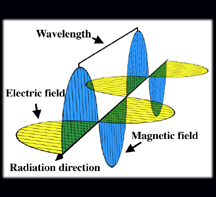
The wavelength of a wave describes how long the wave is. The distance from one crest to the next, or from one trough to the next, of a wave is its wavelength. Water waves in the ocean, sound waves in air,
...more
Here you will find links to all sorts of pictures, animations, videos, sounds, and interactive multimedia that are on Windows to the Universe Explore collections of images in the Image Galleries. Watch
...more
PAH is the short name for a "polycyclic aromatic hydrocarbon". A PAH is a stable structure made up of multiple rings that are fused together. The rings are made of carbon and hydrogen (though other elements
...more
Acids are well known as substances capable of dissolving things. If you've ever gotten some battery acid on your clothes and had a hole develop in a couple weeks you'll know what we mean. In this regard,
...moreLike an acid, a base is a substance capable of dissolving things. Unlike an acid in which the active agent is a substance which has a positive electric charge (H+), in a base the active agent has a negative
...more
Scientists believe, although it is not certain, there are two essential ingredients for generating a magnetic field. Those two ingredients are magnetic material currents A bar of iron can be made into
...more
The scientific field of thermal physics is concerned with heat and temperature. When we delve into topics such as global warming, the structure of Earth's solid and liquid cores, and the way in which energy
...more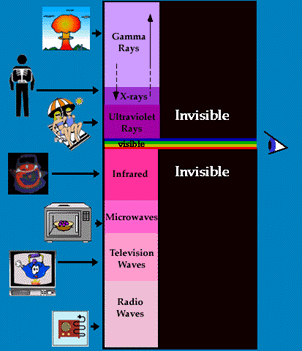
Light is a form of electromagnetic radiation that is very familiar to us. However, there are several other forms of electromagnetic (EM) radiation, such as X-rays, radio waves, and ultraviolet and infrared
...more