Current Events

  • Atmospheric CO2 Level Tops 400 ppm
    During the week of May 13th, the CO2 level at the Mauna Loa Observatory in Hawaii topped 400 ppm rep...Read more

    x

    Atmospheric CO2 Level Tops 400 ppm

    During the week of May 13th, the CO2 level at the Mauna Loa Observatory in Hawaii topped 400 ppm repeatedly. Daily levels of CO2 can vary due to weather, and there are seasonal trends as well. The level of atmospheric greenhouse gases continues to increase, now over 120 ppm since the Industrial Revolution began. For more on the Keeling Curve, see http://keelingcurve.ucsd.edu/. Find out more about greenhouse gases and warming.
  • Massive Tornado Outbreak on Tornado Alley
    The week of May 19 brings dozens of tornadoes to Tornado Alley in the states of Oklahoma, Kansas, Io...Read more

    x

    Massive Tornado Outbreak on Tornado Alley

    The week of May 19 brings dozens of tornadoes to Tornado Alley in the states of Oklahoma, Kansas, Iowa, Illinois and Missouri. On May 20th, a massive tornado struck Moore, Oklahoma, devastating communities - destroying over 100 homes and hitting two elementary schools and a hospital - with many casualties and deaths. Our thoughts are with our friends and colleagues suffering from these storms. For more on the May 20th storms, see the NOAA Storm Prediction Center Storm Report.
  • Kansas Legislator Proposes Bill to Outlaw Sustainability Education
    A bill has been introduced in the Kansas legislature this week that would prohibit the promotion of ...Read more

    x

    Kansas Legislator Proposes Bill to Outlaw Sustainability Education

    A bill has been introduced in the Kansas legislature this week that would prohibit the promotion of sustainability. Here is a link to the one-page bill: http://www.kslegislature.org/li/b2013_14/measures/documents/hb2366_00_0000.pdf. See report on Bloomberg News.

Photodissociation of the Hydroxyl Radical (OH)

Photodissociation of the hydroxyl radical.
Animation courtesy COMET.

The hydroxyl radical (OH) is essentially a piece of a molecule, made up of one oxygen atom and one hydrogen atom. It is highly reactive. It is often produced when a water molecule loses a hydrogen atom.

This animation illustrates the process of photodissociation of the hydroxyl radical. When an extreme ultraviolet (EUV) photon strikes the hydroxyl radical (OH) , it photodissociates the radical into two separate parts - a hydrogen atom (H) and an oxygen atom (O). The energy from the photon breaks the chemical bond that holds the atoms together.

You will need to have the latest version of the Flash player to see this animation.


Photodissociation of Water

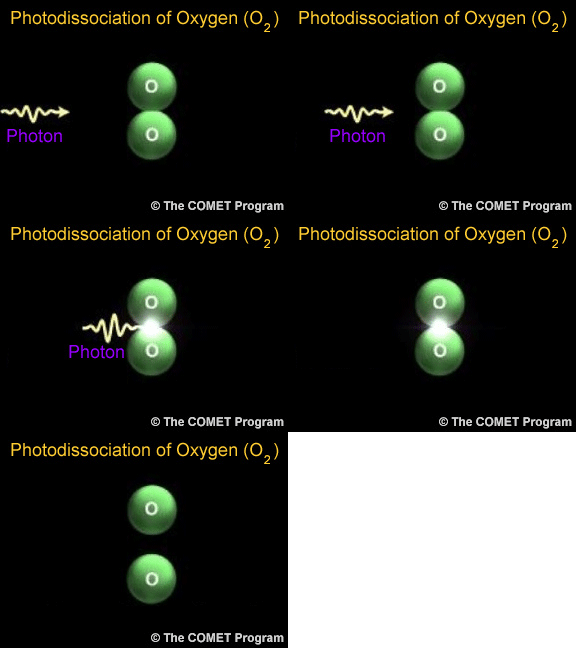
Photodissociation of Molecular Oxygen

Photodissociation of Molecular Nitrogen

Last modified February 17, 2006 by Randy Russell.

Shop Windows to the Universe Science Store!

Our online store includes books on science education, ranging from evolution, classroom research, and the need for science and math literacy!

Windows to the Universe Community

News

Opportunities

You might also be interested in:

Traveling Nitrogen Classroom Activity Kit

Check out our online store - minerals, fossils, books, activities, jewelry, and household items!...more

Molecules

Most things around us are made of groups of atoms bonded together into packages called molecules. The atoms in a molecule are held together because they share or exchange electrons. Molecules are made...more

Photodissociation

Sometimes when a photon hits a molecule, the energy from the photon causes the molecule to break apart. Scientists use the term "photodissociation" for such events. Photodissociation plays a very important...more

Photon

Light is very strange. Sometimes it is best to think of light as a series of waves. At other times, it is useful to think of light as a swarm of particles. When we think of light as particles, we call...more

First local C-130 flight from Veracruz

This picture shows us getting ready for the first local flight of the NCAR/NSF C-130 flying out of Veracruz. We flew toward Mexico City, did some measurements in the Mexico City basin, and then flew West...more

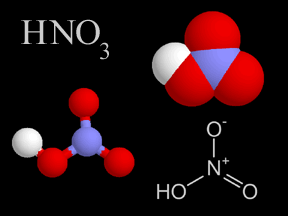
Nitric Acid - HNO3

Nitric acid is a colorless, corrosive liquid and a toxic acid which can cause severe burns. Nitric acid consists of nitrogen, oxygen, and hydrogen atoms. Nitric acid, in its gas phase, is present in very...more

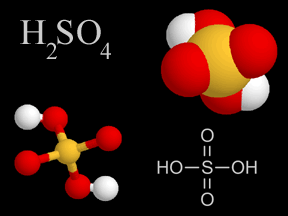
Sulfuric Acid - H2SO4

Sulfuric acid is a viscous, oily liquid and a strong acid which can cause severe burns. Sulfuric acid consists of sulfur, oxygen, and hydrogen atoms. Sulfuric acid is one of the components of acid rain....more

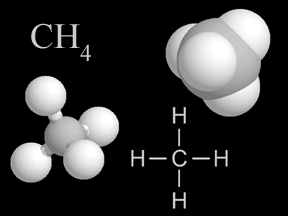
Methane - CH4

Methane is gas that is found in small quantities in Earth's atmosphere. Methane is the simplest hydrocarbon, consisting of one carbon atom and four hydrogen atoms. Methane is a powerful greenhouse gas....more

Shop Windows to the Universe

Dig into Montana Before History: 11K Years of Hunter-Gatherers in the Rockies and Plains by D. H. MacDonald, Ph.D. See our online store book collection.

Windows to the Universe, a project of the National Earth Science Teachers Association, is sponsored in part by the National Science Foundation and NASA, our Founding Partners (the American Geophysical Union and American Geosciences Institute) as well as through Institutional, Contributing, and Affiliate Partners, individual memberships and generous donors. Thank you for your support! NASA AGU AGI NSF