Current Events

  • Kansas Legislator Proposes Bill to Outlaw Sustainability Education
    A bill has been introduced in the Kansas legislature this week that would prohibit the promotion of ...Read more

    x

    Kansas Legislator Proposes Bill to Outlaw Sustainability Education

    A bill has been introduced in the Kansas legislature this week that would prohibit the promotion of sustainability. Here is a link to the one-page bill: http://www.kslegislature.org/li/b2013_14/measures/documents/hb2366_00_0000.pdf. See report on Bloomberg News.
  • Earth's Center Is 1,000 Degrees Hotter Than Previously Thought, Synchrotron X-Ray Experiment Shows
    Scientists have determined the temperature near the Earth’s center to be 6000 degrees Celsius, 1000 ...Read more

    x

    Earth's Center Is 1,000 Degrees Hotter Than Previously Thought, Synchrotron X-Ray Experiment Shows

    Scientists have determined the temperature near the Earth’s center to be 6000 degrees Celsius, 1000 degrees hotter than in a previous experiment run 20 years ago. These measurements confirm geophysical models that the temperature difference between the solid core and the mantle above, must be at least 1500 degrees to explain why the Earth has a magnetic field. For more information about this study, see the press release from the European Synchrotron Radiation Facility.
  • Ocean Volcanic Rocks Contain Samples of Recycled Crust
    Scientists have long believed that lava erupted from certain oceanic volcanoes contains materials fr...Read more

    x

    Ocean Volcanic Rocks Contain Samples of Recycled Crust

    Scientists have long believed that lava erupted from certain oceanic volcanoes contains materials from the early Earth’s crust. But decisive evidence for this phenomenon has proven elusive. New research from a team including Carnegie’s Erik Hauri demonstrates that oceanic volcanic rocks contain samples of recycled crust dating back to the Archean era 2.5 billion years ago. Their work is published in Nature. Oceanic crust sinks into the Earth’s mantle at so-called subduction zones, where two plates come together. Much of what happens to the crust during this journey is unknown. Model-dependent studies for how long subducted material can exist in the mantle are uncertain and evidence of very old crust returning to Earth’s surface via upwellings of magma has not been found until now. For more information about these results, see the press release from the Carnegie Institution.
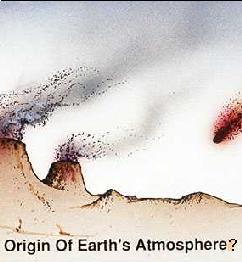
This drawing represents a comet bringing atmospheric molecules and possibly primitive life forms to the Earth's surface.
Click on image for full size
JPL/NASA

Base

Like an acid, a base is a substance capable of dissolving things. Here is a scientific explanation of what a base is:

A base is a substance which accepts a proton from another species in a reaction. (Here, "accept" is a passive term for what really happens. A base attacks and "rips" a proton from a substance which has any capability of giving it away. Thus a base accepts a proton the way a thief "accepts" your purse). Bases are classified as either strong or weak depending upon their relative ability to do this. When it does this, it changes the substance it attacks into a different substance.

There are many bases. Here are a few: Ammonia (used as a cleaner), Calcium hydroxide (used in mortar for construction), Magnesium hydroxide (otherwise known as milk of magnesia; used as a laxative or antacid), Sodium hydroxide (used as an oven cleaner).

Shop Windows to the Universe Science Store!

Our online store includes books on science education, ranging from evolution, classroom research, and the need for science and math literacy!

Windows to the Universe Community

News

Opportunities

You might also be interested in:

Cool It! Game

Check out our online store - minerals, fossils, books, activities, jewelry, and household items!...more

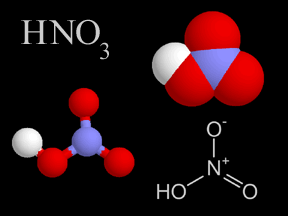
Nitric Acid - HNO3

Nitric acid is a very strong acid that can burn your skin. Nitric acid has nitrogen, oxygen, and hydrogen atoms in it. There is a very tiny bit of nitric acid gas in Earth's atmosphere. Nitric acid is...more

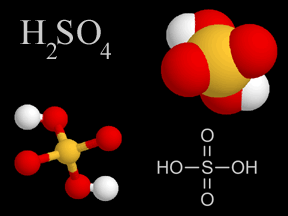
Sulfuric Acid - H2SO4

Sulfuric acid is a very common type of acid. Acid rain has sulfuric acid in it. Acid rain harms plants, fish, and other living things. A type of air pollution causes acid rain. When people burn fossil...more

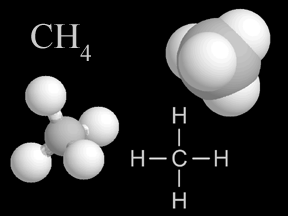
Methane - CH4

Methane is a kind of gas. There is a small amount of methane in the air you breathe. A methane molecule has carbon and hydrogen atoms in it. Methane is a greenhouse gas. That means it helps make Earth...more

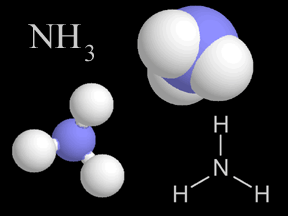
Ammonia - NH3

Ammonia is a kind of gas. Ammonia molecules (NH3) have hydrogen and nitrogen atoms in them. The air you breathe has a tiny bit of ammonia in it. When plants and animals die and decay, they give off ammonia....more

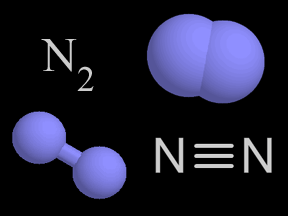
Nitrogen

There is more nitrogen gas in the air than any other kind of gas. About 4/5ths of Earth's atmosphere is nitrogen gas! A molecule of nitrogen gas is made up of two nitrogen atoms. There are other molecules...more

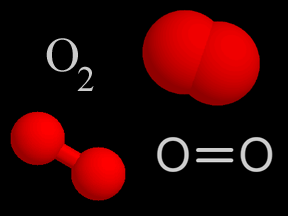
Oxygen

Oxygen (O2) is a kind of gas. A lot of the air you breathe is oxygen. That's a good thing, since we need oxygen to stay alive! About 4/5ths of the air in Earth's atmosphere is nitrogen (N2). Almost all...more

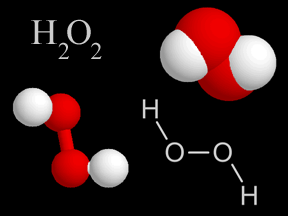
Hydrogen Peroxide - H2O2

Hydrogen peroxide (H2O2) is a kind of chemical. A molecule of hydrogen peroxide has oxygen and hydrogen atoms in it. Hydrogen peroxide is a clear liquid. Hydrogen peroxide is in some liquids that are used...more

Shop Windows to the Universe

Earth Science Rocks! Select one of our four cool NESTA t-shirts from our online store, and express your love of Earth and space science!

Windows to the Universe, a project of the National Earth Science Teachers Association, is sponsored in part by the National Science Foundation and NASA, our Founding Partners (the American Geophysical Union and American Geosciences Institute) as well as through Institutional, Contributing, and Affiliate Partners, individual memberships and generous donors. Thank you for your support! NASA AGU AGI NSF