Current Events

  • Irish Chronicles Document Links Between Volcanoes and Weather
    A study of over 40,000 written entries in Irish Annals and ice core measurements shows a strong corr...Read more

    x

    Irish Chronicles Document Links Between Volcanoes and Weather

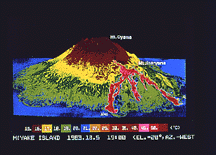
    A study of over 40,000 written entries in Irish Annals and ice core measurements shows a strong correlation between the occurrence of volcanic eruptions and extreme cold weather in Ireland over a 1200 year period. Data analyzed in this study cover the period from 431 to 1649, during which time up to 48 volcanic eruptions are identified in Greenland ice core records through deposition of volcanic sulfate in annual layers of ice. You can find the study (open access), published on 6 June 2013 in IOP Publishing's journal Environmental Research Letters, at http://iopscience.iop.org/1748-9326/8/2/024035/article. Find out more about how volcanoes can influence climate.
  • EF-5 Tornado in El Reno, Oklahoma Widest Ever Recorded in US
    The EF-5 tornado that hit El Reno, Oklahoma on May 31st was the widest ever recorded in the US, acco...Read more

    x

    EF-5 Tornado in El Reno, Oklahoma Widest Ever Recorded in US

    The EF-5 tornado that hit El Reno, Oklahoma on May 31st was the widest ever recorded in the US, according to the National Weather Service in Norman Oklahoma. The tornado, which remained on the ground for 40 minutes and reached 2.6 miles across (4.2 km), took the lives of 18 people including storm chasers Tim Samaras, Paul Samaras and Carl Young. For more information on the tornado, visit http://ow.ly/i/2hfDG.
  • Atmospheric CO2 Level Tops 400 ppm
    During the week of May 13th, the CO2 level at the Mauna Loa Observatory in Hawaii topped 400 ppm rep...Read more

    x

    Atmospheric CO2 Level Tops 400 ppm

    During the week of May 13th, the CO2 level at the Mauna Loa Observatory in Hawaii topped 400 ppm repeatedly. Daily levels of CO2 can vary due to weather, and there are seasonal trends as well. The level of atmospheric greenhouse gases continues to increase, now over 120 ppm since the Industrial Revolution began. For more on the Keeling Curve, see http://keelingcurve.ucsd.edu/. Find out more about greenhouse gases and warming.
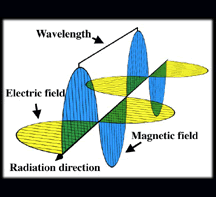
The wavelength of a wave is the distance from one crest to the next.
Click on image for full size
Windows to the Universe original artwork.

Wavelength

There are many kinds of waves all around us. Everyone knows about waves of water in the ocean. Did you also know that sound travels through the air in waves? Or that light is actually made up of waves of electromagnetic energy?

The length of a wave is called, well, its "wavelength". If you think about a wave in the ocean, its wavelength is the distance from the top of one wave (called the wave's "crest") to the top of the next wave. You can also measure the distance from the lowest point between two waves (called the wave's "trough") to the next trough. You should get the same distance either way.

The wavelengths of ocean waves we see at the beach are usually 10 or so meters (33 feet) or longer. Sound waves that humans can hear have wavelengths between about 2 cm (an inch) and 17 meters (56 feet). Waves of electromagnetic radiation that we see as light have really, really short wavelengths between 400 and 700 nanometers (a nanometer is one billionth of a meter!).

A wave also has a "frequency". The frequency is how often a crest goes by. The frequency of a wave depends on how fast the wave is moving. It also depends on the wavelength of the wave. Imagine two sets of waves that have the same speed. If one set has a longer wavelength, it will have a lower frequency (more time between waves). If the other set has a shorter wavelength, it will have a higher frequency (less time between waves). Wavelength and frequency go opposite of each other. Shorter wavelengths mean higher frequencies, while longer wavelengths mean lower frequencies.

Sound waves with a wavelength around 34 cm (about a foot) have a frequency of 1,000 hertz. A hertz is one wave per second. So a thousand sound waves can enter your ear in a second! Sound waves travel much faster than normal water waves. Sound waves move through the air at around 343 meters/second (767 miles/hour).

Light moves even faster AND has shorter wavelengths. These combine to give light extremely high frequencies. Red light has a wavelength of about 682 nanometers. Its frequency is around 440 terahertz. That's 440,000,000,000,000 hertz. That's a whole lot of waves going by in a second!


Last modified August 22, 2006 by Randy Russell.

Shop Windows to the Universe Science Store!

Our online store includes books on science education, classroom activities in The Earth Scientist, mineral and fossil specimens, and educational games!

Windows to the Universe Community

News

Opportunities

You might also be interested in:

Traveling Nitrogen Classroom Activity Kit

Check out our online store - minerals, fossils, books, activities, jewelry, and household items!...more

Electromagnetic Radiation

Electromagnetic radiation is the result of oscillating electric and magnetic fields. The wave of energy generated by such vibrations moves through space at the speed of light. And well it should... for...more

Electricity and Magnetism

Electricity and magnetism are two very important topics in the science of physics. We use electricity to power computers and to make motors go. Magnetism makes a compass point North and keeps notes stuck...more

Radiation

Radiation comes in two basic types: electromagnetic radiation transmitted by photons, and particle radiation consisting of electrons, protons, alpha particles, and so forth. Electromagnetic radiation,...more

Radio Waves

Radio waves are a type of electromagnetic radiation. A radio wave has a much longer wavelength than does visible light. We use radio waves extensively for communications. Radio waves have wavelengths as...more

Tools for Math and Science

Some ideas are used throughout the sciences. They are "tools" that can help us solve puzzles in different fields of science. These "tools" include units of measurement, mathematical formulas, and graphs....more

Starting Points for Science

Some ideas are used in many, many places throughout science. We have grouped these "starting points for science" into three clusters: space, time, and matter. "Space" is the word we use for everything...more

What is a Supercomputer?

Some scientific problems and processes are so complex that you need SUPERCOMPUTING power to tackle them! Just what is a supercomputer? A supercomputer is a computer that is among the largest, fastest or...more

Shop Windows to the Universe

The Universe at Your Fingertips 2.0 DVD from the Astronomical Society of the Pacific is in our online store, filled with Earth and space science resources.

Windows to the Universe, a project of the National Earth Science Teachers Association, is sponsored in part by the National Science Foundation and NASA, our Founding Partners (the American Geophysical Union and American Geosciences Institute) as well as through Institutional, Contributing, and Affiliate Partners, individual memberships and generous donors. Thank you for your support! NASA AGU AGI NSF