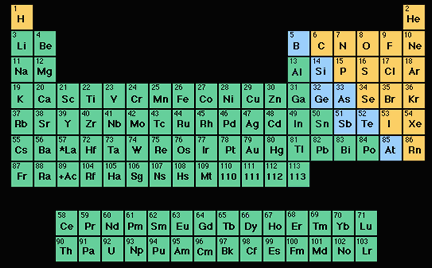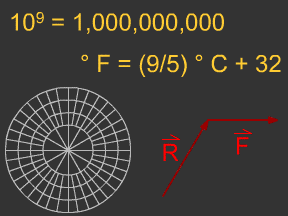
Some elements from our "math and science toolbox" are depicted here. They include scientific notation, unit conversion from one measurement system to another, a graph grid in polar coordinates, and vectors.
Original artwork created for Windows to the Universe by Randy Russell.

Tools for Math and Science

Some ideas are used throughout the sciences. They are "tools" that can help us solve puzzles in different fields of science. These "tools" include units of measurement, mathematical formulas, and graphs.

Scientists use different systems of measurement, like the metric or English systems. Each system has different units, like the gram or pound or meter or foot. Some units, like the meter and mile and pound, are familiar; others, like the ångström or farad or Röntgen, are almost unknown outside of the scientific fields that use them. We need to know how to convert units from one system to another, as when we determine the metric temperature in degrees Celsius when supplied with the English Fahrenheit equivalent.

Some values and ratios seem to be built-in traits of the Universe. These basic traits, in the form of numerical values, are referred to as physical constants. Examples include the speed of light (c), the ratio of a circle's circumference to its diameter (pi), the gravitational constant (G), and the base of the natural logarithms (e).

The use of mathematical concepts and conventions is widespread throughout the sciences. Vectors help us comprehend and manipulate forces and motion. Scientific notation allows us to work with very large and very small numbers.

We use graphs with Cartesian, polar, and logarithmic scales to help us "see" trends. We draw maps of Earth and the heavens, using Mercator or Albers Equal Area projections to most accurately depict certain features of terrain. We employ polar and spherical and Cartesian coordinate systems to specify the locations of objects in space or on the surfaces of planets.


Last modified September 12, 2008 by Randy Russell.

Shop Windows to the Universe Science Store!

Beautiful Nature's Own onyx household items, including bowls, wine goblets, vases, and a mortar and pestle, are available in our online store, for the rock lover in all of us!

Windows to the Universe Community

News

Opportunities

You might also be interested in:

Banded Iron Formation

Check out our online store - minerals, fossils, books, activities, jewelry, and household items!...more

Fundamental Forces

The interactions in the Universe are governed by four forces (strong, weak, electromagnetic and gravitational). Physicists are trying to find one theory that would describe all the forces in nature as...more

Tools for Math and Science

Some ideas are used throughout the sciences. They are "tools" that can help us solve puzzles in different fields of science. These "tools" include units of measurement, mathematical formulas, and graphs....more

Starting Points for Science

Some ideas are used in many, many places throughout science. We have grouped these "starting points for science" into three clusters: space, time, and matter. "Space" is the word we use for everything...more

What is a Supercomputer?

Some scientific problems and processes are so complex that you need SUPERCOMPUTING power to tackle them! Just what is a supercomputer? A supercomputer is a computer that is among the largest, fastest or...more

Using Computers for Science

In the last decades, computers have become a normal part of life. They are used to send e-mail, write a school report or look up recipes. They are used to keep track of the balance in your bank account....more

Universal Time

When it is noon where you live, it is midnight on the opposite side of the world. Usually when we think of time, we mean "the time of day where I live". If we say something happened at 9 AM, we mean it...more

The Magnetic Field

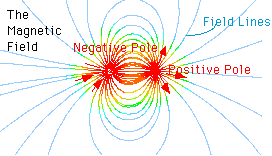
The force of magnetism causes material to point along the direction the magnetic force points. As shown in the diagram to the left, the force of magnetism is illustrated by lines, which represent the force....more

Shop Windows to the Universe

Learn about planets outside our solar system through Exoplanets and Alien Solar Systems by Tahir Yaqoob, Ph.D., a book in our online store book collection.

Generous sponsorship of Windows to the Universe is provided by the Hewlett Foundation, the American Geological Institute, the American Geophysical Union, the National Science Foundation, NASA, NCAR, and the CISM and CMMAP projects. NASA CMMAP AGU CISM NCAR Hewlett AGI NSF