Picture of Johan Kepler
The Bettman Archive. From engraving by MacKenzie
Johan Kepler
Johan Kepler was a German astronomer who lived between 1571-1630. He introduced three important laws of planetary motion and helped the Copernican model of the solar system gain general acceptance.
Kepler inherited Tycho Brahe's observational data on Mars following Brahe's death and showed, mathematically, that Mars followed an elliptical orbit. This new revelation contradicted the age old belief that heavenly bodies all moved in perfect circles.
During his life, Kepler also cast horoscopes and wrote science fiction novels.
You might also be interested in:
How did life evolve on Earth? The answer to this question can help us understand our past and prepare for our future. Although evolution provides credible and reliable answers, polls show that many people turn away from science, seeking other explanations with which they are more comfortable.
...more
Nicholas Copernicus was a Polish astronomer who lived between 1473-1543. Before his time, people believed in the Ptolemaic model of the solar system, which maintained that the Earth was the center of
...more
Tycho Brahe was a Danish astronomer who lived between 1546-1601. For over twenty years, he made very accurate observations of the night sky, all without the aid of a telescope, which had not yet been
...more
For many years, people believed that the Earth was the unmoving center of the universe and that the planets,Sun, moon, and the stars moved on spheres around the Earth. Astronomers such as Copernicus and
...more
Leonardo da Vinci was an Italian artist and scientist who lived between 1452-1519. Leonardo was the original Renaissance man, whose roles included inventor, engineer, architect, mathematician, geologist,
...more
Galileo Galilei was an Italian astronomer and physicist who lived between 1564-1642. He challenged Aristotle's proposition that heavenly bodies were divine and therefore perfect and blemish-free. Galileo
...more
Johan Kepler was a German astronomer who lived between 1571-1630. He introduced three important laws of planetary motion and helped the Copernican model of the solar system gain general acceptance. Kepler
...more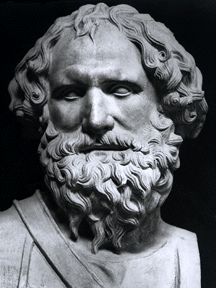
Archimedes was a Greek mathematician and engineer who lived between 287-212 B.C. His greatest contributions are in the field of geometry and in the development of war machines. Legend has it that Archimedes
...more