Current Events

  • Atmospheric CO2 Level Tops 400 ppm
    During the week of May 13th, the CO2 level at the Mauna Loa Observatory in Hawaii topped 400 ppm rep...Read more

    x

    Atmospheric CO2 Level Tops 400 ppm

    During the week of May 13th, the CO2 level at the Mauna Loa Observatory in Hawaii topped 400 ppm repeatedly. Daily levels of CO2 can vary due to weather, and there are seasonal trends as well. The level of atmospheric greenhouse gases continues to increase, now over 120 ppm since the Industrial Revolution began. For more on the Keeling Curve, see http://keelingcurve.ucsd.edu/. Find out more about greenhouse gases and warming.
  • Massive Tornado Outbreak on Tornado Alley
    The week of May 19 brings dozens of tornadoes to Tornado Alley in the states of Oklahoma, Kansas, Io...Read more

    x

    Massive Tornado Outbreak on Tornado Alley

    The week of May 19 brings dozens of tornadoes to Tornado Alley in the states of Oklahoma, Kansas, Iowa, Illinois and Missouri. On May 20th, a massive tornado struck Moore, Oklahoma, devastating communities - destroying over 100 homes and hitting two elementary schools and a hospital - with many casualties and deaths. Our thoughts are with our friends and colleagues suffering from these storms. For more on the May 20th storms, see the NOAA Storm Prediction Center Storm Report.
  • Kansas Legislator Proposes Bill to Outlaw Sustainability Education
    A bill has been introduced in the Kansas legislature this week that would prohibit the promotion of ...Read more

    x

    Kansas Legislator Proposes Bill to Outlaw Sustainability Education

    A bill has been introduced in the Kansas legislature this week that would prohibit the promotion of sustainability. Here is a link to the one-page bill: http://www.kslegislature.org/li/b2013_14/measures/documents/hb2366_00_0000.pdf. See report on Bloomberg News.

    Image courtesy of Patrick Chuang.

From: Dr. Patrick Chuang
Iquique, Chile, November 13, 2008

Airplanes of different sizes

This picture shows the cabin of the Twin Otter looking from the back of the cabin towards the cockpit. Along the left, you can see a number of instrument racks. These hold many of the instruments used on the aircraft. You can also see our fearless leader Bruce Albrecht operating the cloud radar. It's pretty obvious from the picture that this plane is quite a bit smaller than some of the other ones used in VOCALS like the NSF C-130! (Take a look at some of the other posts for pictures of the interiors of other aircraft). We typically have only two scientists on board the airplane, as compared to twenty or more on the NSF C-130. Despite the relatively small size, we manage to pack a lot of instruments onto the plane because we design the instruments to be compact and able to function without a dedicated person to watch over it. That's how we manage to collect a lot of different measurements in such a small space!

This will be my last postcard from Iquique as I'm leaving tomorrow. I hope that these posts helped you get a glimpse of what it's like to be an atmospheric scientist in the field!

Postcards from the Field: Climate Science from the Southeast Pacific

You might also be interested in:

Cool It! Game

Check out our online store - minerals, fossils, books, activities, jewelry, and household items!...more

En Route to Chile on the C-130 Airplane

Jobs in science can be both interesting and challenging. As an example, consider the travel involved. On October 11, 2008 we left Colorado headed for Corpus Christi (Texas), the first leg of a three day...more

End of an Exciting Flight

This photograph was taken at the end of the first C-130 flight sampling Pocket of Open Cells (POCs) regions within the stratus clouds that are more open. They have interested cloud scientists because it...more

Where Are the Windows?

I really wish I had a window on the C-130 airplane. As you can see, the cabin of the C-130 is very different from most airplanes you have probably seen. There are far fewer seats and there are racks of...more

Herculean Women

When I began working on research aircraft in 1988, there were very few women involved. Often I was the only one actually flying on the aircraft, collecting data. Over those 20 years, I've seen a small...more
Introduction to VOCALS Science

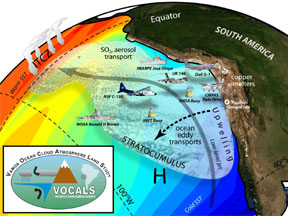
How big of a 'laboratory' would you need to conduct experiments on a climate system? Well, that probably depends on which part of Earth's climate system you want to study. In the case of the VOCALS, the...more

Greetings from Iquique!

I've participated in numerous field measurement campaigns over the past 14 years, and one of the interesting aspects of doing so is living and working in a place that is very different from my normal home...more
Rhea George

Many students in atmospheric science were motivated to enter the field by some fascinating extreme weather event experienced as a child. This was not the case with me. When I was an undergraduate I was...more

Shop Windows to the Universe

Please help support Windows to the Universe, and our activities to help Earth and space science teachers, with a tax-exempt donation today!

Windows to the Universe, a project of the National Earth Science Teachers Association, is sponsored in part by the National Science Foundation and NASA, our Founding Partners (the American Geophysical Union and American Geosciences Institute) as well as through Institutional, Contributing, and Affiliate Partners, individual memberships and generous donors. Thank you for your support! NASA AGU AGI NSF