Current Events

  • Atmospheric CO2 Level Tops 400 ppm
    During the week of May 13th, the CO2 level at the Mauna Loa Observatory in Hawaii topped 400 ppm rep...Read more

    x

    Atmospheric CO2 Level Tops 400 ppm

    During the week of May 13th, the CO2 level at the Mauna Loa Observatory in Hawaii topped 400 ppm repeatedly. Daily levels of CO2 can vary due to weather, and there are seasonal trends as well. The level of atmospheric greenhouse gases continues to increase, now over 120 ppm since the Industrial Revolution began. For more on the Keeling Curve, see http://keelingcurve.ucsd.edu/. Find out more about greenhouse gases and warming.
  • Massive Tornado Outbreak on Tornado Alley
    The week of May 19 brings dozens of tornadoes to Tornado Alley in the states of Oklahoma, Kansas, Io...Read more

    x

    Massive Tornado Outbreak on Tornado Alley

    The week of May 19 brings dozens of tornadoes to Tornado Alley in the states of Oklahoma, Kansas, Iowa, Illinois and Missouri. On May 20th, a massive tornado struck Moore, Oklahoma, devastating communities - destroying over 100 homes and hitting two elementary schools and a hospital - with many casualties and deaths. Our thoughts are with our friends and colleagues suffering from these storms. For more on the May 20th storms, see the NOAA Storm Prediction Center Storm Report.
  • Kansas Legislator Proposes Bill to Outlaw Sustainability Education
    A bill has been introduced in the Kansas legislature this week that would prohibit the promotion of ...Read more

    x

    Kansas Legislator Proposes Bill to Outlaw Sustainability Education

    A bill has been introduced in the Kansas legislature this week that would prohibit the promotion of sustainability. Here is a link to the one-page bill: http://www.kslegislature.org/li/b2013_14/measures/documents/hb2366_00_0000.pdf. See report on Bloomberg News.

    Image courtesy of Dione Rossiter

From: Dione Rossiter
Iquique, Chile, October 16, 2008

What is a PDI?

Hola from Chile!

I arrived in Iquique (pronounced like the letter "E", the word "KEY", and then the letter "K") only a few days ago and have been getting ready for the field mission. Iquique is a town in northern Chile where the Twin Otter airplane will be flying lots of different instruments, including our own, through the atmosphere.

Our instrument is called the Phase Doppler Interferometer, nicknamed the PDI. The PDI contains a laser, a laser beam splitter, lots of little mirrors, and a sensor (kind of like a very fancy eye). The laser in the PDI starts off as one beam. Then, the beam splitter breaks it into two separate beams. Little mirrors are used to reflect the beams in different directions but eventually, the two beams are crossed (like an X). The sensor looks directly at the point where the two beams cross each other. A pattern of light is formed at the center of the X, which an eye cannot see but the sensor can.

When tiny things (including water droplets from a cloud) move through the center of the X, the pattern changes. The sensor notices this and sends information about the changes to a computer. Because the changes in the pattern depend on how big the water droplet is and how fast it is moving, the computer can calculate the size and speed of the droplet. I use this information to try understand how the water droplets that make up clouds are related to the Earth's climate.

You can split one laser beam into two by shining a laser pointer at different angles into a glass of water. Of course, this should be done under adult supervision. :)

Have fun trying the experiment!

~D

Postcards from the Field: Climate Science from the Southeast Pacific

You might also be interested in:

Cool It! Game

Check out our online store - minerals, fossils, books, activities, jewelry, and household items!...more
Rhea George

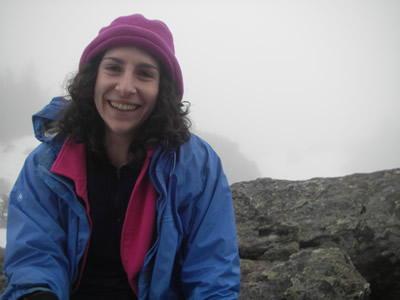
Many students in atmospheric science were motivated to enter the field by some fascinating extreme weather event experienced as a child. This was not the case with me. When I was an undergraduate I was...more
Dr. Boris Dewitte

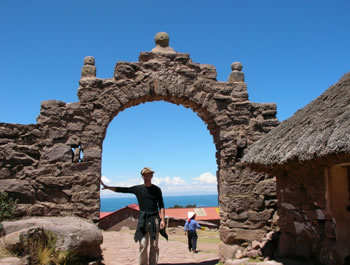
I'm a physical oceanographer interested in climate variability and especially the El Niño phenomenon. Other than the annual cyle of the seasons, El Niño is the largest pulsation of the climate. I'm interested...more
Dr. Paquita Zuidema

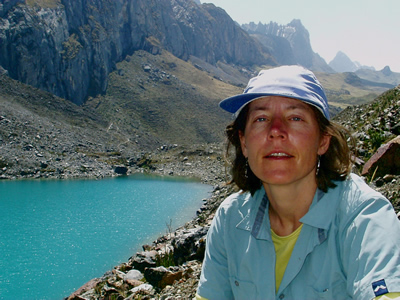
Hola! I am originally from the Netherlands and thereafter spent 3 years as a child in the Peruvian Andes, but I have lived most of my life in the United States. I received my bachelor's degree in physics...more
Lelia Hawkins

I am starting my fourth year of graduate school at Scripps Institution of Oceanography, studying atmospheric chemistry and climate science. I love earth science and have always wanted to do something...more
Dr. Jeff Snider

I am a university professor involved in studies of the concentration and type of particles contained within clouds. It is important to know these things in order to say how often clouds produce precipitation...more
Dr. Chris Zappa

I am a specialist in ocean-atmosphere interactions. My interests include wave dynamics and wave breaking, the effect of near-surface turbulence on heat, gas, and momentum transport, airborne infrared...more

Jake Crouch

I am a graduate student studying meteorology at North Carolina State University in Raleigh, NC. I grew up in Beckley, WV and obtained my B.S. in meteorology from the University of North Carolina – Asheville....more

Shop Windows to the Universe

Warnings: The True Story of How Science Tamed the Weather by Mike Smith tells the story of our storm warning system. See our online store book collection.

Windows to the Universe, a project of the National Earth Science Teachers Association, is sponsored in part by the National Science Foundation and NASA, our Founding Partners (the American Geophysical Union and American Geosciences Institute) as well as through Institutional, Contributing, and Affiliate Partners, individual memberships and generous donors. Thank you for your support! NASA AGU AGI NSF