
Current Events

  • Kansas Legislator Proposes Bill to Outlaw Sustainability Education
    A bill has been introduced in the Kansas legislature this week that would prohibit the promotion of ...Read more

    x

    Kansas Legislator Proposes Bill to Outlaw Sustainability Education

    A bill has been introduced in the Kansas legislature this week that would prohibit the promotion of sustainability. Here is a link to the one-page bill: http://www.kslegislature.org/li/b2013_14/measures/documents/hb2366_00_0000.pdf. See report on Bloomberg News.
  • Earth's Center Is 1,000 Degrees Hotter Than Previously Thought, Synchrotron X-Ray Experiment Shows
    Scientists have determined the temperature near the Earth’s center to be 6000 degrees Celsius, 1000 ...Read more

    x

    Earth's Center Is 1,000 Degrees Hotter Than Previously Thought, Synchrotron X-Ray Experiment Shows

    Scientists have determined the temperature near the Earth’s center to be 6000 degrees Celsius, 1000 degrees hotter than in a previous experiment run 20 years ago. These measurements confirm geophysical models that the temperature difference between the solid core and the mantle above, must be at least 1500 degrees to explain why the Earth has a magnetic field. For more information about this study, see the press release from the European Synchrotron Radiation Facility.
  • Ocean Volcanic Rocks Contain Samples of Recycled Crust
    Scientists have long believed that lava erupted from certain oceanic volcanoes contains materials fr...Read more

    x

    Ocean Volcanic Rocks Contain Samples of Recycled Crust

    Scientists have long believed that lava erupted from certain oceanic volcanoes contains materials from the early Earth’s crust. But decisive evidence for this phenomenon has proven elusive. New research from a team including Carnegie’s Erik Hauri demonstrates that oceanic volcanic rocks contain samples of recycled crust dating back to the Archean era 2.5 billion years ago. Their work is published in Nature. Oceanic crust sinks into the Earth’s mantle at so-called subduction zones, where two plates come together. Much of what happens to the crust during this journey is unknown. Model-dependent studies for how long subducted material can exist in the mantle are uncertain and evidence of very old crust returning to Earth’s surface via upwellings of magma has not been found until now. For more information about these results, see the press release from the Carnegie Institution.

   Image courtesy of Sally Walker

From: Sally Walker
Southern Ocean, October 10, 2008

Flight over Southern Ocean

With the brakes retooled, we were finally ready for take off in the C-17. Take off was amazing, despite all the noise generated by the massive engines (we had to wear ear plugs or headphones): I was pushed sideways in my seat by the inertial forces of take off, but I could not distinguish between when the plane's wheels lifted off the ground and when the C-17 became airborne, it was that smooth. Based on the map on board, we were going to fly straight south toward Antarctica from Christchurch, over the Southern Ocean.

The Southern Ocean is the Earth's youngest ocean, forming approximately 34-30 million years ago when, through plate tectonics, Antarctica separated from its Gondwanaland partners, South America and Australia. It is a unique ocean, home to a great variety of marine life, including whales and their favorite food, krill. Krill is an important food source for not only whales, but also fish upon which seals, penguins, sea birds, and other marine creatures depend. Growth of the Antarctic ozone hole may be negatively affecting krill populations, shifting the ecological balance in this region.

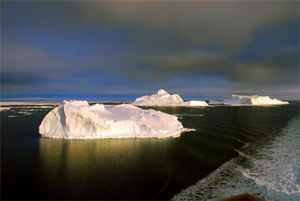
The Southern Ocean is also a treacherous ocean; as I peered out the cockpit's window to view the swirling masses of clouds, frothy white caps on top of waves seemingly coming from several directions, and what looked like icebergs. Some of the Earth's fiercest storms take place here, with high winds and large waves. Captain Scott, Sir Ernest Shackleton and many other early Antarctic explorers crossed the Southern Ocean by ship. I was very thankful to be thousands of feet in the air, looking down upon this active ocean.

As we approached the continent of Antarctica, the cloudier the skies became. I hoped we would not "boomerang", which would mean that the C-17 would have to turn around and fly back another five hours to Christchurch. It had happened on several previous flights already, and I hoped that this time, we would be lucky.

Southern Ocean Diversity

Climate and Ecosystem Dynamics of the Southern Ocean

Southern Ocean

Go to the next postcard

Postcards from the Field: Polar Fossil Mysteries

You might also be interested in:

Cool It! Game

Check out our online store - minerals, fossils, books, activities, jewelry, and household items!...more
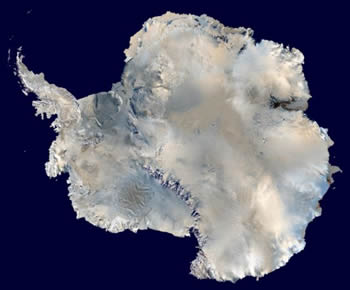
Antarctica

Antarctica is unique. It is the coldest, windiest, and driest continent on Earth. The land is barren and mostly covered with a thick sheet of ice. Antarctica is almost entirely south of the Antarctic Circle...more
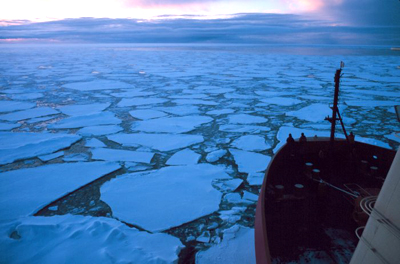
The Southern Ocean

The Southern Ocean is a bit different. Many mapmakers do not even recognize it as an ocean. The Southern Ocean (sometimes known as the Antarctic Ocean or South Polar Ocean) surrounds Antarctica in the...more
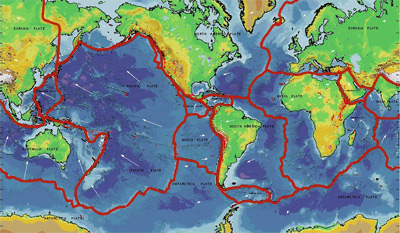
Plate Tectonics

Many forces cause the surface of the Earth to change over time. However, the largest force that changes our planet’s surface is the movement of Earth's outer layer through the process of plate tectonics....more
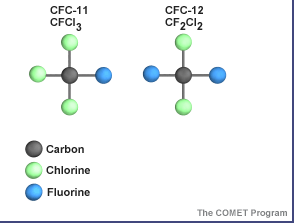
Ozone in the Stratosphere

About 90% of the ozone in the Earth's atmosphere lies in the region called the stratosphere which is found between 16 and 48 kilometers (10 and 30 miles) above the Earth's surface. Ozone forms a kind of...more
Icebergs

Icebergs are large pieces of ice floating in the ocean that have broken off of ice shelves or glaciers in Earth's polar regions. They are a part of the cryosphere. Approximately 90% of an iceberg's mass...more
Antarctic Weather

Antarctica is the southernmost continent on Earth, and since it’s home to the South Pole it is probably no surprise that the weather here is very cold—in fact, Antarctica is quite a bit colder than even...more

Wind

Wind is moving air. Warm air rises, and cool air comes in to take its place. This movement creates different pressures in the atmosphere which creates the winds around the globe. Since the Earth spins,...more

Shop Windows to the Universe

Young Voices for the Planet DVD in our online store includes 8 films where students speak out and take action on climate change.

Windows to the Universe, a project of the National Earth Science Teachers Association, is sponsored in part by the National Science Foundation and NASA, our Founding Partners (the American Geophysical Union and American Geosciences Institute) as well as through Institutional, Contributing, and Affiliate Partners, individual memberships and generous donors. Thank you for your support! NASA AGU AGI NSF