Current Events

  • Kansas Legislator Proposes Bill to Outlaw Sustainability Education
    A bill has been introduced in the Kansas legislature this week that would prohibit the promotion of ...Read more

    x

    Kansas Legislator Proposes Bill to Outlaw Sustainability Education

    A bill has been introduced in the Kansas legislature this week that would prohibit the promotion of sustainability. Here is a link to the one-page bill: http://www.kslegislature.org/li/b2013_14/measures/documents/hb2366_00_0000.pdf. See report on Bloomberg News.
  • Earth's Center Is 1,000 Degrees Hotter Than Previously Thought, Synchrotron X-Ray Experiment Shows
    Scientists have determined the temperature near the Earth’s center to be 6000 degrees Celsius, 1000 ...Read more

    x

    Earth's Center Is 1,000 Degrees Hotter Than Previously Thought, Synchrotron X-Ray Experiment Shows

    Scientists have determined the temperature near the Earth’s center to be 6000 degrees Celsius, 1000 degrees hotter than in a previous experiment run 20 years ago. These measurements confirm geophysical models that the temperature difference between the solid core and the mantle above, must be at least 1500 degrees to explain why the Earth has a magnetic field. For more information about this study, see the press release from the European Synchrotron Radiation Facility.
  • Ocean Volcanic Rocks Contain Samples of Recycled Crust
    Scientists have long believed that lava erupted from certain oceanic volcanoes contains materials fr...Read more

    x

    Ocean Volcanic Rocks Contain Samples of Recycled Crust

    Scientists have long believed that lava erupted from certain oceanic volcanoes contains materials from the early Earth’s crust. But decisive evidence for this phenomenon has proven elusive. New research from a team including Carnegie’s Erik Hauri demonstrates that oceanic volcanic rocks contain samples of recycled crust dating back to the Archean era 2.5 billion years ago. Their work is published in Nature. Oceanic crust sinks into the Earth’s mantle at so-called subduction zones, where two plates come together. Much of what happens to the crust during this journey is unknown. Model-dependent studies for how long subducted material can exist in the mantle are uncertain and evidence of very old crust returning to Earth’s surface via upwellings of magma has not been found until now. For more information about these results, see the press release from the Carnegie Institution.

    Image courtesy of Mark Spear

From: Eric Simms
East Pacific Rise, February 1, 2007

Diving to the Deep

Greetings once again, from the East Pacific Rise!

One of the most useful tools that scientists have for exploring the deep sea is the Alvin research submersible. Here's a postcard showing the submersible just before it begins its dive.

The original Alvin was built in 1964, and since then different versions of the sub have completed over 4300 successful dives to the ocean floor all around the world. Alvin can take a pilot and two scientists to depths of 4500 meters (14,625 feet) – a typical dive lasts eight hours, but at least half of that time can be spent just getting down to the bottom and back depending on the bottom depth. Once on the bottom, manipulator arms controlled by the pilot can collect samples of rocks and organisms to be brought back to the surface. Scientists also leave equipment and location markers on the seafloor to conduct experiments, and cameras on the sub collect photographs and video of each dive.

On this cruise, Alvin is being used to observe how the seafloor has changed since the January 2006 eruption, and to collect samples of the water, rocks and organisms found at the new vent sites. Be sure to check out our cruise log on the SEAS website.

For more information on the Alvin submersible visit http://www.whoi.edu/marops/vehicles/alvin/

Postcards from the Field: Deep Sea

You might also be interested in:

Cool It! Game

Check out our online store - minerals, fossils, books, activities, jewelry, and household items!...more
Penguin Colonies

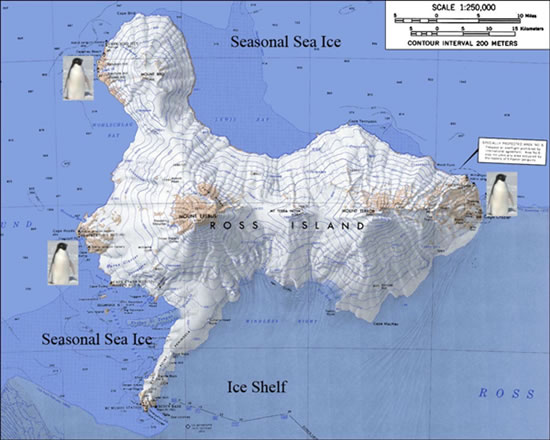
This is Ross Island, a volcanic island embedded in the Ross Ice Shelf, Antarctica. Adelie penguins are found all around Antarctica, but we will be filming the documentary at the breeding colonies shown...more
View from our home

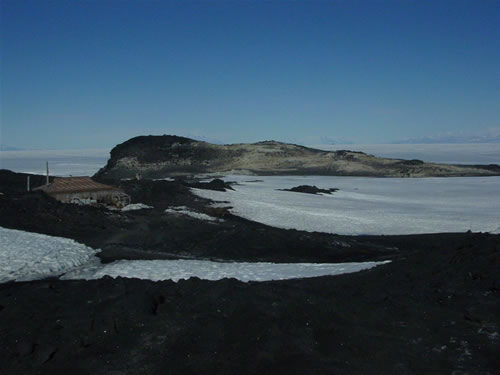
This is a view of the Adelie penguin breeding colony at Cape Royds in Antarctica. In the foreground you see Shackleton’s hut. Sir Ernest Shackleton and his team of explorers tried and failed to cross the...more
Time to Raise the Chicks

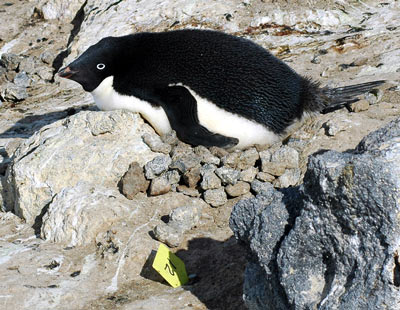
We are at Cape Royds, Ross Island, Antarctica, a penguin breeding colony of several thousand Adelie penguins. This female is 8 years old and has been a successful breeder in the past. She was first seen...more
Ice, Fire, and Penguins

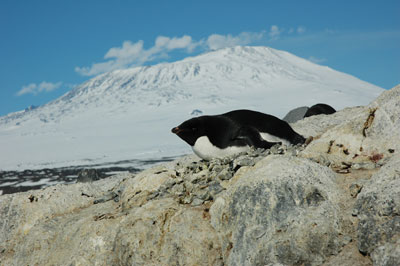
Cape Royds penguin breeding colony is in the shadow of Mt Erebus, one of three volcanoes on Ross Island and the only active one. Antarctica Explorer James Clark Ross named two of the volcanoes after his...more
Proud Parents

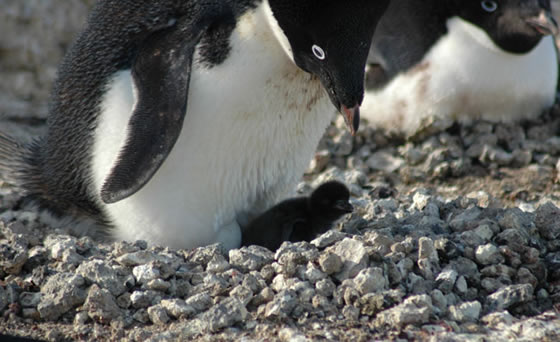
At long last the moment we have been waiting for, the first Adelie chick of the season. We have been scanning nest sites for broken egg shells, evidence that a chick has hatched. On Dec 12, 2006 we sighted...more

A Family of Penguins

Chicks are hatching everyday now and the colony is bubbling with new life. The air is filled with the songs of penguins returning from feeding and the growls of predatory Skua birds as they circle the...more

How Do We Study the Penguins?

This is a device which identifies and weighs the parents as they move from the nest to the ocean to feed, and back. An electronic identification tag (like the ones in pets and race horses) has been inserted...more

Shop Windows to the Universe

Become a nitrogen atom in the nitrogen cycle in our Traveling Nitrogen Classroom Activity Kit/Game. See all our games, activity kits and classroom activities.

Windows to the Universe, a project of the National Earth Science Teachers Association, is sponsored in part by the National Science Foundation and NASA, our Founding Partners (the American Geophysical Union and American Geosciences Institute) as well as through Institutional, Contributing, and Affiliate Partners, individual memberships and generous donors. Thank you for your support! NASA AGU AGI NSF