Current Events

  • Atmospheric CO2 Level Tops 400 ppm
    During the week of May 13th, the CO2 level at the Mauna Loa Observatory in Hawaii topped 400 ppm rep...Read more

    x

    Atmospheric CO2 Level Tops 400 ppm

    During the week of May 13th, the CO2 level at the Mauna Loa Observatory in Hawaii topped 400 ppm repeatedly. Daily levels of CO2 can vary due to weather, and there are seasonal trends as well. The level of atmospheric greenhouse gases continues to increase, now over 120 ppm since the Industrial Revolution began. For more on the Keeling Curve, see http://keelingcurve.ucsd.edu/. Find out more about greenhouse gases and warming.
  • Massive Tornado Outbreak on Tornado Alley
    The week of May 19 brings dozens of tornadoes to Tornado Alley in the states of Oklahoma, Kansas, Io...Read more

    x

    Massive Tornado Outbreak on Tornado Alley

    The week of May 19 brings dozens of tornadoes to Tornado Alley in the states of Oklahoma, Kansas, Iowa, Illinois and Missouri. On May 20th, a massive tornado struck Moore, Oklahoma, devastating communities - destroying over 100 homes and hitting two elementary schools and a hospital - with many casualties and deaths. Our thoughts are with our friends and colleagues suffering from these storms. For more on the May 20th storms, see the NOAA Storm Prediction Center Storm Report.
  • Kansas Legislator Proposes Bill to Outlaw Sustainability Education
    A bill has been introduced in the Kansas legislature this week that would prohibit the promotion of ...Read more

    x

    Kansas Legislator Proposes Bill to Outlaw Sustainability Education

    A bill has been introduced in the Kansas legislature this week that would prohibit the promotion of sustainability. Here is a link to the one-page bill: http://www.kslegislature.org/li/b2013_14/measures/documents/hb2366_00_0000.pdf. See report on Bloomberg News.

    Image Courtesy of Tim Killeen

From: Tim Killeen
Hydrate Ridge, Pacific Ocean, September 7, 2009

Planning for the Dive

After leaving Astoria we steamed to the "Hydrate Ridge" - an area at a latitude of 44N and longitude of 125W, about 45 miles off the coast of Oregon, where the sea floor is at a depth of 780 meters. The area was chosen because previous exploration had shown the presence of microbial "mats" making a living off methane gas released from the seismically active region. The purpose of the dive was to bring back samples of the microbial mats - hopefully the more rare "orange" version, together with samples of snails and mud cores of clam beds that also live in this area. We will dive near the summit of an underwater mountain range. It was a very nice evening and the dive is planned for 7:00 a.m on September 8th. Three of us will go down in Alvin: myself, Dr. Susan Avery, the director of the Woods Hole Oceanography Institution, and our expedition leader and Alvin pilot, Bruce Strickrott.

Tim

Go to the next postcard

Postcards from the Field: Postcards from Alvin

You might also be interested in:

Cool It! Game

Check out our online store - minerals, fossils, books, activities, jewelry, and household items!...more

Methane - CH4

Methane is gas that is found in small quantities in Earth's atmosphere. Methane is the simplest hydrocarbon, consisting of one carbon atom and four hydrogen atoms. Methane is a powerful greenhouse gas....more
Seismic Waves: Moving and Shaking During an Earthquake

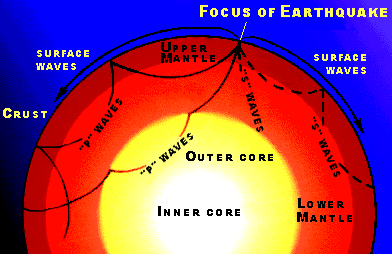
During an earthquake, energy is released in waves that travel from the earthquake’s focus or point of origin, in the form of seismic waves. The seismic waves radiate from the focus like ripples on the...more

The Scene at Astoria

The team is assembling for a short cruise aboard the Atlantis, leaving Astoria, Oregon on a scientific cruise to Hydrate Ridge. At Hydrate Ridge, the deep submersible, Alvin, will explore the sea bottom...more

Planning for the Dive

After leaving Astoria we steamed to the "Hydrate Ridge" - an area at a latitude of 44N and longitude of 125W, about 45 miles off the coast of Oregon, where the sea floor is at a depth of 780 meters. The...more

The Journey to the Ocean Floor

We clambered into the Alvin. Once inside, there wasn't much space for the three of us to move around. The "cabin" is a sphere made out of welded titanium metal and it's about the size of a small walk-in...more

Searching for Microbial Mats

Once on the sea floor, Bruce started moving around to search for the microbial mats. Alvin moves a little like a blimp - you give it some momentum in a particular direction and it will keep going. It turns...more

Alvin Heads Back to the Surface

To return to the surface, Bruce jettisoned two sets of weights and we began to ascend, again very gracefully. Again, we saw all kinds of jellyfish, strange fluorescent creatures, and floating particules...more

Shop Windows to the Universe

Dig into Montana Before History: 11K Years of Hunter-Gatherers in the Rockies and Plains by D. H. MacDonald, Ph.D. See our online store book collection.

Windows to the Universe, a project of the National Earth Science Teachers Association, is sponsored in part by the National Science Foundation and NASA, our Founding Partners (the American Geophysical Union and American Geosciences Institute) as well as through Institutional, Contributing, and Affiliate Partners, individual memberships and generous donors. Thank you for your support! NASA AGU AGI NSF