Current Events

  • Irish Chronicles Document Links Between Volcanoes and Weather
    A study of over 40,000 written entries in Irish Annals and ice core measurements shows a strong corr...Read more

    x

    Irish Chronicles Document Links Between Volcanoes and Weather

    A study of over 40,000 written entries in Irish Annals and ice core measurements shows a strong correlation between the occurrence of volcanic eruptions and extreme cold weather in Ireland over a 1200 year period. Data analyzed in this study cover the period from 431 to 1649, during which time up to 48 volcanic eruptions are identified in Greenland ice core records through deposition of volcanic sulfate in annual layers of ice. You can find the study (open access), published on 6 June 2013 in IOP Publishing's journal Environmental Research Letters, at http://iopscience.iop.org/1748-9326/8/2/024035/article. Find out more about how volcanoes can influence climate.
  • EF-5 Tornado in El Reno, Oklahoma Widest Ever Recorded in US
    The EF-5 tornado that hit El Reno, Oklahoma on May 31st was the widest ever recorded in the US, acco...Read more

    x

    EF-5 Tornado in El Reno, Oklahoma Widest Ever Recorded in US

    The EF-5 tornado that hit El Reno, Oklahoma on May 31st was the widest ever recorded in the US, according to the National Weather Service in Norman Oklahoma. The tornado, which remained on the ground for 40 minutes and reached 2.6 miles across (4.2 km), took the lives of 18 people including storm chasers Tim Samaras, Paul Samaras and Carl Young. For more information on the tornado, visit http://ow.ly/i/2hfDG.
  • Atmospheric CO2 Level Tops 400 ppm
    During the week of May 13th, the CO2 level at the Mauna Loa Observatory in Hawaii topped 400 ppm rep...Read more

    x

    Atmospheric CO2 Level Tops 400 ppm

    During the week of May 13th, the CO2 level at the Mauna Loa Observatory in Hawaii topped 400 ppm repeatedly. Daily levels of CO2 can vary due to weather, and there are seasonal trends as well. The level of atmospheric greenhouse gases continues to increase, now over 120 ppm since the Industrial Revolution began. For more on the Keeling Curve, see http://keelingcurve.ucsd.edu/. Find out more about greenhouse gases and warming.
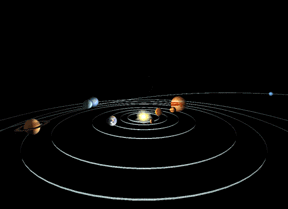
This is an image of the solar system.
Click on image for full size

The Beginning of the Solar System

Scientists believe that the solar system was formed when a cloud of gas and dust in space was disturbed, maybe by the expl osion of a nearby star (called a supernova).


This explosion made waves in space which squeezed the cloud of gas and dust. Squeezing made the cloud start to collapse, as gravity pulled the gas and dust together.


Just like a dancer that spins faster as she pulls in her arms, the cloud began to spin as it collapsed. Eventually, the cloud grew hotter and denser in the center, with a disk of gas and dust surrounding it that was hot in the center but cool at the edges.


As the disk got thinner and thinner, particles began to stick together and form clumps. Some clumps got bigger, as particles and small clumps stuck to them, eventually forming planets or moons .


Near the center of the cloud, where planets like Earth formed, only rocky material could stand the great heat. Icy matter settled in the outer regions of the disk, where the giant planets like Jupiter formed.


As the cloud continued to fall in, the center eventually got so hot that it became a star, the Sun, and blew most of the gas and dust of the new solar system. By studying fragments of rock left over from this early phase of the solar system, scientists have found that the solar system is about 4600 million years old!


Shop Windows to the Universe Science Store!

The Summer 2010 issue of The Earth Scientist, available in our online store, includes articles on rivers and snow, classroom planetariums, satellites and oceanography, hands-on astronomy, and global warming.

Windows to the Universe Community

News

Opportunities

You might also be interested in:

Cool It! Game

Check out our online store - minerals, fossils, books, activities, jewelry, and household items!...more

How a planet-to-be sweeps up nearby material to be part of itself

As shown in this picture, while they were forming in the solar nebula, the core of the planets-to-be drew material to themselves from the cloud of gas and dust around them. The bigger planets-to-be were...more

Where did the atmosphere come from?

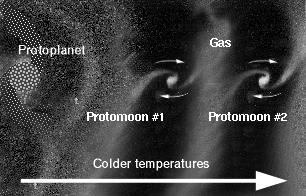
Titan is like other icy moons. Scientists want to know "how come Titan is the only one that has a big atmosphere?" Titan formed the same way other planets did, as shown in this picture. Where Titan formed,...more

The Archean

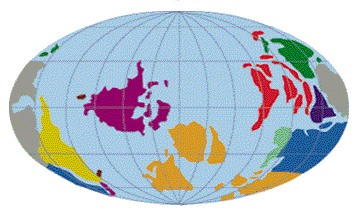
The Archean is the name of the age which began with the forming Earth. This period of Earth's history lasted a long time, 2.8 billion years! That is more than half the expected age of the Earth! And no...more

The position of Jupiter when gas changed to ice

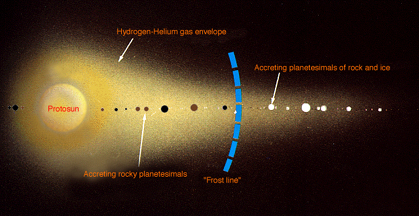
The position of the planets in the solar nebula affected how big they became and what they were made of. The blue line in the picture shows where it became so cold that ice began to form. Planets that...more

Japan And U.S. Join Together for Asteroid Expedition

NASA is going to send a spacecraft to visit an asteroid. Two countries will work on the space mission - Japan and the United States. The name of the asteroid is Nereus. Nereus is a small asteroid. It is...more

CONTOUR on its Way to Catch a Comet!

NASA’s Comet Nucleus Tour (called CONTOUR) launched July 3, 2002. The CONTOUR spacecraft will fly by at least two comets. It will take pictures and collect dust from the nucleus of each comet. Learning...more

A Look at the Solar System's Past - the Tagish Meteorite

Have you ever looked at pictures of friends or relatives to see what they looked like when they were very young? That is what some scientists are trying to do with a meteorite that fell in Canada. This...more

Windows to the Universe, a project of the National Earth Science Teachers Association, is sponsored in part by the National Science Foundation and NASA, our Founding Partners (the American Geophysical Union and American Geosciences Institute) as well as through Institutional, Contributing, and Affiliate Partners, individual memberships and generous donors. Thank you for your support! NASA AGU AGI NSF