Current Events

  • Atmospheric CO2 Level Tops 400 ppm
    During the week of May 13th, the CO2 level at the Mauna Loa Observatory in Hawaii topped 400 ppm rep...Read more

    x

    Atmospheric CO2 Level Tops 400 ppm

    During the week of May 13th, the CO2 level at the Mauna Loa Observatory in Hawaii topped 400 ppm repeatedly. Daily levels of CO2 can vary due to weather, and there are seasonal trends as well. The level of atmospheric greenhouse gases continues to increase, now over 120 ppm since the Industrial Revolution began. For more on the Keeling Curve, see http://keelingcurve.ucsd.edu/. Find out more about greenhouse gases and warming.
  • Massive Tornado Outbreak on Tornado Alley
    The week of May 19 brings dozens of tornadoes to Tornado Alley in the states of Oklahoma, Kansas, Io...Read more

    x

    Massive Tornado Outbreak on Tornado Alley

    The week of May 19 brings dozens of tornadoes to Tornado Alley in the states of Oklahoma, Kansas, Iowa, Illinois and Missouri. On May 20th, a massive tornado struck Moore, Oklahoma, devastating communities - destroying over 100 homes and hitting two elementary schools and a hospital - with many casualties and deaths. Our thoughts are with our friends and colleagues suffering from these storms. For more on the May 20th storms, see the NOAA Storm Prediction Center Storm Report.
  • Kansas Legislator Proposes Bill to Outlaw Sustainability Education
    A bill has been introduced in the Kansas legislature this week that would prohibit the promotion of ...Read more

    x

    Kansas Legislator Proposes Bill to Outlaw Sustainability Education

    A bill has been introduced in the Kansas legislature this week that would prohibit the promotion of sustainability. Here is a link to the one-page bill: http://www.kslegislature.org/li/b2013_14/measures/documents/hb2366_00_0000.pdf. See report on Bloomberg News.
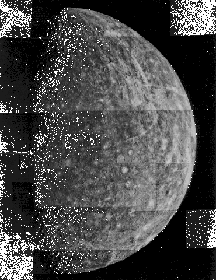
This is an image of the surface of Mercury.
Click on image for full size
NASA

Early Cratering of the Planets

When we look at images of many of the planets, we see all sorts of circular craters on the planet surfaces. Most of these craters were probably formed when the solar system was still very young.

Once the early solar system had planets about the size of the planets today, there were still probably a lot of smaller planetesimals and debri around, too. The gravity of the large planets would attract nearby planetesimals, which would hit the planets and leave a crater on the planet's surface.

Craters on the surfaces of the inner planets are up to 4 billion years old, and some craters seem to have been made by objects up to 200 km across!


Shop Windows to the Universe Science Store!

The Winter 2010 issue of The Earth Scientist, which includes articles on meteor cratering, classroom glaciers, podcasts in the classroom, and pyro-cumulonimbus clouds, is available in our online store.

Windows to the Universe Community

News

Opportunities

You might also be interested in:

Traveling Nitrogen Classroom Activity Kit

Check out our online store - minerals, fossils, books, activities, jewelry, and household items!...more

Exploratour - The Surface of Europa

The significance of the lack of craters is this. There was a period of heavy bombardment of planetary surfaces by craters at the conclusion of the formation of the solar system. The surfaces of most solar...more

Solar System Formation

Scientists believe that the solar system was for med when a cloud of gas and dust in space was disturbed, maybe by the supernova of a nearby star. Shock waves from the explosion compressed the cloud of...more

The Solar System

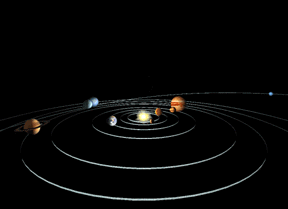
The solar system is made up of the Sun, // Call the planets count function defined in the document head print_planet_count('planets'); planets and // Call the planets count function defined in the document...more

Eris - a dwarf planet

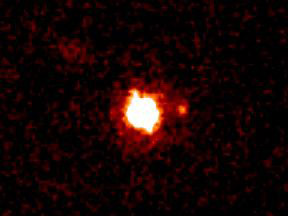
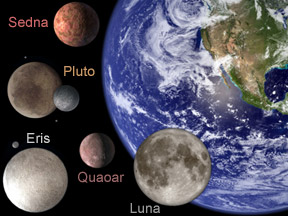
Eris is a dwarf planet that was discovered in 2005. Eris is a trans-Neptunian object (TNO) that orbits the Sun on the frozen fringes of our Solar System beyond the Kuiper Belt. Eris takes 557 years to...more

What is a planet?

It may surprise you, but astronomers don't really have a good definition of a "planet". Because of this, Pluto is at the heart of a controversy about its status. Is Pluto a planet, or isn't it? Scientists...more

Orionid Meteor Shower

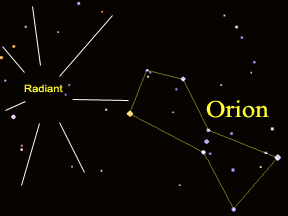
The Orionid meteor shower is one of several major meteor showers that occur on roughly the same date each year. The Orionids typically "peak" (are at their greatest level of activity) around October 21st....more

Leonid Meteor Shower

The Leonid meteor shower is one of several major meteor showers that occur on roughly the same date each year. The Leonids typically "peak" (are at their greatest level of activity) in mid to late November....more

Shop Windows to the Universe

Warnings: The True Story of How Science Tamed the Weather by Mike Smith tells the story of our storm warning system. See our online store book collection.

Windows to the Universe, a project of the National Earth Science Teachers Association, is sponsored in part by the National Science Foundation and NASA, our Founding Partners (the American Geophysical Union and American Geosciences Institute) as well as through Institutional, Contributing, and Affiliate Partners, individual memberships and generous donors. Thank you for your support! NASA AGU AGI NSF