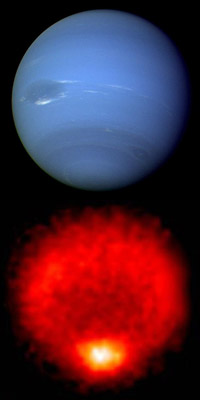
The top image shows Neptune in visible light, much as our eyes would see it. The bottom image was captured at infrared wavelengths. The bright spot (bottom) in the IR image shows that Neptune's South Pole is the warmest place on the planet!
Click on image for full size
Images courtesy of NASA/JPL (visible light) and VLT/ESO/NASA/JPL/Paris Observatory (infrared).
The Poles of Neptune and Its Moons
The South Pole of the planet Neptune is unusual in several ways. Triton, Neptune's largest moon, also has interesting features at its poles.
Like Earth, Neptune's spin axis (which defines the locations of its poles) is tilted a moderate amount. Neptune's axial tilt is 28.32°, slightly more than Earth's 23.45°. That means that Neptune has seasons in a fashion very similar to Earth. However, since Neptune takes roughly 164 years to orbit the Sun once, each season on Neptune lasts more than 40 Earth years! It has been summertime in Neptune's Southern Hemisphere for the last few decades, so that part of the planet has been receiving more sunlight and has been warming up for many years. In 2007 astronomers captured infrared images of Neptune that showed a brighter, relatively warm spot in the planet's atmosphere above its South Pole. Neptune's South Pole is the warmest place on the planet!
Since Neptune is not a solid object, but rather a ball of gas and ice, not all of it spins at the same speed. Areas near the equator rotate once every 18 hours, but regions close to the poles go around every 12 hours. This difference in rotational rates generates strong winds; at 70° S latitude they blow at speeds of 1,080 km/hr (671 mph)! The composition of Neptune's atmosphere also varies with latitude. Methane, ethane and acetylene are 10 to 100 times less abundant at the poles than they are near the equator.
Neptune's magnetic field is tilted with respect to the planet's spin axis. Unlike Earth's mild difference of 11° between magnetic and geographic poles, Neptune's magnetic field is tilted a whopping 46.9°. If Earth's magnetic field was tilted that much, the North Magnetic Pole would be at a latitude somewhere south of Paris.
You might also be interested in:

How did life evolve on Earth? The answer to this question can help us understand our past and prepare for our future. Although evolution provides credible and reliable answers, polls show that many people turn away from science, seeking other explanations with which they are more comfortable.
...more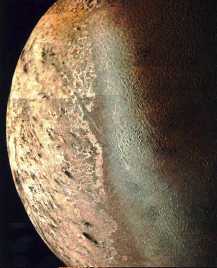
Triton was discovered by W. Lassell in 1846. Of the 8 moons, it is the 2nd farthest from Neptune, with a standoff distance of 354,800 km. Triton may be one of the largest of the icy moons, is comparable
...more
Triton is by far the largest moon of Neptune, and is one of the most unusual large moons in the Solar System. The poles of Triton are especially interesting. Triton has a frozen polar cap with ice geysers.
...more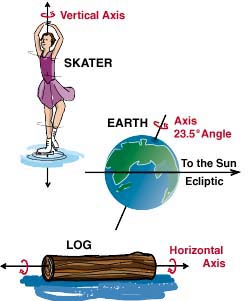
The Earth is rotating around an axis (called its rotational axis). Some objects rotate about a horizontal axis, like a rolling log. Some objects, such as a skater, rotate about a vertical axis. The Earth's
...more
The Earth travels around the Sun one full time per year. During the year, the seasons change depending on the amount of sunlight reaching parts of the Earth. The seasons are caused because the Earth is
...more
Let's pretend, for the moment, that you're the person standing on the Earth in the picture to the left, living in Topeka, Kansas, around 40° N latitude. The picture on the left shows the view from the
...more
Infrared (IR) radiation is a type of electromagnetic radiation. Infrared "light" has a longer wavelength than visible light. Red light has a longer wavelength than other colors of light, and infrared has
...more
The atmosphere of Neptune is very similar to that of Uranus, and unlike that of Saturn and Jupiter. On Jupiter and Saturn, the atmosphere is mostly composed of the simple molecules hydrogen and helium.
...more