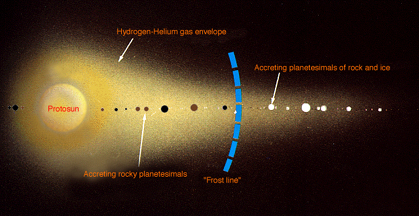
This drawing depicts a position where the formation of ice became important.
Click on image for full size
Windows Original
The position of Neptune when gas changed to ice
The position of the planets in the solar nebula greatly affected their 1. size and 2. composition. This is because of the effect of how cold it was in the nebula.
1. The nebula was a lot warmer close to the proto-sun. The blue line shown in the picture shows the point at which the temperature became cold enough for gases to become ice. At this point and further out, the materials that forming planets (proto-planets) began to extract from the cloud were ice, as well as rocky material and gas molecules. Retention of ice resulted in these proto-planets becoming giant, massive planets. (The same thing happens to raindrops when it becomes cold enough for the raindrops to become slushy snow drops, the drops are more massive). Planets which formed closer to the proto-sun were smaller, and more rocky.
Neptune was very far out in the nebula, however, where the cloud was not only becoming colder, but becoming thinner as well. This meant that there was less gas to sweep up, so proto-Neptune was not able to sweep up as much gas as the proto-Jupiter. Thus Neptune is much smaller than Jupiter.
2. Neptune (unlike Jupiter) is made of complex molecules, and not a simple molecule like hydrogen. That is because near the proto-Neptune, the temperature was so cold that even methane and ammonia, which normally would drift away, solidified into ice and were drawn to the forming planet.
You might also be interested in:

Scientists think that the solar system formed out of a spinning cloud of hydrogen and helium gas. Because the cloud was spinning, it flattened into a frisbee shape, just like a ball of pizza dough becomes
...more
The giant planets have definitely changed since their formation. But how much remains to be seen. Most of the original air of the giant planets remains in place. (The earth-like planets lost most of their
...more
This image shows the new Great Dark Spot of Neptune, which was discovered using the Hubble Space Telescope. The image shown here, shows a "hole" in the clouds of Neptune in pink, in the northern hemisphere,
...more
This image shows some clouds known as "cirrus" clouds, extending for many kilometers across the face of Neptune. These clouds are very high up, for they can be seen to cast shadows on the lower clouds,
...more
This image of Neptune uses false colors to show where the smog is. The smog of Neptune can be seen in red along the edge of the image. These hazes of smog are found at very high altitudes, over the clouds
...moreLike Jupiter and all the giant planets, Neptune's appearance shows a striped pattern of clouds. Other cloud shapes seen over time include a small dark spot, the "scooter" and the Great Dark Spot. The Great
...more
If you had a quiz question in school that asked what year Neptune was discovered, you'd probably choose 1846. But Neptune wasn't discovered the way all the other planets in our solar system were. Astronomers
...more
The picture shows places on Jupiter which are hot. Jupiter is a very warm body in space, as shown in the picture, and this warmth is associated with the energy of Jupiter. Neptune has also been found to
...more