Current Events

  • Kansas Legislator Proposes Bill to Outlaw Sustainability Education
    A bill has been introduced in the Kansas legislature this week that would prohibit the promotion of ...Read more

    x

    Kansas Legislator Proposes Bill to Outlaw Sustainability Education

    A bill has been introduced in the Kansas legislature this week that would prohibit the promotion of sustainability. Here is a link to the one-page bill: http://www.kslegislature.org/li/b2013_14/measures/documents/hb2366_00_0000.pdf. See report on Bloomberg News.
  • Earth's Center Is 1,000 Degrees Hotter Than Previously Thought, Synchrotron X-Ray Experiment Shows
    Scientists have determined the temperature near the Earth’s center to be 6000 degrees Celsius, 1000 ...Read more

    x

    Earth's Center Is 1,000 Degrees Hotter Than Previously Thought, Synchrotron X-Ray Experiment Shows

    Scientists have determined the temperature near the Earth’s center to be 6000 degrees Celsius, 1000 degrees hotter than in a previous experiment run 20 years ago. These measurements confirm geophysical models that the temperature difference between the solid core and the mantle above, must be at least 1500 degrees to explain why the Earth has a magnetic field. For more information about this study, see the press release from the European Synchrotron Radiation Facility.
  • Ocean Volcanic Rocks Contain Samples of Recycled Crust
    Scientists have long believed that lava erupted from certain oceanic volcanoes contains materials fr...Read more

    x

    Ocean Volcanic Rocks Contain Samples of Recycled Crust

    Scientists have long believed that lava erupted from certain oceanic volcanoes contains materials from the early Earth’s crust. But decisive evidence for this phenomenon has proven elusive. New research from a team including Carnegie’s Erik Hauri demonstrates that oceanic volcanic rocks contain samples of recycled crust dating back to the Archean era 2.5 billion years ago. Their work is published in Nature. Oceanic crust sinks into the Earth’s mantle at so-called subduction zones, where two plates come together. Much of what happens to the crust during this journey is unknown. Model-dependent studies for how long subducted material can exist in the mantle are uncertain and evidence of very old crust returning to Earth’s surface via upwellings of magma has not been found until now. For more information about these results, see the press release from the Carnegie Institution.
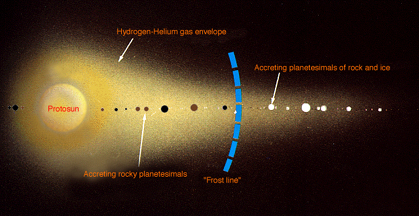
This drawing depicts a position where the formation of ice became important.
Click on image for full size
Windows Original

The position of Neptune when gas changed to ice

The position of the planets in the solar nebula greatly affected their 1. size and 2. composition. This is because of the effect of how cold it was in the nebula.

1. The nebula was a lot warmer close to the proto-sun. The blue line shown in the picture shows the point at which the temperature became cold enough for gases to become ice. At this point and further out, the materials that forming planets (proto-planets) began to extract from the cloud were ice, as well as rocky material and gas molecules. Retention of ice resulted in these proto-planets becoming giant, massive planets. (The same thing happens to raindrops when it becomes cold enough for the raindrops to become slushy snow drops, the drops are more massive). Planets which formed closer to the proto-sun were smaller, and more rocky.

Neptune was farther out in the nebula, however, where the cloud was not only becoming colder, but becoming thinner as well. This meant that there was less gas to sweep up, so proto-Neptune was not able to sweep up as much gas as the proto-Jupiter. Thus Neptune is much smaller than Jupiter.

2. Neptune (unlike Jupiter) is made of complex molecules, and not a simple molecule like hydrogen. That is because near the proto-Neptune, the temperature was so cold that even methane and ammonia, which normally would drift away, solidified into ice and were drawn to the forming planet.


Shop Windows to the Universe Science Store!

Our online store includes books on science education, ranging from evolution, classroom research, and the need for science and math literacy!

Windows to the Universe Community

News

Opportunities

You might also be interested in:

How the Solar System may have formed out of the Primordial Nebula

The solar system contracted, or shrank together, out of a spinning cloud of hydrogen and helium gas. This spinning cloud had a certain amount of momentum, which caused it to flatten, somewhat the way a...more

An Overview of Neptune's Atmospheric Evolution

Atmospheres of the giant planets have definitely evolved from their formation out of the primitive solar nebula. How much they have evolved remains to be seen, however. Because of their enormous gravity,...more

Neptune's Present Great Dark Spot

This image shows the new Great Dark Spot of Neptune, which was discovered using the Hubble Space Telescope. The image shown here, shows a "hole" in the clouds of Neptune in pink, in the northern hemisphere,...more

Neptune's Cirrus Clouds

This image shows some cirrus clouds, extending for many kilometers across the disc of Neptune. These clouds are somewhat high up, for they can be seen to cast shadows on the lower clouddeck, which is 35...more

Neptune's Smog Hazes

This image of Neptune uses false colors to bring out the hazes of smog, which can be seen in red along the limb of Neptune, at the edge of the picture. These hazes of smog are found at very high altitudes,...more

Neptune Clouds, overview

Like Jupiter and all the giant planets, Neptune's appearance shows a striped pattern of clouds. Other cloud shapes seen over time include a small dark spot, the "scooter" and the Great Dark Spot. The Great...more

Discover Neptune

If you had a quiz question in school that asked what year Neptune was discovered, you'd probably choose 1846. But Neptune wasn't discovered the way all the other planets in our solar system were. Astronomers...more

The Source of Heat from Within Neptune

In astronomy, it is a usual procedure to calculate the luminosity of a star, and this calculation indicates the energy and the temperature of the star. When the luminosity of the outer planets was calculated,...more

Shop Windows to the Universe

Arches National Park Geology Tour provides an extensive, visually rich description of the geology of Arches, by Deborah Ragland, Ph.D. See our DVD collection.

Windows to the Universe, a project of the National Earth Science Teachers Association, is sponsored in part by the National Science Foundation and NASA, our Founding Partners (the American Geophysical Union and American Geosciences Institute) as well as through Institutional, Contributing, and Affiliate Partners, individual memberships and generous donors. Thank you for your support! NASA AGU AGI NSF