Current Events

  • Irish Chronicles Document Links Between Volcanoes and Weather
    A study of over 40,000 written entries in Irish Annals and ice core measurements shows a strong corr...Read more

    x

    Irish Chronicles Document Links Between Volcanoes and Weather

    A study of over 40,000 written entries in Irish Annals and ice core measurements shows a strong correlation between the occurrence of volcanic eruptions and extreme cold weather in Ireland over a 1200 year period. Data analyzed in this study cover the period from 431 to 1649, during which time up to 48 volcanic eruptions are identified in Greenland ice core records through deposition of volcanic sulfate in annual layers of ice. You can find the study (open access), published on 6 June 2013 in IOP Publishing's journal Environmental Research Letters, at http://iopscience.iop.org/1748-9326/8/2/024035/article. Find out more about how volcanoes can influence climate.
  • EF-5 Tornado in El Reno, Oklahoma Widest Ever Recorded in US
    The EF-5 tornado that hit El Reno, Oklahoma on May 31st was the widest ever recorded in the US, acco...Read more

    x

    EF-5 Tornado in El Reno, Oklahoma Widest Ever Recorded in US

    The EF-5 tornado that hit El Reno, Oklahoma on May 31st was the widest ever recorded in the US, according to the National Weather Service in Norman Oklahoma. The tornado, which remained on the ground for 40 minutes and reached 2.6 miles across (4.2 km), took the lives of 18 people including storm chasers Tim Samaras, Paul Samaras and Carl Young. For more information on the tornado, visit http://ow.ly/i/2hfDG.
  • Atmospheric CO2 Level Tops 400 ppm
    During the week of May 13th, the CO2 level at the Mauna Loa Observatory in Hawaii topped 400 ppm rep...Read more

    x

    Atmospheric CO2 Level Tops 400 ppm

    During the week of May 13th, the CO2 level at the Mauna Loa Observatory in Hawaii topped 400 ppm repeatedly. Daily levels of CO2 can vary due to weather, and there are seasonal trends as well. The level of atmospheric greenhouse gases continues to increase, now over 120 ppm since the Industrial Revolution began. For more on the Keeling Curve, see http://keelingcurve.ucsd.edu/. Find out more about greenhouse gases and warming.
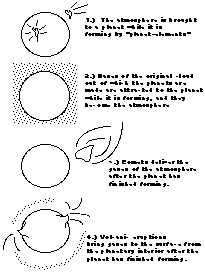
This is a schematic showing how atmospheres form.
Click on image for full size

The Origin of an Atmosphere

There are four ideas for the origin of a planetary atmosphere. Those four ideas are: 1. that the planet-elements of which a planet was made released the atmosphere, 2. that the atmosphere was drawn to the planet from the gaseous cloud out of which everything came, 3. that comets hit the planet and brought molecules of air with them, 4. that volcanoes erupted and made an atmosphere from gases inside the planet.

The one that applies to Neptune is hypothesis #2, in which the original material, which Neptune drew out of the primitive nebula stayed, and forms the atmosphere today.


Shop Windows to the Universe Science Store!

Our online store includes issues of NESTA's quarterly journal, The Earth Scientist, full of classroom activities on different topics in Earth and space science, ranging from seismology, rocks and minerals, oceanography, and Earth system science to astronomy!

Windows to the Universe Community

News

Opportunities

You might also be interested in:

How the Solar System may have formed from a spinning cloud

Scientists think that the solar system formed out of a spinning cloud of hydrogen and helium gas. Because the cloud was spinning, it flattened into a frisbee shape, just like a ball of pizza dough becomes...more

A Look at the History of Neptune's Atmosphere

The giant planets have definitely changed since their formation. But how much remains to be seen. Most of the original air of the giant planets remains in place. (The earth-like planets lost most of their...more

Neptune's Present Great Dark Spot

This image shows the new Great Dark Spot of Neptune, which was discovered using the Hubble Space Telescope. The image shown here, shows a "hole" in the clouds of Neptune in pink, in the northern hemisphere,...more

Neptune's Cirrus Clouds

This image shows some clouds known as "cirrus" clouds, extending for many kilometers across the face of Neptune. These clouds are very high up, for they can be seen to cast shadows on the lower clouds,...more

Neptune's Smog Hazes

This image of Neptune uses false colors to show where the smog is. The smog of Neptune can be seen in red along the edge of the image. These hazes of smog are found at very high altitudes, over the clouds...more

A Look at Neptune's Clouds

Like Jupiter and all the giant planets, Neptune's appearance shows a striped pattern of clouds. Other cloud shapes seen over time include a small dark spot, the "scooter" and the Great Dark Spot. The Great...more

Discover Neptune

If you had a quiz question in school that asked what year Neptune was discovered, you'd probably choose 1846. But Neptune wasn't discovered the way all the other planets in our solar system were. Astronomers...more

The Source of Heat from Within Neptune

The picture shows places on Jupiter which are hot. Jupiter is a very warm body in space, as shown in the picture, and this warmth is associated with the energy of Jupiter. Neptune has also been found to...more

Shop Windows to the Universe

Ready, Set, SCIENCE!, by the National Research Council, focuses on K-8 science classsrooms. Check out the other publications in our online store, as well as classroom materials.

Windows to the Universe, a project of the National Earth Science Teachers Association, is sponsored in part by the National Science Foundation and NASA, our Founding Partners (the American Geophysical Union and American Geosciences Institute) as well as through Institutional, Contributing, and Affiliate Partners, individual memberships and generous donors. Thank you for your support! NASA AGU AGI NSF