
Current Events

  • Atmospheric CO2 Level Tops 400 ppm
    During the week of May 13th, the CO2 level at the Mauna Loa Observatory in Hawaii topped 400 ppm rep...Read more

    x

    Atmospheric CO2 Level Tops 400 ppm

    During the week of May 13th, the CO2 level at the Mauna Loa Observatory in Hawaii topped 400 ppm repeatedly. Daily levels of CO2 can vary due to weather, and there are seasonal trends as well. The level of atmospheric greenhouse gases continues to increase, now over 120 ppm since the Industrial Revolution began. For more on the Keeling Curve, see http://keelingcurve.ucsd.edu/. Find out more about greenhouse gases and warming.
  • Massive Tornado Outbreak on Tornado Alley
    The week of May 19 brings dozens of tornadoes to Tornado Alley in the states of Oklahoma, Kansas, Io...Read more

    x

    Massive Tornado Outbreak on Tornado Alley

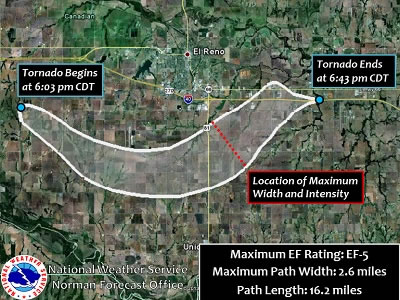
    The week of May 19 brings dozens of tornadoes to Tornado Alley in the states of Oklahoma, Kansas, Iowa, Illinois and Missouri. On May 20th, a massive tornado struck Moore, Oklahoma, devastating communities - destroying over 100 homes and hitting two elementary schools and a hospital - with many casualties and deaths. Our thoughts are with our friends and colleagues suffering from these storms. For more on the May 20th storms, see the NOAA Storm Prediction Center Storm Report.
  • Kansas Legislator Proposes Bill to Outlaw Sustainability Education
    A bill has been introduced in the Kansas legislature this week that would prohibit the promotion of ...Read more

    x

    Kansas Legislator Proposes Bill to Outlaw Sustainability Education

    A bill has been introduced in the Kansas legislature this week that would prohibit the promotion of sustainability. Here is a link to the one-page bill: http://www.kslegislature.org/li/b2013_14/measures/documents/hb2366_00_0000.pdf. See report on Bloomberg News.
On May 20, 2013, a massive EF5 <a href="http://www.windows2universe.org/earth/Atmosphere/tornado.html">tornado</a> hit Moore, Oklahoma, devastating communities and lives.  The tornado, on the ground for 40 minutes, took a path through a subdivision of homes, destroying block after block of homes, and hitting two elementary schools just as school was ending as well as a hospital. Hundreds of people were injured, and 24 were killed.<p><small><em>Image courtesy of Ks0stm, Creative Commons Attribution-Share Alike 3.0 Unported license</em></small></p>Sinkholes are <a href="/teacher_resources/main/frameworks/esl_bi8.html">natural hazards</a> in many places around the world. They are formed when water dissolves underlying <a href="/earth/Water/carbonates.html">limestone</a>, leading to collapse of the surface.  Hydrologic conditions such as a lack of rainfall, lowered water levels, or excessive rainfall can all contribute to sinkhole development. On 2/28/2013, a sinkhole suddenly developed under the house outside of Tampa, Florida, leading to the tragic death of its occupant, Jeff Bush.<p><small><em>Image courtesy of Southwest Florida Water Management District</em></small></p>This historic image is the first ever taken from a spacecraft in orbit about <a href="/mercury/mercury.html">Mercury</a>, the innermost planet of the solar system.  Taken on 3/29/2011 by <a href="/space_missions/robotic/messenger/messenger.html">MESSENGER</a>, it shows numerous craters across the <a href="/mercury/Interior_Surface/Surface/surface_overview.html">surface</a> of the planet.  Temperatures there can reach over 800°F because Mercury is so close to the Sun and rotates so slowly.  MESSENGER entered orbit around Mercury earlier in March 2011.<p><small><em>NASA/Johns Hopkins University Applied Physics Laboratory/Carnegie Institution of Washington</em></small></p>An image of Hurricane Sandy taken by the GOES-13 satellite on October 28.  This category 1 <a href="/earth/Atmosphere/hurricane/hurricane.html">hurricane</a> was huge, spanning a horizontal distance of about one-third the US continental landmass.  The storm came onshore in New Jersey, and gradually moved northeast.  The storm disrupted the lives of tens of millions in the eastern US, doing billions of dollars in damage, resulting in over 30 deaths.  Visit the National Hurricane Center's webpage on <a href="http://www.nhc.noaa.gov/">Hurricane Sandy</a> for details.<p><small><em>Image courtesy of NASA</em></small></p>The spinning vortex of <a href="https://www.windows2universe.org/saturn/saturn.html">Saturn</a>'s north polar storm resembles a giant deep red rose surrounded by green foliage in this false-color <a href="http://www.nasa.gov/mission_pages/cassini/multimedia/pia14944.html">image</a> from NASA's <a href="https://www.windows2universe.org/missions/cassini.html">Cassini spacecraft</a>. The eye is 2,000 kilometers across with cloud speeds as fast as 150 meters per second.
It is not known how long this newly discovered north-polar <a href="https://www.windows2universe.org/earth/Atmosphere/hurricane/hurricane.html">hurricane</a> has been active.
The view was acquired at a distance of approximately 419,000 kilometers from Saturn.<p><small><em>NASA/JPL-Caltech/SSI</em></small></p>A near-Earth <a href="/our_solar_system/asteroids.html">asteroid</a> - named 2012 DA14 by astronomers – passed within 17,200 miles from Earth on February 15, 2013. On closest approach at about 1:25 p.m. CST on February 15, although it was within the orbit of the <a href="/earth/moons_and_rings.html">Moon</a> and even geosynchronous <a href="/space_missions/satellites.html">satellites</a>, it didn't strike Earth!  Find out more from <a href="http://www.nasa.gov/mission_pages/asteroids/news/asteroid20130201315144.html">NASA</a>! Fragments of a meteorite hit Chelyabinsk, Russia on 2/15/2013 <a href="http://www.reuters.com/article/2013/02/15/us-russia-meteorite-idUSBRE91E05Z20130215">injuring over 500</a>. Learn about <a href="http://www.windows2universe.org/our_solar_system/meteors/meteors.html">meteors and meteorites</a>.<p><small><em>NASA/JPL-CalTech</em></small></p>

Shop Windows to the Universe

Our Glaciers: Then and Now activity kit helps you see the changes taking place in glaciers around the world. See all our activity kits and classroom activities.

Windows to the Universe, a project of the National Earth Science Teachers Association, is sponsored in part by the National Science Foundation and NASA, our Founding Partners (the American Geophysical Union and American Geosciences Institute) as well as through Institutional, Contributing, and Affiliate Partners, individual memberships and generous donors. Thank you for your support! NASA AGU AGI NSF