Current Events

  • Kansas Legislator Proposes Bill to Outlaw Sustainability Education
    A bill has been introduced in the Kansas legislature this week that would prohibit the promotion of ...Read more

    x

    Kansas Legislator Proposes Bill to Outlaw Sustainability Education

    A bill has been introduced in the Kansas legislature this week that would prohibit the promotion of sustainability. Here is a link to the one-page bill: http://www.kslegislature.org/li/b2013_14/measures/documents/hb2366_00_0000.pdf. See report on Bloomberg News.
  • Earth's Center Is 1,000 Degrees Hotter Than Previously Thought, Synchrotron X-Ray Experiment Shows
    Scientists have determined the temperature near the Earth’s center to be 6000 degrees Celsius, 1000 ...Read more

    x

    Earth's Center Is 1,000 Degrees Hotter Than Previously Thought, Synchrotron X-Ray Experiment Shows

    Scientists have determined the temperature near the Earth’s center to be 6000 degrees Celsius, 1000 degrees hotter than in a previous experiment run 20 years ago. These measurements confirm geophysical models that the temperature difference between the solid core and the mantle above, must be at least 1500 degrees to explain why the Earth has a magnetic field. For more information about this study, see the press release from the European Synchrotron Radiation Facility.
  • Ocean Volcanic Rocks Contain Samples of Recycled Crust
    Scientists have long believed that lava erupted from certain oceanic volcanoes contains materials fr...Read more

    x

    Ocean Volcanic Rocks Contain Samples of Recycled Crust

    Scientists have long believed that lava erupted from certain oceanic volcanoes contains materials from the early Earth’s crust. But decisive evidence for this phenomenon has proven elusive. New research from a team including Carnegie’s Erik Hauri demonstrates that oceanic volcanic rocks contain samples of recycled crust dating back to the Archean era 2.5 billion years ago. Their work is published in Nature. Oceanic crust sinks into the Earth’s mantle at so-called subduction zones, where two plates come together. Much of what happens to the crust during this journey is unknown. Model-dependent studies for how long subducted material can exist in the mantle are uncertain and evidence of very old crust returning to Earth’s surface via upwellings of magma has not been found until now. For more information about these results, see the press release from the Carnegie Institution.
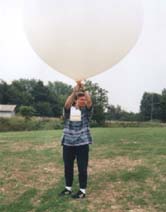
A scientist prepares to launch a balloon with an ozonesonde and radiosonde attached. The dual instruments will collect ozone and weather information at heights up to 115,000 feet (35 km).
Click on image for full size
Source: MILAGRO Image File

People Involved in MILAGRO

More than 300 scientists from over 60 universities and research institutions in the United States, Mexico, and several other nations participated in the MILAGRO field campaign. The focus of the fieldwork was air pollution in Mexico City, one of the world’s largest cities with a population of 22 million people. Teachers were also involved in the project and shared their field science experience through Postcards from the Field.

The scientists’ roles are many and varied during field campaigns. So, too, are the tools and instruments that are used. The MILAGRO campaign was actually composed of four large science projects, each with many groups of scientists responsible for specific areas of research. Together, their work aimed at broading our knowledge of the transport and life cycle of air pollution.

Before the actual field campaign began, the various project scientists worked together to design, organize, and prepare for their mission for nearly two years to ensure that all of MILAGRO’s science objectives would be met. Similarly, their work now continues long after the field campaign is over. The scientists must review and process the data collected to determine what has been learned.

The best way to learn about the people involved in science field work, however, is from the scientists themselves and from the teachers working side-by-side with them. The links below will introduce you to a handful of MILAGRO scientists and teachers. Through their stories, we hope to bring science to life and illustrate the important being done in the area of air quality.


Teachers' and Scientists' Postcards from the Field

Scientists

Dr. Chris Cantrell

David Greenberg

Dr. Barry Lefer

Dr. Judy Lloyd

Robert Long

Oscar Peralta

Dr. Dara Salcedo

Teachers

Catalina Everaert

Alison Lehnherr-George

Last modified August 7, 2006 by Teri Eastburn.

Shop Windows to the Universe Science Store!

Learn about Earth and space science, and have fun while doing it! The games section of our online store includes a climate change card game and the Traveling Nitrogen game!

Windows to the Universe Community

News

Opportunities

You might also be interested in:

Cool It! Game

Check out our online store - minerals, fossils, books, activities, jewelry, and household items!...more

Air Pollution

What do smog, acid rain, carbon monoxide, fossil fuel exhausts, and tropospheric ozone have in common? They are all examples of air pollution. Air pollution is not new. As far back as the 13 th century,...more

David Greenberg

Hi, my name is David Greenberg and I'm the Director of Technology for the Mohawk Trail Regional School District in western Massachusetts. I've been helping teachers use computers in their classrooms for...more

Judy Lloyd

I am a professor at SUNY Old Westbury, a small public college located 30 miles from New York City. I have been teaching chemistry here for over 25 years, and have an active research program involving undergraduate...more

Robert Long

Hi everyone! Throughout high school and college, my main interest was in the weather while my favorite science course was chemistry. I combined the two in graduate school when I entered the Meteorology...more

Dr. Dara Salcedo

I am originally from Mexico City were I grew up and eventually got my Bachelor's degree in Chemistry. When I started college, I had many questions about molecules, reactions, colors, substances, and I...more

Introduction to Milagro

MILAGRO stands for Megacity Initiative: Local and Global Research Observations. What that really means is that a team of researchers from around the world is in Mexico City to study the atmosphere there....more

Megacities

Mexico City, where the field campaign MILAGRO takes place, is a "megacity." A megacity is defined as having 10 million or more inhabitants. The 21st century is definitely shaping up to be the Urban Century....more

Shop Windows to the Universe

Check out the fun Earth science related bumper stickers in our online store! Express yourself!

Windows to the Universe, a project of the National Earth Science Teachers Association, is sponsored in part by the National Science Foundation and NASA, our Founding Partners (the American Geophysical Union and American Geosciences Institute) as well as through Institutional, Contributing, and Affiliate Partners, individual memberships and generous donors. Thank you for your support! NASA AGU AGI NSF