Mercury's Web
These are links to other great web sites about Mercury. But beware: you don't want to get caught in Mercury's Web! Don't stay away from Windows to the Universe for long!

 Mariner 10 JPL has a page about the Mariner 10 spacecraft.
Mercury General information about Mercury.
MESSENGER The mission to Mercury.
More Mercury Another site about this tiny planet.
National Space Science Data Center Mercury Page The name says it all!
Nine Planets: Mercury This great web site has a nice page on Mercury.
NSSDC Master Catalog Display: Spacecraft More on the Mariner 10 spacecraft.
 NSSDC Photo Gallery Mercury Plenty of images of Mercury!
You might also be interested in:
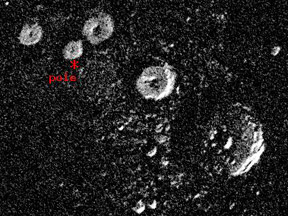
Some planets are tilted so their North and South Poles are not straight up and down. Earth is tilted a bit - about 23°. Uranus is tilted a lot - more than 90°. Mercury, on the other hand, is hardly tilted
...more
Mercury has a magnetic field. Its field is weak. Earth's magnetic field is tilted, and so is Mercury's. That means Mercury's magnetic poles are not in the same place as its geographic poles. Mercury has
...more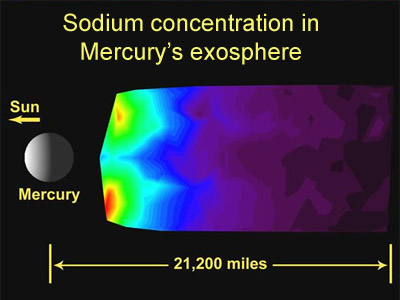
Mercury has almost no atmosphere. The planet's small size means that its gravity is too weak to hold down a normal atmosphere. There is a very thin atmosphere around the planet. Mercury's thin atmosphere
...more Mercury is the only inner planet other than the Earth that has a significant magnetic field (220 nT). This field, along with the planet's high density and small size relative to the Earth, indicates that
...more