This is a false color image of a mosaic of Mercury.
Click on image for full size
Courtesy of NASA.
Related links:
Space Missions
Discover Mercury
Mercury's orbit is so close to the Sun that it is difficult to see from
the ground. This
explains why some early astronomers
never saw the planet. Viewed from Earth, Mercury is never far from
the Sun in the sky. Because of the glare of the Sun, it can only be
seen in twilight.
Timocharis made the first recorded observation of
Mercury in 265 BC. Other early astronomers that studied Mercury
include Zupus (1639), who studied the planet's orbit. Because it
is so difficult to make out features on the surface of the planet
from Earth, it was not until the 1960s that scientists determined the
correct day length rate (59 Earth days) of the planet on its axis.
This also showed that Mercury's day length and year length
are the same.
The one and only space mission to visit
Mercury was
Mariner 10,
which passed by the planet three times in 1974. Images taken by
Mariner 10 are the only close up images we have of the planet's
surface. NASA will send the Messenger (the Mercury Surface, Space Environment, Geochemistry and Ranging) to Mercury in 2004.
You might also be interested in:

How did life evolve on Earth? The answer to this question can help us understand our past and prepare for our future. Although evolution provides credible and reliable answers, polls show that many people turn away from science, seeking other explanations with which they are more comfortable.
...more
Before the Mariner 10 mission of Mercury, it was very difficult to see any markings on the surface of the planet from Earth. This image shows a view of Mercury obtained from a telescope on Earth. The
...more
The Mariner 10 mission (USA) to Mercury was launched on November 3, 1973 and arrived at Mercury on March 29, 1974. The spacecraft made three separate passes by the planet, and obtained about 10,000 images
...more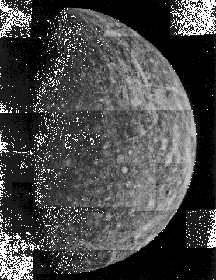
NASA has chosen the next two projects that will join a special series called the Discovery Program. This program specializes in low cost, scientific projects. Out of 26 possible projects, Messenger (the
...more
It takes Mercury about 59 Earth days to spin once on its axis (the rotation period), and about 88 Earth days to complete one orbit about the Sun. However, the length of the day on Mercury (sunrise to
...more Mercury's orbit is so close to the Sun that it is difficult to see from the ground. This explains why some early astronomers never saw the planet. Viewed from Earth, Mercury is never far from the Sun
...more Mercury, like the other planets, is believed to have formed in the earliest stage of the evolution of the solar system as dust came together to form even larger clumps and eventually small planets or
...more Mercury, the innermost planet of the solar system, is a little bigger than the Earth's Moon. The surface of the planet is covered with craters, like the Moon, but temperatures there can reach over 80
...more