Current Events

  • Atmospheric CO2 Level Tops 400 ppm
    During the week of May 13th, the CO2 level at the Mauna Loa Observatory in Hawaii topped 400 ppm rep...Read more

    x

    Atmospheric CO2 Level Tops 400 ppm

    During the week of May 13th, the CO2 level at the Mauna Loa Observatory in Hawaii topped 400 ppm repeatedly. Daily levels of CO2 can vary due to weather, and there are seasonal trends as well. The level of atmospheric greenhouse gases continues to increase, now over 120 ppm since the Industrial Revolution began. For more on the Keeling Curve, see http://keelingcurve.ucsd.edu/. Find out more about greenhouse gases and warming.
  • Massive Tornado Outbreak on Tornado Alley
    The week of May 19 brings dozens of tornadoes to Tornado Alley in the states of Oklahoma, Kansas, Io...Read more

    x

    Massive Tornado Outbreak on Tornado Alley

    The week of May 19 brings dozens of tornadoes to Tornado Alley in the states of Oklahoma, Kansas, Iowa, Illinois and Missouri. On May 20th, a massive tornado struck Moore, Oklahoma, devastating communities - destroying over 100 homes and hitting two elementary schools and a hospital - with many casualties and deaths. Our thoughts are with our friends and colleagues suffering from these storms. For more on the May 20th storms, see the NOAA Storm Prediction Center Storm Report.
  • Kansas Legislator Proposes Bill to Outlaw Sustainability Education
    A bill has been introduced in the Kansas legislature this week that would prohibit the promotion of ...Read more

    x

    Kansas Legislator Proposes Bill to Outlaw Sustainability Education

    A bill has been introduced in the Kansas legislature this week that would prohibit the promotion of sustainability. Here is a link to the one-page bill: http://www.kslegislature.org/li/b2013_14/measures/documents/hb2366_00_0000.pdf. See report on Bloomberg News.
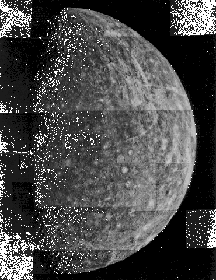
This is a false color image of a mosaic of Mercury.
Click on image for full size
Courtesy of NASA.

Mercury's Interior and Surface

Mercury, the innermost planet of the solar system, is a little bigger than the Earth's Moon. The surface of the planet is covered with craters, like the Moon, but temperatures there can reach over 800oF because Mercury is so close to the Sun and rotates so slowly. Scientists believe that the interior structure of Mercury includes a metallic core, an intermediate rocky layer, and a thin brittle crust. The composition of Mercury is probably high in iron, although surface features indicate that volcanic activity once existed at the surface. There is little evidence of motions near the surface of the planet now, although at earlier times during Mercury's evolution the surface was much more active. We know relatively little about Mercury, compared to most of the other planets, because it is relatively difficult to see and only one spacecraft has studied the planet.


Last modified August 11, 2010 by Randy Russell.

Shop Windows to the Universe Science Store!

Our online store includes books on science education, ranging from evolution, classroom research, and the need for science and math literacy!

Windows to the Universe Community

News

Opportunities

You might also be interested in:

Science, Evolution, and Creationism

How did life evolve on Earth? The answer to this question can help us understand our past and prepare for our future. Although evolution provides credible and reliable answers, polls show that many people turn away from science, seeking other explanations with which they are more comfortable....more

Surface of Mercury

Images of the surface of Mercury obtained by Mariner 10 showed a planet covered with craters, looking very much like the Earth's Moon. During its three passes by the planet, Mariner 10 took pictures of...more

Structure of Mercury's Interior

Mercury has a radius of 2439 km (1524 mi), and the metallic iron-nickel core is believed to make up about 75% of this distance. Measurements of the planet's magnetic field made by Mariner 10 as it flew...more

Surface Features of Mercury

The surface of Mercury has numerous interesting features, including a variety of craters, ridges, and terrains ranging from heavily cratered to nearly crater free. These features, and their location across...more

Evolution of Mercury

Mercury, like the other planets, is believed to have formed in the earliest stage of the evolution of the solar system as dust came together to form even larger clumps and eventually small planets or...more

Mariner 10 Mission to Mercury

The Mariner 10 mission (USA) to Mercury was launched on November 3, 1973 and arrived at Mercury on March 29, 1974. The spacecraft made three separate passes by the planet, and obtained about 10,000 images...more

Mercury's Interior and Surface

Mercury, the innermost planet of the solar system, is a little bigger than the Earth's Moon. The surface of the planet is covered with craters, like the Moon, but temperatures there can reach over 80...more

The Caloris Basin

The Caloris Basin is the largest feature on the surface of Mercury. This crater was formed by the impact of a large meteorite in the early formation of the solar system. We only know what half of the...more

Shop Windows to the Universe

The Universe at Your Fingertips 2.0 DVD from the Astronomical Society of the Pacific is in our online store, filled with Earth and space science resources.

Windows to the Universe, a project of the National Earth Science Teachers Association, is sponsored in part by the National Science Foundation and NASA, our Founding Partners (the American Geophysical Union and American Geosciences Institute) as well as through Institutional, Contributing, and Affiliate Partners, individual memberships and generous donors. Thank you for your support! NASA AGU AGI NSF