Current Events

  • Irish Chronicles Document Links Between Volcanoes and Weather
    A study of over 40,000 written entries in Irish Annals and ice core measurements shows a strong corr...Read more

    x

    Irish Chronicles Document Links Between Volcanoes and Weather

    A study of over 40,000 written entries in Irish Annals and ice core measurements shows a strong correlation between the occurrence of volcanic eruptions and extreme cold weather in Ireland over a 1200 year period. Data analyzed in this study cover the period from 431 to 1649, during which time up to 48 volcanic eruptions are identified in Greenland ice core records through deposition of volcanic sulfate in annual layers of ice. You can find the study (open access), published on 6 June 2013 in IOP Publishing's journal Environmental Research Letters, at http://iopscience.iop.org/1748-9326/8/2/024035/article. Find out more about how volcanoes can influence climate.
  • EF-5 Tornado in El Reno, Oklahoma Widest Ever Recorded in US
    The EF-5 tornado that hit El Reno, Oklahoma on May 31st was the widest ever recorded in the US, acco...Read more

    x

    EF-5 Tornado in El Reno, Oklahoma Widest Ever Recorded in US

    The EF-5 tornado that hit El Reno, Oklahoma on May 31st was the widest ever recorded in the US, according to the National Weather Service in Norman Oklahoma. The tornado, which remained on the ground for 40 minutes and reached 2.6 miles across (4.2 km), took the lives of 18 people including storm chasers Tim Samaras, Paul Samaras and Carl Young. For more information on the tornado, visit http://ow.ly/i/2hfDG.
  • Atmospheric CO2 Level Tops 400 ppm
    During the week of May 13th, the CO2 level at the Mauna Loa Observatory in Hawaii topped 400 ppm rep...Read more

    x

    Atmospheric CO2 Level Tops 400 ppm

    During the week of May 13th, the CO2 level at the Mauna Loa Observatory in Hawaii topped 400 ppm repeatedly. Daily levels of CO2 can vary due to weather, and there are seasonal trends as well. The level of atmospheric greenhouse gases continues to increase, now over 120 ppm since the Industrial Revolution began. For more on the Keeling Curve, see http://keelingcurve.ucsd.edu/. Find out more about greenhouse gases and warming.
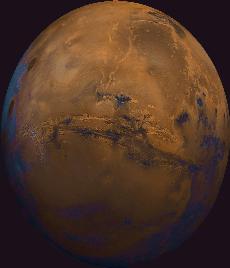
Valles Marineris, the grand valley of Mars named after the Mariner program which first took close-up images.
Click on image for full size
Image from: USGS

Valles Marineris

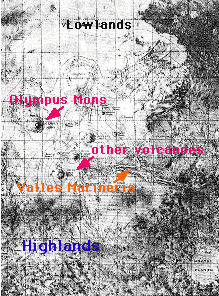
Next to the Tharsis Ridge is Valles Marineris, a very long canyon of Mars.

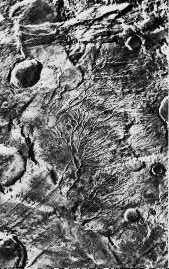
As can be seen in the image, many huge ancient rivers extend toward the top of the image. The three Tharsis volcanoes (dark red spots) are visible on the leftmost edge of the image. To the south are the highlands; very ancient ground, covered by many craters.

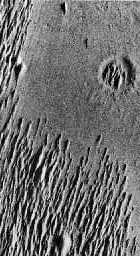
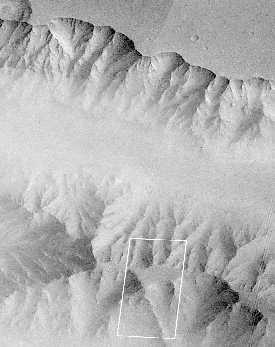
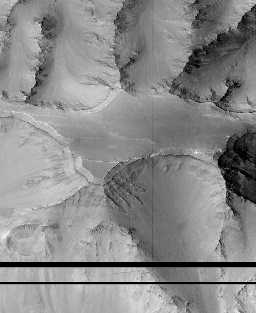
Better images returned by the Mars Global Surveyor spacecraft allow a closer look of this unusual canyon. These images show slopes descending steeply to the north and south in broad, debris-filled gullies. These gullies look a lot like canyons on Earth.

Shop Windows to the Universe Science Store!

Our online store includes issues of NESTA's quarterly journal, The Earth Scientist, full of classroom activities on different topics in Earth and space science, as well as books on science education!

Windows to the Universe Community

News

Opportunities

You might also be interested in:

Science, Evolution, and Creationism

How did life evolve on Earth? The answer to this question can help us understand our past and prepare for our future. Although evolution provides credible and reliable answers, polls show that many people turn away from science, seeking other explanations with which they are more comfortable....more

The Tharsis Ridge

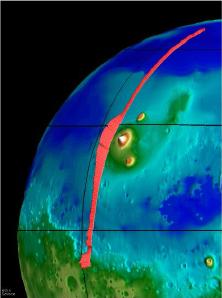
This image, taken from the Mars Global Surveyor mission (MGS), shows the Tharsis Ridge, the green/blue area in the middle of the picture, as well as a portion of the southern hemisphere of Mars. The green...more

Martian Water

Mars doesn't seem to have very much water. If Mars had lots of water life could survive there. There seems to be *some* water because clouds, fog, and icy polar caps are seen on Mars today. There are also...more

Martian Global Geography

The surface of Mars can be broken into two parts, the highlands and lowlands. The highlands are in the southern hemisphere (the bottom of the picture). The lowlands are in the northern hemisphere of Mars...more

What causes a Planet's surface to change?

Over the course of time there are many things which can cause the surface of a planet to change its appearance. winds slowly wear away the surface. weather & water, which cause a planet's surface to be...more

Martian Cratered Terrain

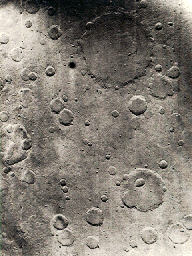
This is an example of the cratered surface of Mars. Almost all of the surface of Mars is covered with craters. Craters can be wiped out over time, so a surface which has many craters is very old. The lowlands...more

An Overview of the Mars Global Surveyor Mission

The mission of Mars Global Surveyor (MGS for short) is to map the surface of Mars from space. MGS is also looking at the atmosphere of Mars and the weather of Mars. MGS and the Mars Pathfinder (MPF for...more

Gullies of Valles Marineris

This view of Valles Marineris shows debris-filled gullies very much like canyons on Earth. The layered rocks seen in these images indicates that there may have been a complicated and active early history...more

Shop Windows to the Universe

Earth Science Rocks! Select one of our four cool NESTA t-shirts from our online store, and express your love of Earth and space science!

Windows to the Universe, a project of the National Earth Science Teachers Association, is sponsored in part by the National Science Foundation and NASA, our Founding Partners (the American Geophysical Union and American Geosciences Institute) as well as through Institutional, Contributing, and Affiliate Partners, individual memberships and generous donors. Thank you for your support! NASA AGU AGI NSF