Current Events

  • Irish Chronicles Document Links Between Volcanoes and Weather
    A study of over 40,000 written entries in Irish Annals and ice core measurements shows a strong corr...Read more

    x

    Irish Chronicles Document Links Between Volcanoes and Weather

    A study of over 40,000 written entries in Irish Annals and ice core measurements shows a strong correlation between the occurrence of volcanic eruptions and extreme cold weather in Ireland over a 1200 year period. Data analyzed in this study cover the period from 431 to 1649, during which time up to 48 volcanic eruptions are identified in Greenland ice core records through deposition of volcanic sulfate in annual layers of ice. You can find the study (open access), published on 6 June 2013 in IOP Publishing's journal Environmental Research Letters, at http://iopscience.iop.org/1748-9326/8/2/024035/article. Find out more about how volcanoes can influence climate.
  • EF-5 Tornado in El Reno, Oklahoma Widest Ever Recorded in US
    The EF-5 tornado that hit El Reno, Oklahoma on May 31st was the widest ever recorded in the US, acco...Read more

    x

    EF-5 Tornado in El Reno, Oklahoma Widest Ever Recorded in US

    The EF-5 tornado that hit El Reno, Oklahoma on May 31st was the widest ever recorded in the US, according to the National Weather Service in Norman Oklahoma. The tornado, which remained on the ground for 40 minutes and reached 2.6 miles across (4.2 km), took the lives of 18 people including storm chasers Tim Samaras, Paul Samaras and Carl Young. For more information on the tornado, visit http://ow.ly/i/2hfDG.
  • Atmospheric CO2 Level Tops 400 ppm
    During the week of May 13th, the CO2 level at the Mauna Loa Observatory in Hawaii topped 400 ppm rep...Read more

    x

    Atmospheric CO2 Level Tops 400 ppm

    During the week of May 13th, the CO2 level at the Mauna Loa Observatory in Hawaii topped 400 ppm repeatedly. Daily levels of CO2 can vary due to weather, and there are seasonal trends as well. The level of atmospheric greenhouse gases continues to increase, now over 120 ppm since the Industrial Revolution began. For more on the Keeling Curve, see http://keelingcurve.ucsd.edu/. Find out more about greenhouse gases and warming.
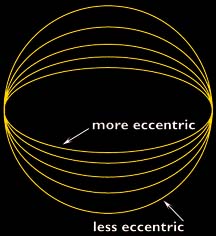
This drawing illustrates "eccentricity".
Click on image for full size

Martian Orbital Eccentricity

The Martian climate is more influenced by the shape of the Martian orbit than the climate of the Earth is influenced by the shape of the Earth's orbit. The orbit of Mars is more oval-shaped than that of the Earth. The difference between the oval shape of the Martian orbit and a perfect circle is called the *eccentricity* of the orbit.

Because the Martian orbit has large differences in the distance from the sun, the surface of Mars can experience larger changes in temperature than does the Earth.

Changes in the inclination of the axis of revolution of Mars is also much more extreme than that of the Earth. This means that differences between summer and winter of Mars can be more extreme than on Earth.

The high eccentricity of the Martian orbit, combined with the high inclination of the axis of revolution, means that, if conditions are just right, there are times when Mars can experience a great deal more warming than normal. These extremes in the warming of the surface of Mars means that Mars has more potential for climate change brought about by orbit conditions than does the Earth.

Shop Windows to the Universe Science Store!

Our online store includes books on science education, ranging from evolution, classroom research, and the need for science and math literacy!

Windows to the Universe Community

News

Opportunities

You might also be interested in:

Exploratour - The Atmosphere of Mars

We have presented the fact that the atmosphere of Mars has very little water vapor so clouds don't form very easily. And we looked at the temperature, the fact that it is very cold almost everywhere in...more

Mars Opposition in August 2003

On August 27, 2003, Earth and Mars will be closer together than they have been in thousands of years. Mars will pass within 55,758,006 kilometers (34,646,418 miles) from Earth. Astronomers have calculated...more

Mars Opposition on October 30, 2005

The planet Mars is closer to Earth than normal right now. On October 30, 2005, the two planets will be very close to each other. They will be about 69 million km (43 million miles) apart. Mars will look...more

Martian Volcanoes

On this map of Mars, the lightly cratered Tharsis Ridge is shown, as well as the heavily cratered Martian highlands (near the bottom of the picture), and Valles Marineris to the right. The volcanoes are...more

The Transfer of Water in Martian History

On Mars, the water is trapped, frozen, within the ground. Nevertheless, there is evidence for running water on Mars. When the water is melted and released to the surface, it will run from higher ground...more

The Martian Cryosphere

The drawing shows a crossection of the crust, and the unusual altitude variation of the Martian surface. The figure illustrates the depth of frozen ground at various latitudes, called the cryosphere. The...more

Martian Floods

Separate from the Martian outflow channels, or the river valley networks, are large Martian lakes (600 km, or ~1000 miles across) which exhibit evidence of a periodic and catastrophic release of water...more

Martian Fog

This is an image of fog in a Martian canyon. The presence of fog provides evidence of water, and a water cycle on Mars. More fog has been seen in images returned by Mars Global Surveyor of the south polar...more

Shop Windows to the Universe

Dig into Montana Before History: 11K Years of Hunter-Gatherers in the Rockies and Plains by D. H. MacDonald, Ph.D. See our online store book collection.

Windows to the Universe, a project of the National Earth Science Teachers Association, is sponsored in part by the National Science Foundation and NASA, our Founding Partners (the American Geophysical Union and American Geosciences Institute) as well as through Institutional, Contributing, and Affiliate Partners, individual memberships and generous donors. Thank you for your support! NASA AGU AGI NSF