Current Events

  • Irish Chronicles Document Links Between Volcanoes and Weather
    A study of over 40,000 written entries in Irish Annals and ice core measurements shows a strong corr...Read more

    x

    Irish Chronicles Document Links Between Volcanoes and Weather

    A study of over 40,000 written entries in Irish Annals and ice core measurements shows a strong correlation between the occurrence of volcanic eruptions and extreme cold weather in Ireland over a 1200 year period. Data analyzed in this study cover the period from 431 to 1649, during which time up to 48 volcanic eruptions are identified in Greenland ice core records through deposition of volcanic sulfate in annual layers of ice. You can find the study (open access), published on 6 June 2013 in IOP Publishing's journal Environmental Research Letters, at http://iopscience.iop.org/1748-9326/8/2/024035/article. Find out more about how volcanoes can influence climate.
  • EF-5 Tornado in El Reno, Oklahoma Widest Ever Recorded in US
    The EF-5 tornado that hit El Reno, Oklahoma on May 31st was the widest ever recorded in the US, acco...Read more

    x

    EF-5 Tornado in El Reno, Oklahoma Widest Ever Recorded in US

    The EF-5 tornado that hit El Reno, Oklahoma on May 31st was the widest ever recorded in the US, according to the National Weather Service in Norman Oklahoma. The tornado, which remained on the ground for 40 minutes and reached 2.6 miles across (4.2 km), took the lives of 18 people including storm chasers Tim Samaras, Paul Samaras and Carl Young. For more information on the tornado, visit http://ow.ly/i/2hfDG.
  • Atmospheric CO2 Level Tops 400 ppm
    During the week of May 13th, the CO2 level at the Mauna Loa Observatory in Hawaii topped 400 ppm rep...Read more

    x

    Atmospheric CO2 Level Tops 400 ppm

    During the week of May 13th, the CO2 level at the Mauna Loa Observatory in Hawaii topped 400 ppm repeatedly. Daily levels of CO2 can vary due to weather, and there are seasonal trends as well. The level of atmospheric greenhouse gases continues to increase, now over 120 ppm since the Industrial Revolution began. For more on the Keeling Curve, see http://keelingcurve.ucsd.edu/. Find out more about greenhouse gases and warming.
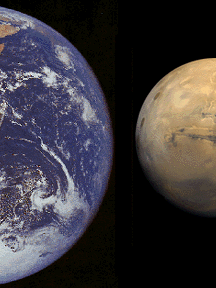
This image shows the Earth and Mars
NASA

An Overview of the History of Mars

This is probably what happened to Mars:

  • an early warm period
  • the inside of Mars cools off very fast
  • volcanoes appeared, and the Tharsis Bulge is created
  • changes in climate every once and awhile, which affect the way in which the frozen water of Mars comes to the surface.
The changes in climate may persist to the present day, but the rest of the history of Mars was finished 3.5 Billion Years ago.

The reason that the history of Mars is this way has to do with the fact that Mars is small, and the fact that Mars is farther from the sun that either the Earth or Venus. Some scientists call this the "Goldilocks" phenomenon.

Shop Windows to the Universe Science Store!

Our online store includes books on science education, classroom activities in The Earth Scientist, mineral and fossil specimens, and educational games!

Windows to the Universe Community

News

Opportunities

You might also be interested in:

Ready, Set, SCIENCE!: Putting Research to Work in K-8 Science Classrooms

What types of instructional experiences help K-8 students learn science with understanding? What do science educators teachers, teacher leaders, science specialists, professional development staff, curriculum designers, school administrators need to know to create and support such experiences?...more

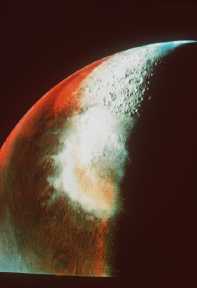
The Earliest History of Mars

The terrestrial planets formed about 4 Billion Years ago. As the process which formed them came to an end, the planets may have been left in either of the following two states: very warm, with a softer...more

The Cooling of Mars

Mars is small. Mars is about 1/3 the size of the Earth. This means that it cooled off very fast. Mars probably started colder than the other earth-like planets. Then, Mars cooled rapidly from the outside,...more

Exciting News from the Red Planet!

The Mars Global Surveyor (MGS) was launched on November 7, 1996. It has been in orbit around Mars for over 1500 days. It may have made its greatest observation this month! Pictures taken by the camera...more

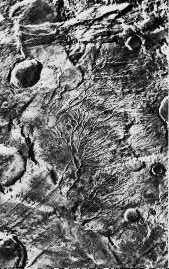
Martian Water

There seems to be no running water on the surface of Mars today even though there is evidence for running water, including river channels such as those shown here, and there are frozen, icy polar caps....more

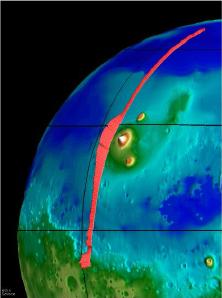
The Tharsis Ridge

This image, taken from the Mars Global Surveyor mission (MGS), shows the Tharsis Ridge, the green/blue area in the middle of the picture, as well as a portion of the southern hemisphere of Mars. The green...more

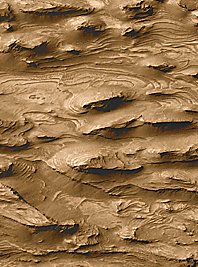
Steep slopes of Valles Marineris

High resolution images returned by the Mars Global Surveyor spacecraft allow closer examination of this unusual canyon. As shown here, slopes seem to descend steeply to the north and south in broad, debris-filled...more

Gullies of Valles Marineris

This view of Valles Marineris shows debris-filled gullies with intervening rocky spurs, reminiscent of terrestrial canyons. Layered rocks on Earth form from sedimentary processes (such as those that formed...more

Shop Windows to the Universe

Hands On Mineral Identification helps you to identify over 14,500 minerals! By M. Darby Dyar, Ph.D. See our DVD collection.

Windows to the Universe, a project of the National Earth Science Teachers Association, is sponsored in part by the National Science Foundation and NASA, our Founding Partners (the American Geophysical Union and American Geosciences Institute) as well as through Institutional, Contributing, and Affiliate Partners, individual memberships and generous donors. Thank you for your support! NASA AGU AGI NSF