Current Events

  • Kansas Legislator Proposes Bill to Outlaw Sustainability Education
    A bill has been introduced in the Kansas legislature this week that would prohibit the promotion of ...Read more

    x

    Kansas Legislator Proposes Bill to Outlaw Sustainability Education

    A bill has been introduced in the Kansas legislature this week that would prohibit the promotion of sustainability. Here is a link to the one-page bill: http://www.kslegislature.org/li/b2013_14/measures/documents/hb2366_00_0000.pdf. See report on Bloomberg News.
  • Earth's Center Is 1,000 Degrees Hotter Than Previously Thought, Synchrotron X-Ray Experiment Shows
    Scientists have determined the temperature near the Earth’s center to be 6000 degrees Celsius, 1000 ...Read more

    x

    Earth's Center Is 1,000 Degrees Hotter Than Previously Thought, Synchrotron X-Ray Experiment Shows

    Scientists have determined the temperature near the Earth’s center to be 6000 degrees Celsius, 1000 degrees hotter than in a previous experiment run 20 years ago. These measurements confirm geophysical models that the temperature difference between the solid core and the mantle above, must be at least 1500 degrees to explain why the Earth has a magnetic field. For more information about this study, see the press release from the European Synchrotron Radiation Facility.
  • Ocean Volcanic Rocks Contain Samples of Recycled Crust
    Scientists have long believed that lava erupted from certain oceanic volcanoes contains materials fr...Read more

    x

    Ocean Volcanic Rocks Contain Samples of Recycled Crust

    Scientists have long believed that lava erupted from certain oceanic volcanoes contains materials from the early Earth’s crust. But decisive evidence for this phenomenon has proven elusive. New research from a team including Carnegie’s Erik Hauri demonstrates that oceanic volcanic rocks contain samples of recycled crust dating back to the Archean era 2.5 billion years ago. Their work is published in Nature. Oceanic crust sinks into the Earth’s mantle at so-called subduction zones, where two plates come together. Much of what happens to the crust during this journey is unknown. Model-dependent studies for how long subducted material can exist in the mantle are uncertain and evidence of very old crust returning to Earth’s surface via upwellings of magma has not been found until now. For more information about these results, see the press release from the Carnegie Institution.
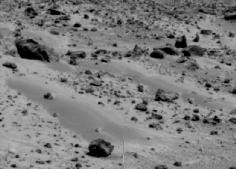
This image shows the rock called "Souffle".
Click on image for full size
Image from: NASA/JPL

Martian Weathering by Wind and Sand

Dried debris left after a flood is "wind mobile" and can be lifted into the air by winds. The general process by which this occurs is called "saltation". Saltation is the primary form of abrasion and erosion of the Martian surface. Saltation is carried to an extreme during the frequent Martian global dust storms.

Features found in and near the rocks by the Mars Pathfinder lander provide evidence for both sandblasting and saltation on the Martian surface. The rock shown here, dubbed "Souffle", is surrounded by wind drifts as well as showing evidence of pits and holes formed in the rock by sand erosion.

The power of particles for abrasive action depends upon how many particles are available, their size, and the angle of attack. On Mars the winds accelerate to higher speeds than on Earth so that the sand grains are accelerated to higher speeds as well, and for a greater length of time. This leads to a different angle of impact of sand grains on rocks and affects the gouging and chipping power of sandblasting winds. This makes the erosion of Martian rock a little different than on Earth.


Shop Windows to the Universe Science Store!

Our online store includes books on science education, classroom activities in The Earth Scientist, mineral and fossil specimens, and educational games!

Windows to the Universe Community

News

Opportunities

You might also be interested in:

Traveling Nitrogen Classroom Activity Kit

Check out our online store - minerals, fossils, books, activities, jewelry, and household items!...more

An Overview of the Mars Pathfinder Mission

The goal of the Mars Pathfinder (MPF) mission was to analyze the rocks and soil of Mars. The MPF was actually 2 parts, a lander and a rover. The lander stayed right where it landed while the rover named...more

Pits and Holes in rocks of Mars

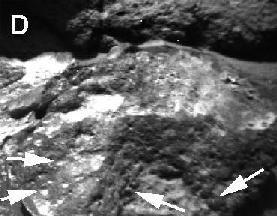
This image shows pits and holes (ventifacts) in a small rock found by the Mars Pathfinder Rover. These ventifacts are artifacts of weathering on Mars and were created by wind erosion. The Souffle rock...more

Martian Sand

Sand grains on Earth are usually made of quartz. Sand grains of Mars seem to come from basalt. They seem to be particles which are cemented together, rather than round crystal fragments such as sand grains...more

Mars Odyssey

The Mars Odyssey was launched April 7, 2001, from Florida. After a six-month, 285 million-mile journey, the Odyssey arrived at Mars on October 24, 2001. The Odyssey is in its aerobraking phase right now....more

Mars 2005

The Mars 2005 mission is still in the planning stages. It is set to launch in the year 2005. ...more
Aerobraking

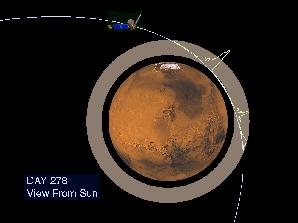
The Mars Global Surveyor reached Mars in September of 1997. But it didn't make it into its final mapping orbit until February 1999. What took so long? Surveyor needed to reach a near-circular, low-altitude...more

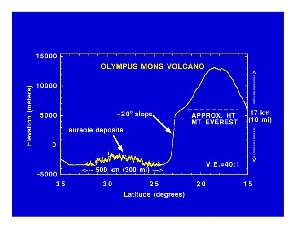
Mars Global Surveyor Measures Olympus Mons

Mars Global Surveyor carries an instrument which measures the heights of things. This instrument is called an altimeter, or "altitude-meter". The graph to the left shows the results returned from Mars...more

Shop Windows to the Universe

Ready, Set, SCIENCE!, by the National Research Council, focuses on K-8 science classsrooms. Check out the other publications in our online store, as well as classroom materials.

Windows to the Universe, a project of the National Earth Science Teachers Association, is sponsored in part by the National Science Foundation and NASA, our Founding Partners (the American Geophysical Union and American Geosciences Institute) as well as through Institutional, Contributing, and Affiliate Partners, individual memberships and generous donors. Thank you for your support! NASA AGU AGI NSF