Current Events

  • Irish Chronicles Document Links Between Volcanoes and Weather
    A study of over 40,000 written entries in Irish Annals and ice core measurements shows a strong corr...Read more

    x

    Irish Chronicles Document Links Between Volcanoes and Weather

    A study of over 40,000 written entries in Irish Annals and ice core measurements shows a strong correlation between the occurrence of volcanic eruptions and extreme cold weather in Ireland over a 1200 year period. Data analyzed in this study cover the period from 431 to 1649, during which time up to 48 volcanic eruptions are identified in Greenland ice core records through deposition of volcanic sulfate in annual layers of ice. You can find the study (open access), published on 6 June 2013 in IOP Publishing's journal Environmental Research Letters, at http://iopscience.iop.org/1748-9326/8/2/024035/article. Find out more about how volcanoes can influence climate.
  • EF-5 Tornado in El Reno, Oklahoma Widest Ever Recorded in US
    The EF-5 tornado that hit El Reno, Oklahoma on May 31st was the widest ever recorded in the US, acco...Read more

    x

    EF-5 Tornado in El Reno, Oklahoma Widest Ever Recorded in US

    The EF-5 tornado that hit El Reno, Oklahoma on May 31st was the widest ever recorded in the US, according to the National Weather Service in Norman Oklahoma. The tornado, which remained on the ground for 40 minutes and reached 2.6 miles across (4.2 km), took the lives of 18 people including storm chasers Tim Samaras, Paul Samaras and Carl Young. For more information on the tornado, visit http://ow.ly/i/2hfDG.
  • Atmospheric CO2 Level Tops 400 ppm
    During the week of May 13th, the CO2 level at the Mauna Loa Observatory in Hawaii topped 400 ppm rep...Read more

    x

    Atmospheric CO2 Level Tops 400 ppm

    During the week of May 13th, the CO2 level at the Mauna Loa Observatory in Hawaii topped 400 ppm repeatedly. Daily levels of CO2 can vary due to weather, and there are seasonal trends as well. The level of atmospheric greenhouse gases continues to increase, now over 120 ppm since the Industrial Revolution began. For more on the Keeling Curve, see http://keelingcurve.ucsd.edu/. Find out more about greenhouse gases and warming.
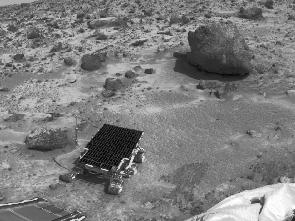
This image shows the landing site for the Mars Pathfinder mission.
Click on image for full size
Image from: NASA/JPL

The Flood Plain explored by Mars Pathfinder

The nature of the flood plain observed by the Rover was unusual compared to a terrestrial flood plain, and suggested that it might not actually be a floodplain. The rocks could have come from ejecta from impacts which created the nearby craters. Scientists have to consider all the evidence before them so that they can prove a hypothesis is true.

Some of the reasons for doubting the flow-origin hypothesis include:

  • some of the boulders found by the Rover were larger than those expected to be carried by catastrophic flood waters.
  • there was no gravel present
On the other hand, scientists discovered many pebbles, cobbles and conglomerate-type rocks. These suggest that the landingsite *was* formed from outflowing water.

Scientists considered carefully whether the origin of the rocks could be from flowing water or from impact processes. Findings from these studies contribute to the overall results of the Pathfinder mission, and help answer some questions.


Shop Windows to the Universe Science Store!

Our online store includes issues of NESTA's quarterly journal, The Earth Scientist, full of classroom activities on different topics in Earth and space science, as well as books on science education!

Windows to the Universe Community

News

Opportunities

You might also be interested in:

Cool It! Game

Check out our online store - minerals, fossils, books, activities, jewelry, and household items!...more

Pits and Holes in rocks of Mars

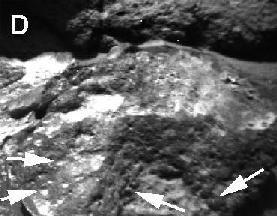
This image shows pits and holes (ventifacts) in a small rock found by the Mars Pathfinder Rover. These ventifacts are artifacts of weathering on Mars and were created by wind erosion. The Souffle rock...more

Results from Mars Pathfinder

These are the findings of Mars Pathfinder. Rounded Pebbles, Cobbles and possible Conglomerates were found - a result from analysis of the landing site, the rocks, and the soils. showed that there were...more

Mars Odyssey

The Mars Odyssey was launched April 7, 2001, from Florida. After a six-month, 285 million-mile journey, the Odyssey arrived at Mars on October 24, 2001. The Odyssey is in its aerobraking phase right now....more

Mars 2005

The Mars 2005 mission is still in the planning stages. It is set to launch in the year 2005. ...more
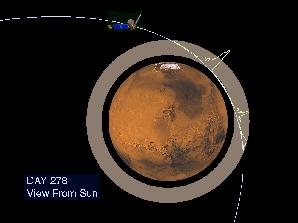
Aerobraking

The Mars Global Surveyor reached Mars in September of 1997. But it didn't make it into its final mapping orbit until February 1999. What took so long? Surveyor needed to reach a near-circular, low-altitude...more

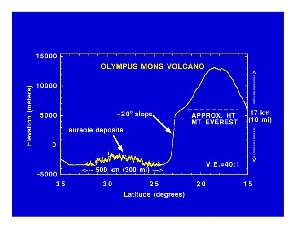
Mars Global Surveyor Measures Olympus Mons

Mars Global Surveyor carries an instrument which measures the heights of things. This instrument is called an altimeter, or "altitude-meter". The graph to the left shows the results returned from Mars...more

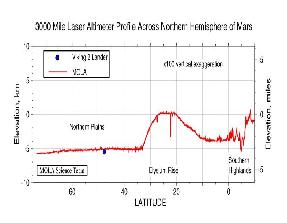
Mars Global Surveyor Measures Martian Global Hemispheres

Mars Global Surveyor carries an instrument which measures the heights of things. This instrument is called an altimeter, or "altitude-meter". The picture to the left shows Mars Global Surveyor's measurement...more

Shop Windows to the Universe

Please help support Windows to the Universe, and our activities to help Earth and space science teachers, with a tax-exempt donation today!

Windows to the Universe, a project of the National Earth Science Teachers Association, is sponsored in part by the National Science Foundation and NASA, our Founding Partners (the American Geophysical Union and American Geosciences Institute) as well as through Institutional, Contributing, and Affiliate Partners, individual memberships and generous donors. Thank you for your support! NASA AGU AGI NSF