Current Events

  • Atmospheric CO2 Level Tops 400 ppm
    During the week of May 13th, the CO2 level at the Mauna Loa Observatory in Hawaii topped 400 ppm rep...Read more

    x

    Atmospheric CO2 Level Tops 400 ppm

    During the week of May 13th, the CO2 level at the Mauna Loa Observatory in Hawaii topped 400 ppm repeatedly. Daily levels of CO2 can vary due to weather, and there are seasonal trends as well. The level of atmospheric greenhouse gases continues to increase, now over 120 ppm since the Industrial Revolution began. For more on the Keeling Curve, see http://keelingcurve.ucsd.edu/. Find out more about greenhouse gases and warming.
  • Massive Tornado Outbreak on Tornado Alley
    The week of May 19 brings dozens of tornadoes to Tornado Alley in the states of Oklahoma, Kansas, Io...Read more

    x

    Massive Tornado Outbreak on Tornado Alley

    The week of May 19 brings dozens of tornadoes to Tornado Alley in the states of Oklahoma, Kansas, Iowa, Illinois and Missouri. On May 20th, a massive tornado struck Moore, Oklahoma, devastating communities - destroying over 100 homes and hitting two elementary schools and a hospital - with many casualties and deaths. Our thoughts are with our friends and colleagues suffering from these storms. For more on the May 20th storms, see the NOAA Storm Prediction Center Storm Report.
  • Kansas Legislator Proposes Bill to Outlaw Sustainability Education
    A bill has been introduced in the Kansas legislature this week that would prohibit the promotion of ...Read more

    x

    Kansas Legislator Proposes Bill to Outlaw Sustainability Education

    A bill has been introduced in the Kansas legislature this week that would prohibit the promotion of sustainability. Here is a link to the one-page bill: http://www.kslegislature.org/li/b2013_14/measures/documents/hb2366_00_0000.pdf. See report on Bloomberg News.
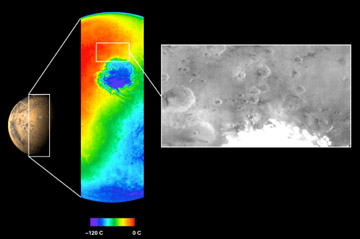
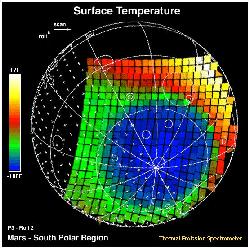
This graph contains information about the surface temperature of Mars.
Click on image for full size
Image from: NASA/JPL

Mars Global Surveyor Measures Martian Surface Temperatures

This image shows how cold the surface of Mars can be. The temperature was measured by the Mars Global Surveyor spacecraft. The scale to the left shows that purple regions are the coldest, about -170 degrees F (-113C), while the yellow areas are the warmest at about 17 degrees F (-8C). The surface of Mars may often become warmer than 17 degrees. Other data returned by Mars Global Surveyor shows the temperatures can be 30 degrees F (~0C) or more. These temperatures are very cold, however. The surface is either freezing cold or much colder than freezing. No wonder the water of Mars may be frozen into the ground! Freezing temperatures may have something to do with the thin atmosphere and lack of a greenhouse effect.

Temperature data from the surface of Mars is being returned everyday now that Mars Global Surveyor has reached Mars. Check the Mars Global Surveyor Image Archives or the Mars Global Surveyor Webpage, below, for sample data. Scientists are interested in learning if temperatures ever come above freezing for long period of time. This would affect theories about Martian water and climate. Recent Martian exploration is directed at these and other questions.


Shop Windows to the Universe Science Store!

Learn about Earth and space science, and have fun while doing it! The games section of our online store includes a climate change card game and the Traveling Nitrogen game!

Windows to the Universe Community

News

Opportunities

You might also be interested in:

Traveling Nitrogen Classroom Activity Kit

Check out our online store - minerals, fossils, books, activities, jewelry, and household items!...more

Instruments of the Mars Global Surveyor Mission

It has been more than 30 years since America's first exploratory missions to Mars. Here are some of the instruments carried onboard Mars Global Surveyor (called MGS for short). Many of these instruments...more

Initial Mars Global Surveyor Findings

These are some of the initial findings of Mars Global Surveyor. There definitely is a magnetosphere near Mars. suggests scientists must rethink theories about the evolution of Mars. Geologic features at...more

Mars Odyssey

The Mars Odyssey was launched April 7, 2001, from Florida. After a six-month, 285 million-mile journey, the Odyssey arrived at Mars on October 24, 2001. The Odyssey is in its aerobraking phase right now....more

Mars 2005

The Mars 2005 mission is still in the planning stages. It is set to launch in the year 2005. ...more
Aerobraking

The Mars Global Surveyor reached Mars in September of 1997. But it didn't make it into its final mapping orbit until February 1999. What took so long? Surveyor needed to reach a near-circular, low-altitude...more

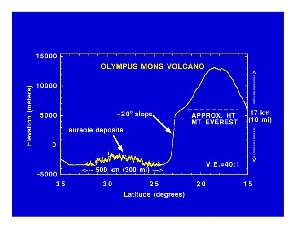
Mars Global Surveyor Measures Olympus Mons

Mars Global Surveyor carries an instrument which measures the heights of things. This instrument is called an altimeter, or "altitude-meter". The graph to the left shows the results returned from Mars...more

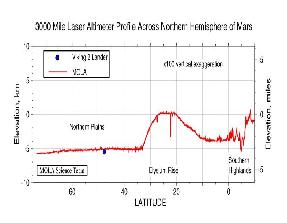
Mars Global Surveyor Measures Martian Global Hemispheres

Mars Global Surveyor carries an instrument which measures the heights of things. This instrument is called an altimeter, or "altitude-meter". The picture to the left shows Mars Global Surveyor's measurement...more

Shop Windows to the Universe

Please help support Windows to the Universe, and our activities to help Earth and space science teachers, with a tax-exempt donation today!

Windows to the Universe, a project of the National Earth Science Teachers Association, is sponsored in part by the National Science Foundation and NASA, our Founding Partners (the American Geophysical Union and American Geosciences Institute) as well as through Institutional, Contributing, and Affiliate Partners, individual memberships and generous donors. Thank you for your support! NASA AGU AGI NSF