Current Events

  • Irish Chronicles Document Links Between Volcanoes and Weather
    A study of over 40,000 written entries in Irish Annals and ice core measurements shows a strong corr...Read more

    x

    Irish Chronicles Document Links Between Volcanoes and Weather

    A study of over 40,000 written entries in Irish Annals and ice core measurements shows a strong correlation between the occurrence of volcanic eruptions and extreme cold weather in Ireland over a 1200 year period. Data analyzed in this study cover the period from 431 to 1649, during which time up to 48 volcanic eruptions are identified in Greenland ice core records through deposition of volcanic sulfate in annual layers of ice. You can find the study (open access), published on 6 June 2013 in IOP Publishing's journal Environmental Research Letters, at http://iopscience.iop.org/1748-9326/8/2/024035/article. Find out more about how volcanoes can influence climate.
  • EF-5 Tornado in El Reno, Oklahoma Widest Ever Recorded in US
    The EF-5 tornado that hit El Reno, Oklahoma on May 31st was the widest ever recorded in the US, acco...Read more

    x

    EF-5 Tornado in El Reno, Oklahoma Widest Ever Recorded in US

    The EF-5 tornado that hit El Reno, Oklahoma on May 31st was the widest ever recorded in the US, according to the National Weather Service in Norman Oklahoma. The tornado, which remained on the ground for 40 minutes and reached 2.6 miles across (4.2 km), took the lives of 18 people including storm chasers Tim Samaras, Paul Samaras and Carl Young. For more information on the tornado, visit http://ow.ly/i/2hfDG.
  • Atmospheric CO2 Level Tops 400 ppm
    During the week of May 13th, the CO2 level at the Mauna Loa Observatory in Hawaii topped 400 ppm rep...Read more

    x

    Atmospheric CO2 Level Tops 400 ppm

    During the week of May 13th, the CO2 level at the Mauna Loa Observatory in Hawaii topped 400 ppm repeatedly. Daily levels of CO2 can vary due to weather, and there are seasonal trends as well. The level of atmospheric greenhouse gases continues to increase, now over 120 ppm since the Industrial Revolution began. For more on the Keeling Curve, see http://keelingcurve.ucsd.edu/. Find out more about greenhouse gases and warming.
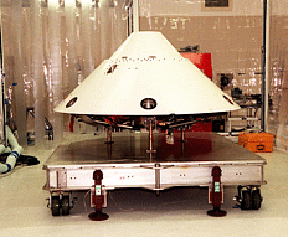
This is an image of the Mars '98 spacecraft being prepared for launch.
Click on image for full size
NASA

An Overview of the Mars '98 mission

The Mars '98 mission was designed to be a study of Martian climate, weather, and surface properties at the Martian south pole. Mars '98 was supposed to build upon the discoveries of the Mars Pathfinder and Mars Global Surveyor missions by digging into the Martian surface in search of water. The south pole of Mars is an important region because of the unusual terrain found there and the possiblility of that region affecting the overall weather and climate of Mars.

Mars '98 consisted of two spacecraft. One was a lander, dubbed the Martian Polar Lander, which was going to land on the surface of Mars and dig into the soil with a robot arm. The other was an orbiter named the Martian Climage Orbiter, which would have remained in orbit around Mars.

Unfortunately, both spacecraft were lost during the mission. A math error resulted in the orbiter to burning up in Mars' atmosphere. Also, contact with the lander was lost on December 3, 1999. The spacecraft has not been heard from again and no reason for the loss of signal is known.


Last modified April 25, 2001 by Jennifer Bergman.

Shop Windows to the Universe Science Store!

Our online store includes fun classroom activities for you and your students. Issues of NESTA's quarterly journal, The Earth Scientist are also full of classroom activities on different topics in Earth and space science!

Windows to the Universe Community

News

Opportunities

You might also be interested in:

Cool It! Game

Check out our online store - minerals, fossils, books, activities, jewelry, and household items!...more

An Overview of the Mars Pathfinder Mission

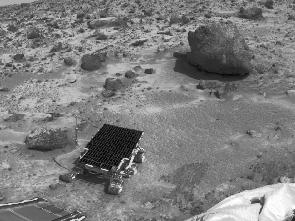
The Mars Pathfinder (MPF) mission was sent to investigate the geology of Mars. Its principal objective was to analyze the rocks and soil of Mars. The MPF consisted of 2 components, a lander and a mobile...more

The South Pole of Mars

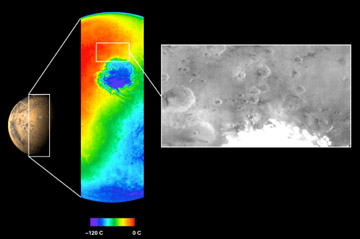
The Martian South Pole was first imaged by Mariner 7. The south polar region is part of the highlands of Mars, consisting of old, cratered terrain, and other interesting geologic features. The Mariner...more

Mars Lander may be Alive

Just when everyone had given up hope, a faint signal was received at Stanford University. Scientists say it most likely came from Mars, although they won't know for sure until later this week. The signals...more

NASA Needs to Change Mars Program

A panel made up of aerospace experts studied NASA's recent ventures into space, including the Mars Climate Orbiter and Polar Lander. The results of the study aren't very friendly to the NASA organization....more

Martian Clouds

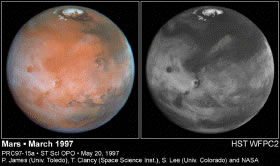
Unlike the Earth, where clouds are found around the entire globe, on Mars, clouds seem to be plentiful only in the middle latitudes, as shown in this Hubble telescope image. This may be because water of...more

The Mars Surveyor Program

Born as a result of the failure of Mars Observer (MO), the Mars Surveyor Program was designed to explore Mars with all the original measurements planned for MO, and a lot more. It varied from the MO mission...more

Mars Odyssey

The Mars Odyssey was launched April 7, 2001, from Cape Canaveral Air Force Station in Florida. After a six-month, 285 million-mile journey, the Odyssey arrived at Mars on October 24, 2001 (02:30 Universal...more

Shop Windows to the Universe

We now offer the Cool It! card game in our Science Store. Cool It! is the new card game from UCS that teaches kids about the choices we have when it comes to climate change.

Windows to the Universe, a project of the National Earth Science Teachers Association, is sponsored in part by the National Science Foundation and NASA, our Founding Partners (the American Geophysical Union and American Geosciences Institute) as well as through Institutional, Contributing, and Affiliate Partners, individual memberships and generous donors. Thank you for your support! NASA AGU AGI NSF