Current Events

  • Kansas Legislator Proposes Bill to Outlaw Sustainability Education
    A bill has been introduced in the Kansas legislature this week that would prohibit the promotion of ...Read more

    x

    Kansas Legislator Proposes Bill to Outlaw Sustainability Education

    A bill has been introduced in the Kansas legislature this week that would prohibit the promotion of sustainability. Here is a link to the one-page bill: http://www.kslegislature.org/li/b2013_14/measures/documents/hb2366_00_0000.pdf. See report on Bloomberg News.
  • Earth's Center Is 1,000 Degrees Hotter Than Previously Thought, Synchrotron X-Ray Experiment Shows
    Scientists have determined the temperature near the Earth’s center to be 6000 degrees Celsius, 1000 ...Read more

    x

    Earth's Center Is 1,000 Degrees Hotter Than Previously Thought, Synchrotron X-Ray Experiment Shows

    Scientists have determined the temperature near the Earth’s center to be 6000 degrees Celsius, 1000 degrees hotter than in a previous experiment run 20 years ago. These measurements confirm geophysical models that the temperature difference between the solid core and the mantle above, must be at least 1500 degrees to explain why the Earth has a magnetic field. For more information about this study, see the press release from the European Synchrotron Radiation Facility.
  • Ocean Volcanic Rocks Contain Samples of Recycled Crust
    Scientists have long believed that lava erupted from certain oceanic volcanoes contains materials fr...Read more

    x

    Ocean Volcanic Rocks Contain Samples of Recycled Crust

    Scientists have long believed that lava erupted from certain oceanic volcanoes contains materials from the early Earth’s crust. But decisive evidence for this phenomenon has proven elusive. New research from a team including Carnegie’s Erik Hauri demonstrates that oceanic volcanic rocks contain samples of recycled crust dating back to the Archean era 2.5 billion years ago. Their work is published in Nature. Oceanic crust sinks into the Earth’s mantle at so-called subduction zones, where two plates come together. Much of what happens to the crust during this journey is unknown. Model-dependent studies for how long subducted material can exist in the mantle are uncertain and evidence of very old crust returning to Earth’s surface via upwellings of magma has not been found until now. For more information about these results, see the press release from the Carnegie Institution.
The spinning vortex of <a href="https://www.windows2universe.org/saturn/saturn.html">Saturn</a>'s north polar storm resembles a giant deep red rose surrounded by green foliage in this false-color <a href="http://www.nasa.gov/mission_pages/cassini/multimedia/pia14944.html">image</a> from NASA's <a href="https://www.windows2universe.org/missions/cassini.html">Cassini spacecraft</a>. The eye is 2,000 kilometers across with cloud speeds as fast as 150 meters per second.
It is not known how long this newly discovered north-polar <a href="https://www.windows2universe.org/earth/Atmosphere/hurricane/hurricane.html">hurricane</a> has been active.
The view was acquired at a distance of approximately 419,000 kilometers from Saturn.<p><small><em>NASA/JPL-Caltech/SSI</em></small></p>An artist's rendering of the moment of impact of a massive <a
  href="/our_solar_system/meteors/meteors.html&edu=elem">meteorite</a>
  at the end of the Cretaceous (at the end of the <a
  href="/earth/geology/hist_mesozoic.html&edu=elem">Mesozoic
  Era</a>). Many
  scientists have concluded for decades that a meteorite four to six kilometers
  in diameter impacted the Earth at this time, resulting in a <a
  href="/earth/past/KTextinction.html&edu=elem">mass extinction
  of dinosaurs</a> and many other life forms.  Recent research suggests that
 perhaps <a
  href="/headline_universe/olpa/chicxulub.html&edu=elem">massive
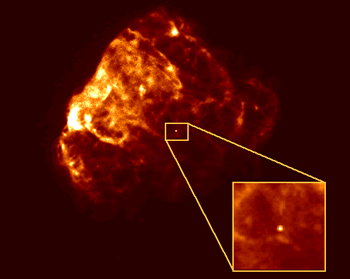
  volcanic eruptions</a> may be been responsible for the extinction.<p><small><em>Courtesy of Don Davis, NASA</em></small></p>An image of Hurricane Sandy taken by the GOES-13 satellite on October 28.  This category 1 <a href="/earth/Atmosphere/hurricane/hurricane.html&edu=elem">hurricane</a> was huge, spanning a horizontal distance of about one-third the US continental landmass.  The storm came onshore in New Jersey, and gradually moved northeast.  The storm disrupted the lives of tens of millions in the eastern US, doing billions of dollars in damage, resulting in over 30 deaths.  Visit the National Hurricane Center's webpage on <a href="http://www.nhc.noaa.gov/">Hurricane Sandy</a> for details.<p><small><em>Image courtesy of NASA</em></small></p>Scientists at the University of Michigan have found that <a href="/earth/polar/cryosphere_permafrost1.html&edu=elem">permafrost</a> in the <a href="/earth/polar/polar_north.html&edu=elem">Arctic</a> is extremely sensitive to sunlight.  Exposure to sunlight releases carbon gases trapped in the permafrost, including <a href="/earth/climate/earth_greenhouse.html&edu=elem">climate-warming</a> <a href="/physical_science/chemistry/carbon_dioxide.html&edu=elem">carbon dioxide</a>, to the <a href="/earth/Atmosphere/overview.html&edu=elem">atmosphere</a> much faster than previously thought.<p><small><em>George Kling, The University of Michigan</em></small></p>Please help support Windows to the Universe, a project of the <a href="http://www.nestanet.org">National Earth Science Teachers Association</a>, with a <a href="https://www.nestanet.org/cms/content/support/donate/form">donation</a> today (select Windows to the Universe in the box on the form). Your support helps fund our professional development workshops for educators, as well as our efforts to update and improve the website.  Thank you for your support!<p><small><em></em></small></p>Stars don't last forever. Occasionally, a star bigger than our Sun will end its life in a huge explosion, called a <a href="/the_universe/supernova.html&edu=elem">supernova</a>. The center of the star collapses in less than a second, blowing away the outer layers of the star.  There are many beautiful images of supernova remnants, the expanding shell of gas made up of the outer layers of the original star. This image is the Vela Supernova Remnant.<p><small><em>Image courtesy of the Anglo-Australian Observatory/Royal Observatory Edinburgh</em></small></p>

Shop Windows to the Universe

The Winter 2010 issue of The Earth Scientist includes a variety of educational resources, ranging from astronomy to glaciers. Check out the other publications and classroom materials in our online store.

Windows to the Universe, a project of the National Earth Science Teachers Association, is sponsored in part by the National Science Foundation and NASA, our Founding Partners (the American Geophysical Union and American Geosciences Institute) as well as through Institutional, Contributing, and Affiliate Partners, individual memberships and generous donors. Thank you for your support! NASA AGU AGI NSF