Current Events

  • Atmospheric CO2 Level Tops 400 ppm
    During the week of May 13th, the CO2 level at the Mauna Loa Observatory in Hawaii topped 400 ppm rep...Read more

    x

    Atmospheric CO2 Level Tops 400 ppm

    During the week of May 13th, the CO2 level at the Mauna Loa Observatory in Hawaii topped 400 ppm repeatedly. Daily levels of CO2 can vary due to weather, and there are seasonal trends as well. The level of atmospheric greenhouse gases continues to increase, now over 120 ppm since the Industrial Revolution began. For more on the Keeling Curve, see http://keelingcurve.ucsd.edu/. Find out more about greenhouse gases and warming.
  • Massive Tornado Outbreak on Tornado Alley
    The week of May 19 brings dozens of tornadoes to Tornado Alley in the states of Oklahoma, Kansas, Io...Read more

    x

    Massive Tornado Outbreak on Tornado Alley

    The week of May 19 brings dozens of tornadoes to Tornado Alley in the states of Oklahoma, Kansas, Iowa, Illinois and Missouri. On May 20th, a massive tornado struck Moore, Oklahoma, devastating communities - destroying over 100 homes and hitting two elementary schools and a hospital - with many casualties and deaths. Our thoughts are with our friends and colleagues suffering from these storms. For more on the May 20th storms, see the NOAA Storm Prediction Center Storm Report.
  • Kansas Legislator Proposes Bill to Outlaw Sustainability Education
    A bill has been introduced in the Kansas legislature this week that would prohibit the promotion of ...Read more

    x

    Kansas Legislator Proposes Bill to Outlaw Sustainability Education

    A bill has been introduced in the Kansas legislature this week that would prohibit the promotion of sustainability. Here is a link to the one-page bill: http://www.kslegislature.org/li/b2013_14/measures/documents/hb2366_00_0000.pdf. See report on Bloomberg News.

How hot is the Sun, its surface and core? How long does it take the Sun's rays to reach the Earth?

A process called fusion heats the Sun. Fusion happens in the core of the Sun. It is very hot there. In fact, the core's average temperature is around 27,000,000 degrees Fahrenheit. The surface of the Sun is cool compared with the core, only 10,000 degrees Fahrenheit.

This fusion process not only heats the Sun, it makes the sunlight we see here on Earth. This sunlight travels the speed of light which is 186,282 miles per second or 299,792,458 meters per second. This means the light from the Sun takes 8.4 minutes to travel 93 million miles to Earth. If the world's fastest land animal were to travel that same distance, it would take a cheetah over 151 years to reach the Earth running about 70 mph nonstop!

Submitted by Jasmine (age 11, Minnesota, USA)
Submitted by Bobby (age 12, Quebec, Canada)
Submitted by John (age 48, Australia)
Submitted by Derek (age 7, Kansas, USA)
(September 22, 1997)


Shop Windows to the Universe Science Store!

Learn about Earth and space science, and have fun while doing it! The games section of our online store includes a climate change card game and the Traveling Nitrogen game!

Windows to the Universe Community

News

Opportunities

You might also be interested in:

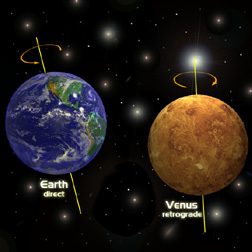
What are the retrograde motions of planets in the sky?

It depends on which type of motion you are asking about. If you take a birds-eye view from the top of the solar system all the planets orbit around the Sun in a counter-clockwise (or direct) direction....more

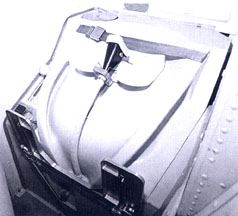
How do Astronauts Live in Space?

Almost everyone has a question or two about living in space. What do astronauts do in space? How do they do everyday things like eat, sleep and go to the bathroom? It's important to note that astronauts...more

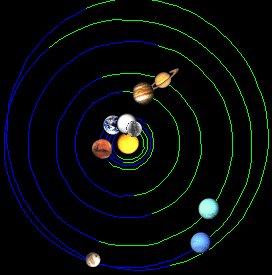
How far is the Earth from the Sun, the Moon and all the other planets? How far are all of the planets from the Sun? Do you know of a software that tracks the planets in real-time?

There is a really neat internet program called Solar System Live that shows the position of all of the planets and the Sun for any given day. If you go to that page, you'll see an image similar to the...more

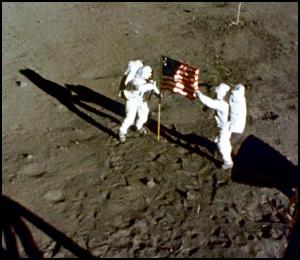
Is it really true that man never really walked on the Moon?

The picture of the American Flag (the one put there by the Apollo astronauts) is waving (or straight out) in the wind. How could that be possible if there is no atmosphere on the Moon? Was it some sort...more

How many planets orbit the sun?

I was wondering if there is a new planet? Are there planets (a tenth planet?) after Pluto belonging to our solar system? What are the names of the new planets discovered in the solar system? Are there...more

According to Stephen Hawking, any object with an energy which equals Plank's energy has to become a black hole.

If that is so, the energy released during the Big Bang must have created many such black holes. Therefore most of the Energy of the Big bang must have disappeared in that form. Then how did the Universe...more

Shop Windows to the Universe

The Universe at Your Fingertips 2.0 DVD from the Astronomical Society of the Pacific is in our online store, filled with Earth and space science resources.

Windows to the Universe, a project of the National Earth Science Teachers Association, is sponsored in part by the National Science Foundation and NASA, our Founding Partners (the American Geophysical Union and American Geosciences Institute) as well as through Institutional, Contributing, and Affiliate Partners, individual memberships and generous donors. Thank you for your support! NASA AGU AGI NSF