Current Events

  • Irish Chronicles Document Links Between Volcanoes and Weather
    A study of over 40,000 written entries in Irish Annals and ice core measurements shows a strong corr...Read more

    x

    Irish Chronicles Document Links Between Volcanoes and Weather

    A study of over 40,000 written entries in Irish Annals and ice core measurements shows a strong correlation between the occurrence of volcanic eruptions and extreme cold weather in Ireland over a 1200 year period. Data analyzed in this study cover the period from 431 to 1649, during which time up to 48 volcanic eruptions are identified in Greenland ice core records through deposition of volcanic sulfate in annual layers of ice. You can find the study (open access), published on 6 June 2013 in IOP Publishing's journal Environmental Research Letters, at http://iopscience.iop.org/1748-9326/8/2/024035/article. Find out more about how volcanoes can influence climate.
  • EF-5 Tornado in El Reno, Oklahoma Widest Ever Recorded in US
    The EF-5 tornado that hit El Reno, Oklahoma on May 31st was the widest ever recorded in the US, acco...Read more

    x

    EF-5 Tornado in El Reno, Oklahoma Widest Ever Recorded in US

    The EF-5 tornado that hit El Reno, Oklahoma on May 31st was the widest ever recorded in the US, according to the National Weather Service in Norman Oklahoma. The tornado, which remained on the ground for 40 minutes and reached 2.6 miles across (4.2 km), took the lives of 18 people including storm chasers Tim Samaras, Paul Samaras and Carl Young. For more information on the tornado, visit http://ow.ly/i/2hfDG.
  • Atmospheric CO2 Level Tops 400 ppm
    During the week of May 13th, the CO2 level at the Mauna Loa Observatory in Hawaii topped 400 ppm rep...Read more

    x

    Atmospheric CO2 Level Tops 400 ppm

    During the week of May 13th, the CO2 level at the Mauna Loa Observatory in Hawaii topped 400 ppm repeatedly. Daily levels of CO2 can vary due to weather, and there are seasonal trends as well. The level of atmospheric greenhouse gases continues to increase, now over 120 ppm since the Industrial Revolution began. For more on the Keeling Curve, see http://keelingcurve.ucsd.edu/. Find out more about greenhouse gases and warming.

Do you think that in about another century the human race will be able to travel to Pluto? How long would it take to travel to Pluto?

Pluto is the least studied of all the planets in our solar system. It wasn't even discovered until 1930. The main reason is that it is so far away. At its closest point to Earth, it's still 4.28 billion km (2.66 billion miles) away! It takes light at least four hours to travel from Pluto to Earth.

But since we can't travel at the speed of light, how fast would a probe get to Pluto? It took the Voyager probes about 20 years to travel to Pluto's neighborhood. Without gravity assists from Jupiter and the other gas giants, it would have taken about another 20 years.

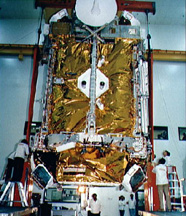
Soon we will find out how long it takes for a probe to get to Pluto. The U.S. is launching Pluto-Kuiper Express around the turn of the century. They expect that it will take less than ten years for the probe to reach Pluto. This is because it's smaller and the planets are aligned differently than during the Voyagers' time.

The prospects for human travel to Pluto are slim for now. In order to make travelling to Pluto feasible, we need to able to get there faster.


Submitted by Ashley (age 10, Tennessee, USA)
Submitted by Megan (age 13, Tennessee, USA)
(September 2, 1997)


Shop Windows to the Universe Science Store!

Learn about Earth and space science, and have fun while doing it! The games section of our online store includes a climate change card game and the Traveling Nitrogen game!

Windows to the Universe Community

News

Opportunities

You might also be interested in:

Happy Anniversary Voyager!

The Voyager program is celebrating its 20th anniversary. Voyager 1 and Voyager 2 were both launched in the summer of 1977 from Cape Canaveral. Their main mission was to explore Jupiter and its moons, Saturn...more

What are the retrograde motions of planets in the sky?

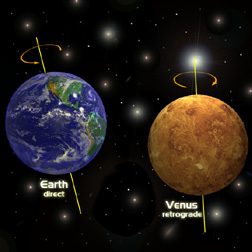
It depends on what kind of motion you are talking about. When seen from the north pole of the celestial sphere all planets orbit around the Sun in a counter-clockwise or direct path. Most planets also...more

How do Astronauts Live in Space?

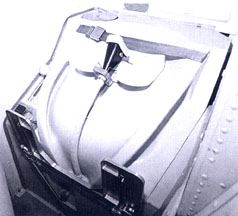
Almost everyone has a question or two about living in space. What do astronauts do in space? How do they do everyday things like eat, sleep and go to the bathroom? Well, this is our attempt to answer...more

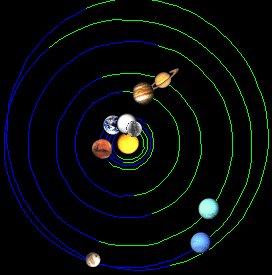
How far is the Earth from the Sun, the Moon and all the other planets? How far are all of the planets from the Sun? Do you know of a software that tracks the planets in real-time?

There is a really neat internet program called Solar System Live that shows the position of all of the planets and the Sun for any given day. If you go to that page, you'll see an image similar to the...more

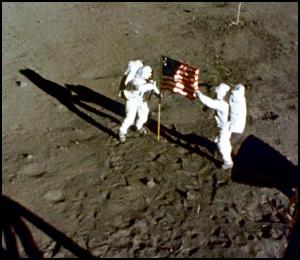
Is it really true that man never really walked on the Moon?

The picture of the American Flag (the one put there by the Apollo astronauts) is waving (or straight out) in the wind. How could that be possible if there is no atmosphere on the Moon? Was it some sort...more

How many planets orbit the sun?

I was wondering if there is a new planet? Are there planets (a tenth planet?) after Pluto belonging to our solar system? What are the names of the new planets discovered in the solar system? Are there...more

According to Stephen Hawking, any object with an energy which equals Plank's energy has to become a black hole.

If that is so, the energy released during the Big Bang must have created many such black holes. Therefore most of the Energy of the Big bang must have disappeared in that form. Then how did the Universe...more

Shop Windows to the Universe

Our Glaciers: Then and Now activity kit helps you see the changes taking place in glaciers around the world. See all our activity kits and classroom activities.

Windows to the Universe, a project of the National Earth Science Teachers Association, is sponsored in part by the National Science Foundation and NASA, our Founding Partners (the American Geophysical Union and American Geosciences Institute) as well as through Institutional, Contributing, and Affiliate Partners, individual memberships and generous donors. Thank you for your support! NASA AGU AGI NSF