Current Events

  • Atmospheric CO2 Level Tops 400 ppm
    During the week of May 13th, the CO2 level at the Mauna Loa Observatory in Hawaii topped 400 ppm rep...Read more

    x

    Atmospheric CO2 Level Tops 400 ppm

    During the week of May 13th, the CO2 level at the Mauna Loa Observatory in Hawaii topped 400 ppm repeatedly. Daily levels of CO2 can vary due to weather, and there are seasonal trends as well. The level of atmospheric greenhouse gases continues to increase, now over 120 ppm since the Industrial Revolution began. For more on the Keeling Curve, see http://keelingcurve.ucsd.edu/. Find out more about greenhouse gases and warming.
  • Massive Tornado Outbreak on Tornado Alley
    The week of May 19 brings dozens of tornadoes to Tornado Alley in the states of Oklahoma, Kansas, Io...Read more

    x

    Massive Tornado Outbreak on Tornado Alley

    The week of May 19 brings dozens of tornadoes to Tornado Alley in the states of Oklahoma, Kansas, Iowa, Illinois and Missouri. On May 20th, a massive tornado struck Moore, Oklahoma, devastating communities - destroying over 100 homes and hitting two elementary schools and a hospital - with many casualties and deaths. Our thoughts are with our friends and colleagues suffering from these storms. For more on the May 20th storms, see the NOAA Storm Prediction Center Storm Report.
  • Kansas Legislator Proposes Bill to Outlaw Sustainability Education
    A bill has been introduced in the Kansas legislature this week that would prohibit the promotion of ...Read more

    x

    Kansas Legislator Proposes Bill to Outlaw Sustainability Education

    A bill has been introduced in the Kansas legislature this week that would prohibit the promotion of sustainability. Here is a link to the one-page bill: http://www.kslegislature.org/li/b2013_14/measures/documents/hb2366_00_0000.pdf. See report on Bloomberg News.
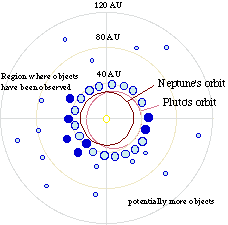
This drawing shows where trans-neptunian objects are found.
Click on image for full size

How many planets orbit the sun?

I was wondering if there is a new planet? Are there planets (a tenth planet?) after Pluto belonging to our solar system? What are the names of the new planets discovered in the solar system? Are there any objects that orbit the sun that are not in the same plane as the planets, excluding Pluto, comets, asteroids? Do we know any names to any other planets than those in our solar system? If yes, could you give me any examples?

As of today, January, 26, 2001, it's known that only 9 planets orbit the Sun. There have been many solar system objects that have been discovered recently, but none of them have been classified as planets. And none of them are the mysterious Planet X!

These objects have been called asteroids, minor-planets, trans-neptunian objects, or objects of the Kuiper belt. We'll use the word trans-neptunian object (TNO) because that simply means an object past Neptune. The first TNO to be discovered (beside Pluto!) was discovered in 1992. Since then, over 300 of these objects have been found!

One of the most recent discoveries of a TNO was in October of 2000. Astronomers found a huge TNO and called it 2000 EB 173. It is between 300-700 kilometers in size and as far as non-planets go in the solar system, it is second only in size to asteroid Ceres.

So, although no new planets have been discovered in our solar system, there have been many discoveries of planet systems outside our solar system. One such finding was in April 1999 of three planets around the star Upsilon Andromedae. Many other findings have been made. In fact there was just an announcement last week that astronomers found planets around two other stars. Please see this page for a listing of TNOs.


Submitted by Jana (age 7, New Jersey, USA), Sean (age 30, Ohio, USA), John (age 12, Ohio, USA), Saravanan (age 28, India), Puneet (age 12, India), Cassie (age 11, Colorado, USA), Jason (middleschool)
(January 26, 2001)

Last modified January 26, 2001 by Jennifer Bergman.

Shop Windows to the Universe Science Store!

Learn about Earth and space science, and have fun while doing it! The games section of our online store includes a climate change card game and the Traveling Nitrogen game!

Windows to the Universe Community

News

Opportunities

You might also be interested in:

Exploratour - Evolution of the Solar System

Beyond the orbit of Pluto is a region which contains objects which look like planetismals. The objects are very small, and not very bright. It takes hundreds of years for these objects to go around the...more

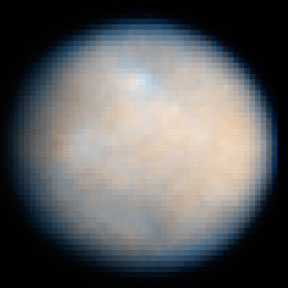
Ceres: Asteroid and Dwarf Planet

Ceres is the largest asteroid in the main asteroid belt. It was classified as a "dwarf planet" in 2006, along with Pluto and Eris. Ceres was discovered on January 1, 1801 by the Italian astronomer...more

New Planets Discovered around the Star Upsilon Andromedae

Recently two groups of astronomers working seperately reported that they had found evidence for two more planets orbiting star Upsilon Andromedae (c and d on the image to the left). This makes the grand...more

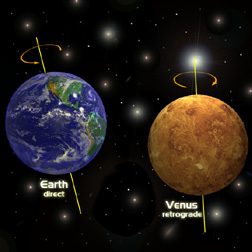
What are the retrograde motions of planets in the sky?

It depends on which type of motion you are asking about. If you take a birds-eye view from the top of the solar system all the planets orbit around the Sun in a counter-clockwise (or direct) direction....more

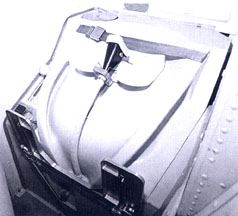
How do Astronauts Live in Space?

Almost everyone has a question or two about living in space. What do astronauts do in space? How do they do everyday things like eat, sleep and go to the bathroom? It's important to note that astronauts...more

How far is the Earth from the Sun, the Moon and all the other planets? How far are all of the planets from the Sun? Do you know of a software that tracks the planets in real-time?

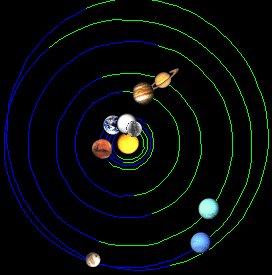
There is a really neat internet program called Solar System Live that shows the position of all of the planets and the Sun for any given day. If you go to that page, you'll see an image similar to the...more

Is it really true that man never really walked on the Moon?

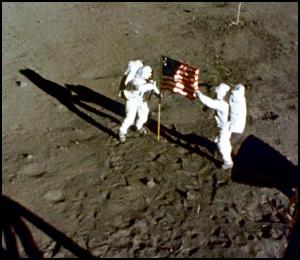
The picture of the American Flag (the one put there by the Apollo astronauts) is waving (or straight out) in the wind. How could that be possible if there is no atmosphere on the Moon? Was it some sort...more

How many planets orbit the sun?

I was wondering if there is a new planet? Are there planets (a tenth planet?) after Pluto belonging to our solar system? What are the names of the new planets discovered in the solar system? Are there...more

Shop Windows to the Universe

Science, Evolution, and Creationism, by the National Academies, focuses on teaching evolution in today's classrooms. Check out the other publications in our online store.

Windows to the Universe, a project of the National Earth Science Teachers Association, is sponsored in part by the National Science Foundation and NASA, our Founding Partners (the American Geophysical Union and American Geosciences Institute) as well as through Institutional, Contributing, and Affiliate Partners, individual memberships and generous donors. Thank you for your support! NASA AGU AGI NSF