Current Events

  • Kansas Legislator Proposes Bill to Outlaw Sustainability Education
    A bill has been introduced in the Kansas legislature this week that would prohibit the promotion of ...Read more

    x

    Kansas Legislator Proposes Bill to Outlaw Sustainability Education

    A bill has been introduced in the Kansas legislature this week that would prohibit the promotion of sustainability. Here is a link to the one-page bill: http://www.kslegislature.org/li/b2013_14/measures/documents/hb2366_00_0000.pdf. See report on Bloomberg News.
  • Earth's Center Is 1,000 Degrees Hotter Than Previously Thought, Synchrotron X-Ray Experiment Shows
    Scientists have determined the temperature near the Earth’s center to be 6000 degrees Celsius, 1000 ...Read more

    x

    Earth's Center Is 1,000 Degrees Hotter Than Previously Thought, Synchrotron X-Ray Experiment Shows

    Scientists have determined the temperature near the Earth’s center to be 6000 degrees Celsius, 1000 degrees hotter than in a previous experiment run 20 years ago. These measurements confirm geophysical models that the temperature difference between the solid core and the mantle above, must be at least 1500 degrees to explain why the Earth has a magnetic field. For more information about this study, see the press release from the European Synchrotron Radiation Facility.
  • Ocean Volcanic Rocks Contain Samples of Recycled Crust
    Scientists have long believed that lava erupted from certain oceanic volcanoes contains materials fr...Read more

    x

    Ocean Volcanic Rocks Contain Samples of Recycled Crust

    Scientists have long believed that lava erupted from certain oceanic volcanoes contains materials from the early Earth’s crust. But decisive evidence for this phenomenon has proven elusive. New research from a team including Carnegie’s Erik Hauri demonstrates that oceanic volcanic rocks contain samples of recycled crust dating back to the Archean era 2.5 billion years ago. Their work is published in Nature. Oceanic crust sinks into the Earth’s mantle at so-called subduction zones, where two plates come together. Much of what happens to the crust during this journey is unknown. Model-dependent studies for how long subducted material can exist in the mantle are uncertain and evidence of very old crust returning to Earth’s surface via upwellings of magma has not been found until now. For more information about these results, see the press release from the Carnegie Institution.
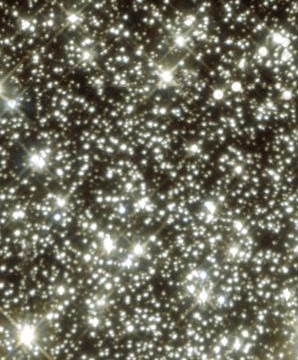
This false-color image shows the near-infrared sky as seen by the COBE satellite. The dominant source of light at this wavelength is stars in our galaxy. So, you end up with an image that shows the thin disk and the central bulge of the Milky Way Galaxy. Our Sun lies in the plane of the disk, 28,000 light years from the center which is why the Milky Way disk appears edge-on to us.
Click on image for full size
NASA

How far across is the Milky Way?

At a given time how can one locate the center of our galaxy as we orbit the Sun and the Sun orbits the galaxy? Is our solar system moving away from the center of the galaxy? How many years does it take the Sun to orbit the center of the galaxy? Specifically, where in the universe can our solar system be found?

The Milky Way galaxy is the home of our solar system, as well as more than 200 billion other stars. It is a spiral galaxy, with a bulged central section and radial arms that start in the center and form a flat pinwheel shape. The galaxy is roughly 90,000 light-years across, and the Sun is located about two-thirds of the way out from the center in one of the arms (ours is known as the Orion Arm). At our position in the galaxy, the Milky Way is only about 3,000 light-years thick, which makes it about the same proportions (ratio of thickness to width) as a music CD.

The Sun (and our solar system) is revolving around the center of the galaxy, and makes a complete revolution every 220 million years or so. As far as we can tell, the Sun and the solar system revolve around the center of the galaxy at a constant radius. The Sun has made less than 25 trips around the galaxy in its lifetime.

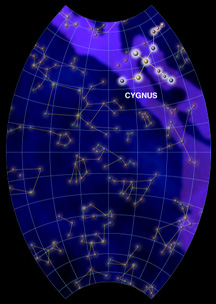
The center of our galaxy is located about 28,000 light-years away, beyond the constellation Sagittarius (actually just beyond the border of Sagittarius and Scorpio). We can look down the arm the solar system is located in by looking in the direction of the constellation of Orion, and we can look up the same arm by looking in the direction of the constellation of Cygnus. Looking up or down the arm we are located in doesn't point you in the direction of the center of the galaxy because the arms are curved.

The Milky Way is part of a set of galaxies known as the Local Group, which includes several dozen different galaxies within 3 million light-years. Only one of these, the Andromeda galaxy, is close to the size of the Milky Way--the rest are much smaller (each is less than 5% of the mass of the Milky Way). This Local Group is part of a supercluster, known as the Virgo supercluster, which has at least 5,000 member galaxies and is roughly 100 million light-years across. Beyond this level of organization, not much is known about our position in the universe.

Last modified July 18, 2001 by Jennifer Bergman.

Shop Windows to the Universe Science Store!

Learn about Earth and space science, and have fun while doing it! The games section of our online store includes a climate change card game and the Traveling Nitrogen game!

Windows to the Universe Community

News

Opportunities

You might also be interested in:

Ready, Set, SCIENCE!: Putting Research to Work in K-8 Science Classrooms

What types of instructional experiences help K-8 students learn science with understanding? What do science educators teachers, teacher leaders, science specialists, professional development staff, curriculum designers, school administrators need to know to create and support such experiences?...more

Stars

The pinpoints of light that you see in the night sky are stars. Your ability to see the stars depends on their magnitude as seen from Earth. Stars are giant balls of gas in space that shine through the...more

Sagittarius

Sagittarius is a centaur, with the torso of a man atop the body of a horse. Unlike the wise and peaceful centaur Chiron (Centaurus), Sagittarius is aiming his giant bow at his neighbor, Scorpius. While...more

Scorpius

More than any other constellation, Scorpius resembles its given name. It is located low in the south for northern latitudes, but passes high in the sky for viewers in the southern hemisphere. The bright...more

Cygnus

Cygnus, the Swan, is also known as the Northern Cross because of its distinctive shape. The tail of the swan is marked by the bright star Deneb, Arabic for "tail". Three fainter stars cross the line between...more

Me and my boyfriend are arguing over whether or not the Moon is round (circular like Earth). I say it is and he says it's not.

What is the diameter of the Moon in Kilometers? By how much is the Earth heavier than the Moon? How far is the Moon from the Earth? How old is the Moon? What is the internal structure of the Moon? I was...more

What Role Have Women Played in the History of the Space Program

*Please note that this page is a student project written by Nicole Turner. It was not written or edited by Windows to the Universe scientists.* From Harriet Quimby (the first licensed woman pilot,) to...more

What are the most commonly used symbols for the planets, the Sun, and the Moon? What is the symbol for Venus?

Here they are! Submitted by Ardith (age 45), and Ashley (age 10) (January 26, 1999) ...more

Shop Windows to the Universe

The Universe at Your Fingertips 2.0 DVD from the Astronomical Society of the Pacific is in our online store, filled with Earth and space science resources.

Windows to the Universe, a project of the National Earth Science Teachers Association, is sponsored in part by the National Science Foundation and NASA, our Founding Partners (the American Geophysical Union and American Geosciences Institute) as well as through Institutional, Contributing, and Affiliate Partners, individual memberships and generous donors. Thank you for your support! NASA AGU AGI NSF