Current Events

  • Kansas Legislator Proposes Bill to Outlaw Sustainability Education
    A bill has been introduced in the Kansas legislature this week that would prohibit the promotion of ...Read more

    x

    Kansas Legislator Proposes Bill to Outlaw Sustainability Education

    A bill has been introduced in the Kansas legislature this week that would prohibit the promotion of sustainability. Here is a link to the one-page bill: http://www.kslegislature.org/li/b2013_14/measures/documents/hb2366_00_0000.pdf. See report on Bloomberg News.
  • Earth's Center Is 1,000 Degrees Hotter Than Previously Thought, Synchrotron X-Ray Experiment Shows
    Scientists have determined the temperature near the Earth’s center to be 6000 degrees Celsius, 1000 ...Read more

    x

    Earth's Center Is 1,000 Degrees Hotter Than Previously Thought, Synchrotron X-Ray Experiment Shows

    Scientists have determined the temperature near the Earth’s center to be 6000 degrees Celsius, 1000 degrees hotter than in a previous experiment run 20 years ago. These measurements confirm geophysical models that the temperature difference between the solid core and the mantle above, must be at least 1500 degrees to explain why the Earth has a magnetic field. For more information about this study, see the press release from the European Synchrotron Radiation Facility.
  • Ocean Volcanic Rocks Contain Samples of Recycled Crust
    Scientists have long believed that lava erupted from certain oceanic volcanoes contains materials fr...Read more

    x

    Ocean Volcanic Rocks Contain Samples of Recycled Crust

    Scientists have long believed that lava erupted from certain oceanic volcanoes contains materials from the early Earth’s crust. But decisive evidence for this phenomenon has proven elusive. New research from a team including Carnegie’s Erik Hauri demonstrates that oceanic volcanic rocks contain samples of recycled crust dating back to the Archean era 2.5 billion years ago. Their work is published in Nature. Oceanic crust sinks into the Earth’s mantle at so-called subduction zones, where two plates come together. Much of what happens to the crust during this journey is unknown. Model-dependent studies for how long subducted material can exist in the mantle are uncertain and evidence of very old crust returning to Earth’s surface via upwellings of magma has not been found until now. For more information about these results, see the press release from the Carnegie Institution.

How much (in meters) is a black hole's diameter? Where do you go if you were to be sucked down a black hole? What would happen to you?

The diameter of a black hole depends on the mass of the original object that becomes a black hole. So the more massive the object, the bigger the diameter of a black hole formed from that object.

If earth became a black hole it would have a diameter of about 0.017 meters, about the size of a marble! Think of how small your bedroom would seem then! Our sun would have a diameter of about 6000 meters, just a little less than 4 miles.

No one really knows what would happen if you were to get sucked into a black hole. The problem is that once you are inside the black hole there is no way to talk to the people outside the black hole. So, we don't know what goes on inside a black hole.

A possibility is that you would slowly be stretched out like a string of spaghetti until you snapped! So stay far away from the edges of black holes!


Submitted by John (age 15, MI, USA)
Submitted by Madalynne (age 13, CO, USA)
(October 13, 1997)


Shop Windows to the Universe Science Store!

Learn about Earth and space science, and have fun while doing it! The games section of our online store includes a climate change card game and the Traveling Nitrogen game!

Windows to the Universe Community

News

Opportunities

You might also be interested in:

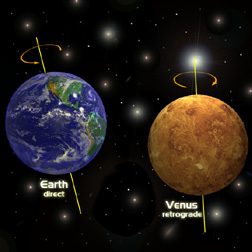
What are the retrograde motions of planets in the sky?

It depends on which type of motion you are asking about. If you take a birds-eye view from the top of the solar system all the planets orbit around the Sun in a counter-clockwise (or direct) direction....more

How do Astronauts Live in Space?

Have you ever wondered how astronauts live in space? Did you know they do a lot of the same things we do here on Earth? Astronauts eat, exercise and sleep just like we do. However, their food isn't always...more

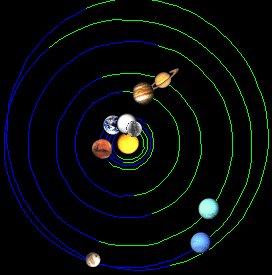
How far is the Earth from the Sun, the Moon and all the other planets? How far are all of the planets from the Sun? Do you know of a software that tracks the planets in real-time?

There is a really neat internet program called Solar System Live that shows where all of the planets and the Sun are. If you go to that page, you'll see an image similar to the one on the left. Below the...more

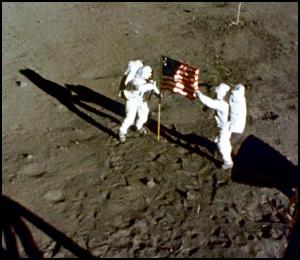
Is it really true that man never really walked on the Moon?

The picture of the American Flag (the one put there by the Apollo astronauts) is waving (or straight out) in the wind. How could that be possible if there is no atmosphere on the Moon? Was it some sort...more

How many planets orbit the sun?

I was wondering if there is a new planet? Are there planets (a tenth planet?) after Pluto belonging to our solar system? What are the names of the new planets discovered in the solar system? Are there...more

Did the Big Bang create any black holes? Wouldn't the universe evolve differently if some of the original energy had disappeared in black holes?

When an object has a really high energy, it can form a black hole. This is called a primordial black hole. Primordial black holes were formed near the beginning of the universe. Primoridal black holes...more

Shop Windows to the Universe

Hands On Mineral Identification helps you to identify over 14,500 minerals! By M. Darby Dyar, Ph.D. See our DVD collection.

Windows to the Universe, a project of the National Earth Science Teachers Association, is sponsored in part by the National Science Foundation and NASA, our Founding Partners (the American Geophysical Union and American Geosciences Institute) as well as through Institutional, Contributing, and Affiliate Partners, individual memberships and generous donors. Thank you for your support! NASA AGU AGI NSF