Current Events

  • Irish Chronicles Document Links Between Volcanoes and Weather
    A study of over 40,000 written entries in Irish Annals and ice core measurements shows a strong corr...Read more

    x

    Irish Chronicles Document Links Between Volcanoes and Weather

    A study of over 40,000 written entries in Irish Annals and ice core measurements shows a strong correlation between the occurrence of volcanic eruptions and extreme cold weather in Ireland over a 1200 year period. Data analyzed in this study cover the period from 431 to 1649, during which time up to 48 volcanic eruptions are identified in Greenland ice core records through deposition of volcanic sulfate in annual layers of ice. You can find the study (open access), published on 6 June 2013 in IOP Publishing's journal Environmental Research Letters, at http://iopscience.iop.org/1748-9326/8/2/024035/article. Find out more about how volcanoes can influence climate.
  • EF-5 Tornado in El Reno, Oklahoma Widest Ever Recorded in US
    The EF-5 tornado that hit El Reno, Oklahoma on May 31st was the widest ever recorded in the US, acco...Read more

    x

    EF-5 Tornado in El Reno, Oklahoma Widest Ever Recorded in US

    The EF-5 tornado that hit El Reno, Oklahoma on May 31st was the widest ever recorded in the US, according to the National Weather Service in Norman Oklahoma. The tornado, which remained on the ground for 40 minutes and reached 2.6 miles across (4.2 km), took the lives of 18 people including storm chasers Tim Samaras, Paul Samaras and Carl Young. For more information on the tornado, visit http://ow.ly/i/2hfDG.
  • Atmospheric CO2 Level Tops 400 ppm
    During the week of May 13th, the CO2 level at the Mauna Loa Observatory in Hawaii topped 400 ppm rep...Read more

    x

    Atmospheric CO2 Level Tops 400 ppm

    During the week of May 13th, the CO2 level at the Mauna Loa Observatory in Hawaii topped 400 ppm repeatedly. Daily levels of CO2 can vary due to weather, and there are seasonal trends as well. The level of atmospheric greenhouse gases continues to increase, now over 120 ppm since the Industrial Revolution began. For more on the Keeling Curve, see http://keelingcurve.ucsd.edu/. Find out more about greenhouse gases and warming.
This drawing shows the 4 Galilean satellites and the path of the Galileo spacecraft.
Click on image for full size
NASA

Io's Position

This drawing shows the positions of the four Galilean satellites relative to each other, and the path of the Galileo spacecraft on one of its flyby's past Jupiter.

Of the four Galilean satellites, Io is the inside moon, Europa the next closest to Jupiter, Ganymede the third furthest out, followed by Callisto as the furthest from Jupiter.


Shop Windows to the Universe Science Store!

Learn about Earth and space science, and have fun while doing it! The games section of our online store includes a climate change card game and the Traveling Nitrogen game!

Windows to the Universe Community

News

Opportunities

You might also be interested in:

Traveling Nitrogen Classroom Activity Kit

Check out our online store - minerals, fossils, books, activities, jewelry, and household items!...more

Galilean Satellites

The Galilean satellites are the 4 major moons of Jupiter, Io, Europa, Ganymede, and Callisto. In this picture, Io, and Io’s surface, are shown on the left-most end, then Europa, and its surface, then Ganymede,...more

Galileo

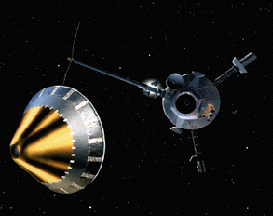
The Galileo spacecraft was launched on October 19, 1989. Galileo had two parts: an orbiter and a descent probe that parachuted into Jupiter's atmosphere. Galileo's main mission was to explore Jupiter and...more

Amalthea

Amalthea was discovered by E Barnard in 1872. Of the 17 moons it is the 3rd closest to Jupiter, with a standoff distance of 181,300 km. Amalthea is about the size of a county or small state, and is just...more

Callisto

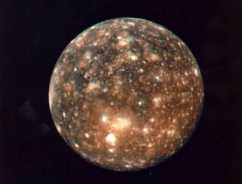
Callisto was first discovered by Galileo in 1610, making it one of the Galilean Satellites. Of the 60 moons it is the 8th closest to Jupiter, with a standoff distance of 1,070,000 km. It is the 2nd largest...more

Evolution of Callisto

The insides of most of the moons and planets separated while they were forming out of the primitive solar nebula. Measurements by the Galileo spacecraft have been shown that Callisto is the same inside...more

Very Large Impact Crater

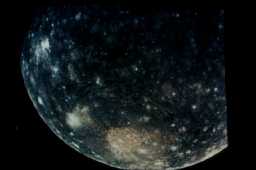
Many examples of the differing types of surface are shown in this image. In the foreground is a huge impact crater, which extends for almost an entire hemisphere on the surface. This crater may be compared...more

Surface of Callisto

The surface of Callisto is deeply pockmarked with craters. It looks to be perhaps the most severely cratered body in the solar system. There are also very large craters to be found there. The severity...more

Shop Windows to the Universe

Earth Science Rocks! Select one of our four cool NESTA t-shirts from our online store, and express your love of Earth and space science!

Windows to the Universe, a project of the National Earth Science Teachers Association, is sponsored in part by the National Science Foundation and NASA, our Founding Partners (the American Geophysical Union and American Geosciences Institute) as well as through Institutional, Contributing, and Affiliate Partners, individual memberships and generous donors. Thank you for your support! NASA AGU AGI NSF