Current Events

  • Kansas Legislator Proposes Bill to Outlaw Sustainability Education
    A bill has been introduced in the Kansas legislature this week that would prohibit the promotion of ...Read more

    x

    Kansas Legislator Proposes Bill to Outlaw Sustainability Education

    A bill has been introduced in the Kansas legislature this week that would prohibit the promotion of sustainability. Here is a link to the one-page bill: http://www.kslegislature.org/li/b2013_14/measures/documents/hb2366_00_0000.pdf. See report on Bloomberg News.
  • Earth's Center Is 1,000 Degrees Hotter Than Previously Thought, Synchrotron X-Ray Experiment Shows
    Scientists have determined the temperature near the Earth’s center to be 6000 degrees Celsius, 1000 ...Read more

    x

    Earth's Center Is 1,000 Degrees Hotter Than Previously Thought, Synchrotron X-Ray Experiment Shows

    Scientists have determined the temperature near the Earth’s center to be 6000 degrees Celsius, 1000 degrees hotter than in a previous experiment run 20 years ago. These measurements confirm geophysical models that the temperature difference between the solid core and the mantle above, must be at least 1500 degrees to explain why the Earth has a magnetic field. For more information about this study, see the press release from the European Synchrotron Radiation Facility.
  • Ocean Volcanic Rocks Contain Samples of Recycled Crust
    Scientists have long believed that lava erupted from certain oceanic volcanoes contains materials fr...Read more

    x

    Ocean Volcanic Rocks Contain Samples of Recycled Crust

    Scientists have long believed that lava erupted from certain oceanic volcanoes contains materials from the early Earth’s crust. But decisive evidence for this phenomenon has proven elusive. New research from a team including Carnegie’s Erik Hauri demonstrates that oceanic volcanic rocks contain samples of recycled crust dating back to the Archean era 2.5 billion years ago. Their work is published in Nature. Oceanic crust sinks into the Earth’s mantle at so-called subduction zones, where two plates come together. Much of what happens to the crust during this journey is unknown. Model-dependent studies for how long subducted material can exist in the mantle are uncertain and evidence of very old crust returning to Earth’s surface via upwellings of magma has not been found until now. For more information about these results, see the press release from the Carnegie Institution.
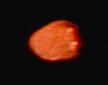
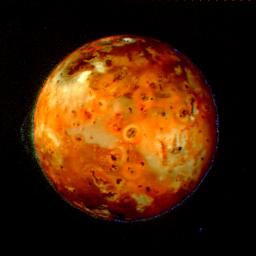
This is an image of Io.
Click on image for full size
The Jet Propulsion Laboratory

Io's Atmosphere

There are no clouds and lightning. The atmosphere of Io is very thin and does not remain gravitationally bound to Io for very long. Even so, it has an important impact on the Jupiter system.

Io's atmosphere comes from its volcanoes, then disperses because, as a small moon, Io is not massive enough to have substantial gravity. Portions of the atmosphere may also come from other processes which cause molecules to be extracted from the surface.

Because the atmosphere comes from it's volcanos, the air of Io is made primarily of sulphur.

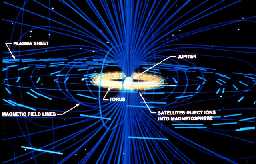
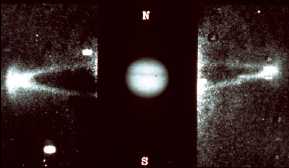
Once the particles from the atmosphere get into the magnetosphere, they create a donut-shaped cloud of material around Io.

The Galileo spacecraft, in exploring the moons of Jupiter will try to learn more about the atmosphere of Io.


Shop Windows to the Universe Science Store!

Learn about Earth and space science, and have fun while doing it! The games section of our online store includes a climate change card game and the Traveling Nitrogen game!

Windows to the Universe Community

News

Opportunities

You might also be interested in:

Cool It! Game

Check out our online store - minerals, fossils, books, activities, jewelry, and household items!...more

Torus

A satellite which has an atmosphere, such as Jupiter's moon Io, will leave a cloud of particles behind as it orbits the planet. Rhea, a body with an icy surface exposed to energetic particles, will have...more

The Io Torus

A satellite which has an atmosphere, such as Jupiter's moon Io, and which also is inside a magnetosphere (unlike the Earth's moon), will leave a cloud of particles behind as it orbits the planet. This...more

Looking for Life's garbage

Most forms of life leave evidence behind that they are there. Plants use up carbon dioxide and release oxygen. Some bacteria are known to release nitrogen into the environment. People leave behind smog,...more

Amalthea

Amalthea was discovered by E Barnard in 1872. Of the 17 moons it is the 3rd closest to Jupiter, with a standoff distance of 181,300 km. Amalthea is about the size of a county or small state, and is just...more

Callisto

Callisto was first discovered by Galileo in 1610, making it one of the Galilean Satellites. Of the 60 moons it is the 8th closest to Jupiter, with a standoff distance of 1,070,000 km. It is the 2nd largest...more

Evolution of Callisto

Most of the moons and planets formed by accretion of rocky material and volatiles out of the primitive solar nebula and soon thereafter they differentiated. Measurements by the Galileo spacecraft have...more

Very Large Impact Crater

Many examples of the differing types of terrain are shown in this image. In the foreground is a huge impact crater, which extends for almost an entire hemisphere on the surface. This crater may be compared...more

Shop Windows to the Universe

Ready, Set, SCIENCE!, by the National Research Council, focuses on K-8 science classsrooms. Check out the other publications in our online store, as well as classroom materials.

Windows to the Universe, a project of the National Earth Science Teachers Association, is sponsored in part by the National Science Foundation and NASA, our Founding Partners (the American Geophysical Union and American Geosciences Institute) as well as through Institutional, Contributing, and Affiliate Partners, individual memberships and generous donors. Thank you for your support! NASA AGU AGI NSF