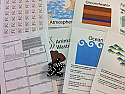
This is an drawing of the Galileo probe plunging into Jupiter's atmosphere on an exploratory mission.
The Magnetospheres of Moons
Since it has been determined that the
composition of the moons is mostly ice, there is probably not enough magnetic material, such as iron, present for these to have a magnetosphere of their own. Nevertheless, these moons may possibly have an
influence on the larger magnetosphere in which they orbit.
You might also be interested in:
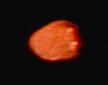
Amalthea was discovered by E Barnard in 1872. Of the 17 moons it is the 3rd closest to Jupiter, with a standoff distance of 181,300 km. Amalthea is about the size of a county or small state, and is just
...more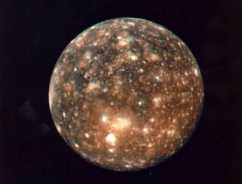
Callisto was first discovered by Galileo in 1610, making it one of the Galilean Satellites. Of the 60 moons it is the 8th closest to Jupiter, with a standoff distance of 1,070,000 km. It is the 2nd largest
...more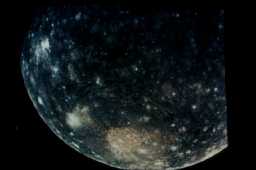
The insides of most of the moons and planets separated while they were forming out of the primitive solar nebula. Measurements by the Galileo spacecraft have been shown that Callisto is the same inside
...moreMany examples of the differing types of surface are shown in this image. In the foreground is a huge impact crater, which extends for almost an entire hemisphere on the surface. This crater may be compared
...more
The surface of Callisto is deeply pockmarked with craters. It looks to be perhaps the most severely cratered body in the solar system. There are also very large craters to be found there. The severity
...more
Europa was first discovered by Galileo in 1610, making it one of the Galilean Satellites. It is Jupiter's 4th largest moon, 670,900 km from Jupiter. With a diameter that is about half the distance across
...more
The Galileo mission discovered something amazing! Europa has its own atmosphere, although it is very, very thin. This atmosphere is created when fast moving molecules in Jupiter's magnetosphere hit the
...more