Ganymede's Atmosphere
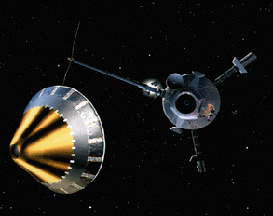
The Galileo mission discovered that Ganymede not only has a
magnetosphere, but a thin atmosphere as well. It is created when molecules from the magnetosphere, moving very fast, hit the surface and knock out a water molecule. This process is known as ‘sputtering’. Water molecules loosed from the surface are quickly separated into the constituents Oxygen and Hydrogen. These molecules are also quickly ionized by ultraviolet radiation and charged particles in the vicinity. . The surface may also evaporate, or ‘sublimate’ when the sun is shining, the way the surface of a
comet does. Because there is a magnetosphere, the charged particles in the atmosphere of Ganymede are not transported out of the environment the way they are at Europa.
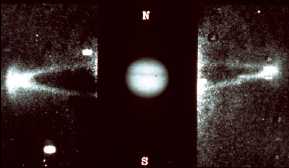
One of the instruments on the spacecraft measured a stream of hydrogen molecules flowing away from the moon over its north pole. Another instrument measured the presence of an Ionosphere, a part of the atmosphere that is filled with ions. If lightweight hydrogen escapes easily from Ganymede’s low gravity, it must be replenished continuously due to an active process at the surface. Terrestrial observations, such as this image of ozone from the Hubble Space Telescope have suggested that Ganymede may have a substantial trapped component of oxygen under the surface. Ozone is an important constituent of the Earth’s atmosphere. Calculations show that the trapped atmospheric component may be as large as the atmosphere of Mars. Ground based telescopes show other components of the atmosphere.
Even though Ganymede and Callisto have thin atmospheres, there does not seem to be a Ganymede or Callisto torus, the way there is at Europa and Io.


Shop Windows to the Universe Science Store!
Our
online store includes fun
classroom activities for you and your students.
Issues of NESTA's quarterly journal, The Earth Scientist are also full of classroom activities on different topics in Earth and space science!
You might also be interested in:

When the Galileo spacecraft flew by Ganymede, to everyone's surprise, it measured a very strong magnetic field for the first time near any moon. To generate a magnetic field, there must be conducting material
...more
The Galileo mission discovered an amazing thing. Europa has its own atmosphere, although it is very, very thin. This atmosphere is created when fast moving molecules in Jupiter's magnetosphere hit the
...more
A satellite which has an atmosphere, such as Jupiter's moon Io, and which also is inside a magnetosphere (unlike the Earth's moon), will leave a cloud of particles behind as it orbits the planet. This
...more
The Galileo spacecraft was launched on October 19, 1989. Galileo had two parts: an orbiter and a descent probe that parachuted into Jupiter's atmosphere. Galileo's primary mission was to explore the Jovian
...more
The Galileo spacecraft, which has been orbiting Jupiter since 1995, has finally reached the end of its road. On September 21, 2003, Galileo will make a fiery plunge into Jupiter's atmosphere and be vaporized.
...more
Amalthea was discovered by E Barnard in 1872. Of the 17 moons it is the 3rd closest to Jupiter, with a standoff distance of 181,300 km. Amalthea is about the size of a county or small state, and is just
...more
Callisto was first discovered by Galileo in 1610, making it one of the Galilean Satellites. Of the 60 moons it is the 8th closest to Jupiter, with a standoff distance of 1,070,000 km. It is the 2nd largest
...more