This drawing shows the possible interior of Callisto.
NASA
Interior of Callisto
When the Galileo spacecraft flew by Callisto, it made measurements which showed that Callisto was made almost entirely of the same thing. This means that Callisto never separated into layers, but is probably formed of a unusual material which is made of rock and ice combined. The fact that Callisto never
separated, early in its
history, probably means that Callisto never warmed up after formation.
At the same time, there were some measurements that suggested that there might be a thin salty-slushy layer of watery-ice that creates current. Water supports current. That is why people don’t drop electric appliances into the bathtub! An instrument on the spacecraft that is sensitive to current measured something that, like on Callisto, suggested a watery layer was present on Ganymede and Europa as well.
This is a picture that shows the interiors of Io, Europa, Ganymede and Callisto together.
You might also be interested in:

Differentiation is a scientific term which really means "to separate". In their earliest history, elements which comprised the planets and moons would part into separate regions, if the body was warm enough.
...more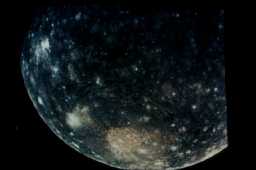
Most of the moons and planets formed by accretion of rocky material and volatiles out of the primitive solar nebula and soon thereafter they differentiated. Measurements by the Galileo spacecraft have
...more The diagram to the left shows a cutaway of the possible interior structure of Ganymede, based on recent measurements by the Galileo spacecraft. It shows a small core of metal, overlain with some rocky
...more
The diagram shows possibilities for the interior structure of Europa. There is a core of rocky material buried inside, overlain with ice of various phases. The diagram shows that there may be an ocean
...more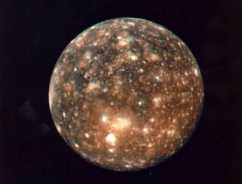
Callisto was first discovered by Galileo in 1610, making it one of the Galilean Satellites. Of the 60 moons it is the 8th closest to Jupiter, with a standoff distance of 1,070,000 km. It is the 2nd largest
...more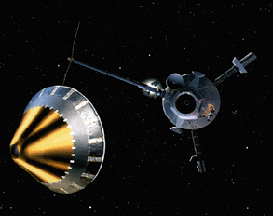
The Galileo spacecraft was launched on October 19, 1989. Galileo had two parts: an orbiter and a descent probe that parachuted into Jupiter's atmosphere. Galileo's primary mission was to explore the Jovian
...more
The Galileo spacecraft, which has been orbiting Jupiter since 1995, has finally reached the end of its road. On September 21, 2003, Galileo will make a fiery plunge into Jupiter's atmosphere and be vaporized.
...more