Current Events

  • Atmospheric CO2 Level Tops 400 ppm
    During the week of May 13th, the CO2 level at the Mauna Loa Observatory in Hawaii topped 400 ppm rep...Read more

    x

    Atmospheric CO2 Level Tops 400 ppm

    During the week of May 13th, the CO2 level at the Mauna Loa Observatory in Hawaii topped 400 ppm repeatedly. Daily levels of CO2 can vary due to weather, and there are seasonal trends as well. The level of atmospheric greenhouse gases continues to increase, now over 120 ppm since the Industrial Revolution began. For more on the Keeling Curve, see http://keelingcurve.ucsd.edu/. Find out more about greenhouse gases and warming.
  • Massive Tornado Outbreak on Tornado Alley
    The week of May 19 brings dozens of tornadoes to Tornado Alley in the states of Oklahoma, Kansas, Io...Read more

    x

    Massive Tornado Outbreak on Tornado Alley

    The week of May 19 brings dozens of tornadoes to Tornado Alley in the states of Oklahoma, Kansas, Iowa, Illinois and Missouri. On May 20th, a massive tornado struck Moore, Oklahoma, devastating communities - destroying over 100 homes and hitting two elementary schools and a hospital - with many casualties and deaths. Our thoughts are with our friends and colleagues suffering from these storms. For more on the May 20th storms, see the NOAA Storm Prediction Center Storm Report.
  • Kansas Legislator Proposes Bill to Outlaw Sustainability Education
    A bill has been introduced in the Kansas legislature this week that would prohibit the promotion of ...Read more

    x

    Kansas Legislator Proposes Bill to Outlaw Sustainability Education

    A bill has been introduced in the Kansas legislature this week that would prohibit the promotion of sustainability. Here is a link to the one-page bill: http://www.kslegislature.org/li/b2013_14/measures/documents/hb2366_00_0000.pdf. See report on Bloomberg News.
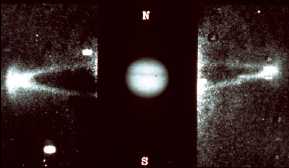
This is an image of the aurora of Jupiter.
Click on image for full size
NASA

Jupiter's Aurora

Jupiter's aurora is a very powerful source of energy. The power dissipated in Jupiter's atmosphere as a result of the aurora is much more than that dissipated in Earth's atmosphere (about 1000 MegaWatts). Some scientists estimate it at a million MegaWatts, which is comparable to the power used by a large city of 10,000 MegaWatts. This energy can sometimes have a significant impact on the atmosphere.

Like the scene of a crime, the aurora of Jupiter is still being studied by scientists to gain complete understanding. This means that not all the evidence can yet be put together to tell a complete story.

Unlike the terrestrial aurora, the Jovian aurora is thought to come from two sources, Field-Aligned currents (FAC's) from the moon Io, and from currents carrying particles from somewhere deeper in Jupiter's magnetotail.

The streams of particles responsible for the aurora are thought to generate a type of radio emission called "DAM". On Earth, "Hiss" is thought to occur when particles are being forced into the auroral zone. Jupiter's magnetosphere is far different from the Earth's, so scientists studying the aurora of Jupiter look for DAM and other radio signals as proof of how the aurora is generated.


Shop Windows to the Universe Science Store!

Our online store includes books on science education, classroom activities in The Earth Scientist, mineral and fossil specimens, and educational games!

Windows to the Universe Community

News

Opportunities

You might also be interested in:

Traveling Nitrogen Classroom Activity Kit

Check out our online store - minerals, fossils, books, activities, jewelry, and household items!...more

The Effect of Aurora on the Atmosphere

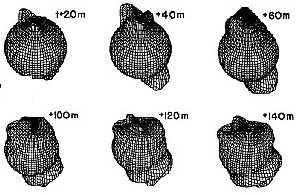
This figure shows the effect of the aurora on the atmosphere. When FAC's enter the atmosphere and create the aurora, they warm the atmosphere impulsively. This impulse travels throughout the atmosphere...more

Radio Signals of Jupiter

Radio signals are a signature of activity within the magnetosphere. There are many kinds of radio waves in the Jupiter environment. These are: DIM - the name for radio waves which have a wavelength of...more

Jupiter's Plasmasphere

Jupiter's magnetosphere is practically all plasmasphere. Jupiter's magnetosphere is filled with plasma. Most of the plasma comes from the donut-shaped cloud (torus) of material from Io. Besides ions and...more

An Overview of Jupiter's Magnetosphere

Jupiter's magnetosphere is a unique object in the solar system. It is the biggest object in the entire solar system. Not only is it big enough to contain all of Jupiter's moons, but the sun itself could...more

The Io Torus

A satellite which has an atmosphere, such as Jupiter's moon Io, and which also is inside a magnetosphere (unlike the Earth's moon), will leave a cloud of particles behind as it orbits the planet. This...more

An Overview of the Parts of Jupiter's Magnetosphere

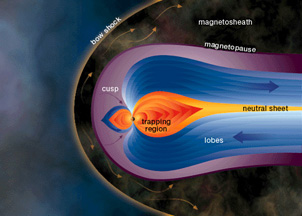
Jupiter's magnetosphere is very pointed and bullet-shaped, as shown in this picture, because of the nature of how it is created. The magnetosphere has many parts, such as the bow shock, magnetospheath,...more

Impact on Jupiter - July 2009

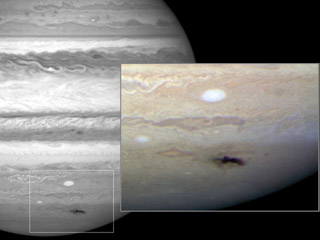
On the night of July 19, 2009, Anthony Wesley noticed a dark splotch on Jupiter that hadn't been there before. Wesley, an amateur astronomer in Australia, had discovered the remnants of a huge impact on...more

Shop Windows to the Universe

Dig into Montana Before History: 11K Years of Hunter-Gatherers in the Rockies and Plains by D. H. MacDonald, Ph.D. See our online store book collection.

Windows to the Universe, a project of the National Earth Science Teachers Association, is sponsored in part by the National Science Foundation and NASA, our Founding Partners (the American Geophysical Union and American Geosciences Institute) as well as through Institutional, Contributing, and Affiliate Partners, individual memberships and generous donors. Thank you for your support! NASA AGU AGI NSF