Jupiter's Quadrupole Component
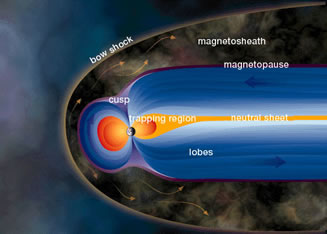
Jupiter's magnetosphere is very pointed and bullet-shaped, because of the nature of how it is created within Jupiter.
 |
 |
The left diagram shows a typical dipole, which is very much like the Earth's magnetic field in shape. The Earth's field is shown to the right. |
 |
 |
Jupiter's magnetic field, shown to the right is not shaped like a dipole at all. |
 |
 |
This means that the quadrupole and octupole components of the magnetic field must be more important at Jupiter than at the Earth. These components all add together to make up Jupiter's magnetic field. |
These drawings show the different components of the magnetosphere of Jupiter.
Click on image for full size version (92K GIF)
Images courtesy of JPL/NASA
"What is a Magnetosphere?"


Shop Windows to the Universe Science Store!
Learn about Earth and space science, and have fun while doing it! The
games section of our
online store includes a
climate change card game and the
Traveling Nitrogen game!
You might also be interested in:

A magnetosphere has many parts, such as the bow shock, magnetosheath, magnetotail, plasmasheet, lobes, plasmasphere, radiation belts and many electric currents. It is composed of charged particles and
...more
Jupiter's magnetosphere is very pointed and bullet-shaped, as shown in this picture, because of the nature of how it is created. The magnetosphere has many parts, such as the bow shock, magnetospheath,
...more
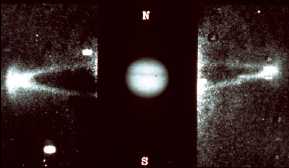
A satellite which has an atmosphere, such as Jupiter's moon Io, and which also is inside a magnetosphere (unlike the Earth's moon), will leave a cloud of particles behind as it orbits the planet. This
...more
Jupiter's magnetosphere is practically all plasmasphere. Jupiter's magnetosphere is filled with plasma. Most of the plasma comes from the donut-shaped cloud of material from Io. Particles enter the plasmasphere
...more
Radio signals are a signature of activity within the magnetosphere. There are many kinds of radio waves in the Jupiter environment. These are: DAM - the name for radio waves which have a wavelength of
...more
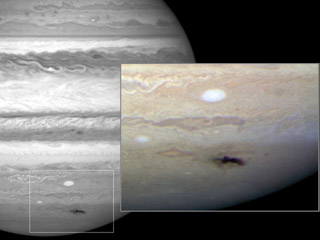
Anthony Wesley is an amateur astronomer in Australia. On the night of July 19, 2009, Wesley noticed a dark spot on Jupiter that hadn't been there before. He had discovered the remains of a huge impact
...more
The giant planets have definitely changed since their formation. But how much remains to be seen. Most of the original air of the giant planets remains in place. (The earth-like planets lost most of their
...more