Current Events

  • Irish Chronicles Document Links Between Volcanoes and Weather
    A study of over 40,000 written entries in Irish Annals and ice core measurements shows a strong corr...Read more

    x

    Irish Chronicles Document Links Between Volcanoes and Weather

    A study of over 40,000 written entries in Irish Annals and ice core measurements shows a strong correlation between the occurrence of volcanic eruptions and extreme cold weather in Ireland over a 1200 year period. Data analyzed in this study cover the period from 431 to 1649, during which time up to 48 volcanic eruptions are identified in Greenland ice core records through deposition of volcanic sulfate in annual layers of ice. You can find the study (open access), published on 6 June 2013 in IOP Publishing's journal Environmental Research Letters, at http://iopscience.iop.org/1748-9326/8/2/024035/article. Find out more about how volcanoes can influence climate.
  • EF-5 Tornado in El Reno, Oklahoma Widest Ever Recorded in US
    The EF-5 tornado that hit El Reno, Oklahoma on May 31st was the widest ever recorded in the US, acco...Read more

    x

    EF-5 Tornado in El Reno, Oklahoma Widest Ever Recorded in US

    The EF-5 tornado that hit El Reno, Oklahoma on May 31st was the widest ever recorded in the US, according to the National Weather Service in Norman Oklahoma. The tornado, which remained on the ground for 40 minutes and reached 2.6 miles across (4.2 km), took the lives of 18 people including storm chasers Tim Samaras, Paul Samaras and Carl Young. For more information on the tornado, visit http://ow.ly/i/2hfDG.
  • Atmospheric CO2 Level Tops 400 ppm
    During the week of May 13th, the CO2 level at the Mauna Loa Observatory in Hawaii topped 400 ppm rep...Read more

    x

    Atmospheric CO2 Level Tops 400 ppm

    During the week of May 13th, the CO2 level at the Mauna Loa Observatory in Hawaii topped 400 ppm repeatedly. Daily levels of CO2 can vary due to weather, and there are seasonal trends as well. The level of atmospheric greenhouse gases continues to increase, now over 120 ppm since the Industrial Revolution began. For more on the Keeling Curve, see http://keelingcurve.ucsd.edu/. Find out more about greenhouse gases and warming.
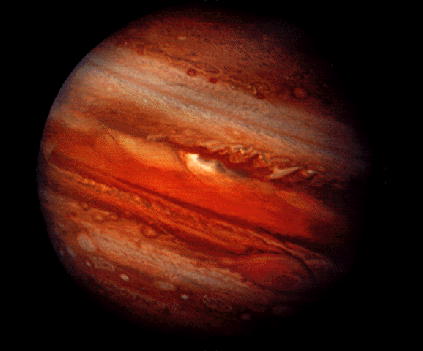
This image of Jupiter was taken by Voyage I.
Click on image for full size
Courtesy of NASA

Discover Jupiter

Jupiter is the largest planet in our solar system. It is also one of the brighter objects in the night sky. No one knows for sure who discovered Jupiter, but we know the ancient Greeks named him after the god, Zeus.

The most famous feature of Jupiter is the Great Red Spot. This violent storm has been watched from Earth since the 1600's. But it wasn't until the 1930's that we knew what Jupiter was made of. Astronomer Rupert Wildt researched the planet and found the atmosphere is mostly hydrogen and helium.

Beginning in 1973, the United States sent four spacecraft to observe this giant planet. Pioneer 10 and 11, along with Voyager I and II, sailed past Jupiter. They gathered many images that we still see today.

Jupiter's moons are too! Galileo discovered four of the larger moons: Io, Europa, Ganymede and Callisto in 1610. Most of the other moons were found by the Voyager spacecraft during its flyby.

Shop Windows to the Universe Science Store!

Our online store includes books on science education, ranging from evolution, classroom research, and the need for science and math literacy!

Windows to the Universe Community

News

Opportunities

You might also be interested in:

Traveling Nitrogen Classroom Activity Kit

Check out our online store - minerals, fossils, books, activities, jewelry, and household items!...more

The Great Red Spot of Jupiter

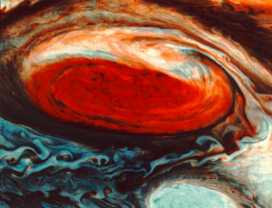
The Great Red Spot is thought to be a hurricane which has been raging on Jupiter for at least 400 years. The connected page shows an image of the Great Red Spot next to Tropical Storm Emily for comparison....more

Voyager

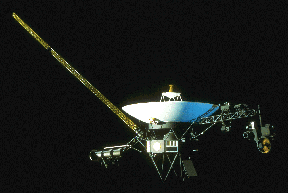
The rare arrangement of planets Jupiter, Saturn, Uranus, and Neptune in the 1980's made it possible for the Voyager spacecrafts to visit them over a 12 year span instead of the normal 30. They used gravity...more

Impact on Jupiter - July 2009

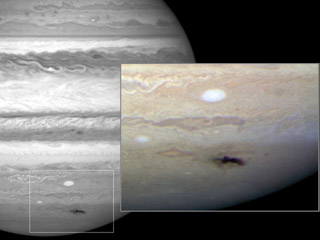
Anthony Wesley is an amateur astronomer in Australia. On the night of July 19, 2009, Wesley noticed a dark spot on Jupiter that hadn't been there before. He had discovered the remains of a huge impact...more

Discover Jupiter

Jupiter is the largest planet in our solar system. It is also one of the brighter objects in the night sky. No one knows for sure who discovered Jupiter, but we know the ancient Greeks named him after...more

A Look at Jupiter's Magnetosphere

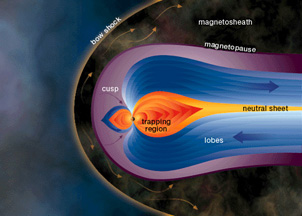
Jupiter's magnetosphere is very special. It is the biggest thing in the entire solar system. Not only is it big enough to hold all of Jupiter's moons, but the sun itself could fit inside. It goes all...more

The Rings of Jupiter

Jupiter has a series of rings circling it! Unlike Saturn's rings, which are clearly visible from Earth even through small telescopes, Jupiter's rings are very difficult to see. So difficult, in fact, that...more

An Overview of the Evolution of Jupiter's Atmosphere

The giant planets have definitely changed since their formation. But how much remains to be seen. Most of the original air of the giant planets remains in place. (The earth-like planets lost most of their...more

Shop Windows to the Universe

Arches National Park Geology Tour provides an extensive, visually rich description of the geology of Arches, by Deborah Ragland, Ph.D. See our DVD collection.

Windows to the Universe, a project of the National Earth Science Teachers Association, is sponsored in part by the National Science Foundation and NASA, our Founding Partners (the American Geophysical Union and American Geosciences Institute) as well as through Institutional, Contributing, and Affiliate Partners, individual memberships and generous donors. Thank you for your support! NASA AGU AGI NSF