This is a schematic showing where material forms.
Click on image for full size
Image from: After Moons and Planets
The effect of temperatures on the condensation of certain materials
In the picture, the proto-sun is shown at the top, and the temperature in the nebula is shown to decrease with distance away from the proto-sun, towards the bottom of the drawing.
The temperature at which ice begins to form solid material is the freezing temperature, near 250 K on the diagram. The temperature at which rocky materials, of which the terrestrial planets are made of, such as Calcium, Magnesium, Iron, Nickel, and Lead, can begin to form solid material, is much higher.
Thus solid material condensed close to the proto-sun, and formed the terrestrial planets. Solid material also condensed in the middle of the nebula, near the proto-Jupiter, but Jupiter also drew ice and many of the very simple gases from the nebula. The gaseous material which Jupiter drew from the nebula stayed, while the gaseous material which the terrestrial planets drew from the nebula probably drifted away.
You might also be interested in:
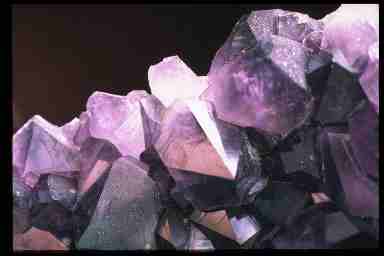
Minerals are the building blocks of rocks. They are non-living, solid, and, like all matter, are made of atoms of elements. There are many different types of minerals and each type is made of particular
...more
This diagram shows 3 things, a comparison of the planets of the solar system, the probable temperature of the primordial nebula at the location in which they formed, and the corresponding materials which
...more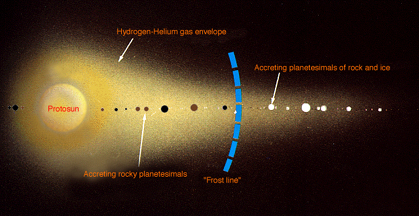
The position of the planets in the solar nebula greatly affected their 1. size and 2. composition. This is because of the effect of how cold it was in the nebula. 1. The nebula was a lot warmer close to
...more
The giant planets have definitely changed since their formation. But how much remains to be seen. Most of the original air of the giant planets remains in place. (The earth-like planets lost most of their
...more
The mesosphere of Jupiter is a region of balance between warming and cooling. That essentially means that nothing happens there. Except for diffusion, the atmosphere is still. Upper reaches of the atmosphere,
...more
As on Earth, the atmosphere of Jupiter consists of a troposphere, stratosphere, mesosphere, and thermosphere. The troposphere is the region where the visible clouds are to be found. The stratosphere, as
...more
The stratosphere of Jupiter is a region of warming as determined by infrared measurements of methane (CH4) in the region. Like the troposphere, the stratosphere is warmed by the sun, warmed by Jupiter's
...more