Current Events

  • Irish Chronicles Document Links Between Volcanoes and Weather
    A study of over 40,000 written entries in Irish Annals and ice core measurements shows a strong corr...Read more

    x

    Irish Chronicles Document Links Between Volcanoes and Weather

    A study of over 40,000 written entries in Irish Annals and ice core measurements shows a strong correlation between the occurrence of volcanic eruptions and extreme cold weather in Ireland over a 1200 year period. Data analyzed in this study cover the period from 431 to 1649, during which time up to 48 volcanic eruptions are identified in Greenland ice core records through deposition of volcanic sulfate in annual layers of ice. You can find the study (open access), published on 6 June 2013 in IOP Publishing's journal Environmental Research Letters, at http://iopscience.iop.org/1748-9326/8/2/024035/article. Find out more about how volcanoes can influence climate.
  • EF-5 Tornado in El Reno, Oklahoma Widest Ever Recorded in US
    The EF-5 tornado that hit El Reno, Oklahoma on May 31st was the widest ever recorded in the US, acco...Read more

    x

    EF-5 Tornado in El Reno, Oklahoma Widest Ever Recorded in US

    The EF-5 tornado that hit El Reno, Oklahoma on May 31st was the widest ever recorded in the US, according to the National Weather Service in Norman Oklahoma. The tornado, which remained on the ground for 40 minutes and reached 2.6 miles across (4.2 km), took the lives of 18 people including storm chasers Tim Samaras, Paul Samaras and Carl Young. For more information on the tornado, visit http://ow.ly/i/2hfDG.
  • Atmospheric CO2 Level Tops 400 ppm
    During the week of May 13th, the CO2 level at the Mauna Loa Observatory in Hawaii topped 400 ppm rep...Read more

    x

    Atmospheric CO2 Level Tops 400 ppm

    During the week of May 13th, the CO2 level at the Mauna Loa Observatory in Hawaii topped 400 ppm repeatedly. Daily levels of CO2 can vary due to weather, and there are seasonal trends as well. The level of atmospheric greenhouse gases continues to increase, now over 120 ppm since the Industrial Revolution began. For more on the Keeling Curve, see http://keelingcurve.ucsd.edu/. Find out more about greenhouse gases and warming.
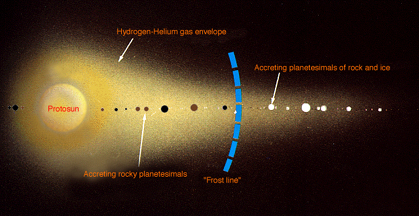
This is a schematic showing where material forms.
Click on image for full size
Image from: After Moons and Planets

The effect of temperatures on the condensation of certain materials

In the picture, the proto-sun is shown at the top, and the temperature in the nebula is shown to decrease with distance away from the proto-sun, towards the bottom of the drawing.

The temperature at which ice begins to form solid material is the freezing temperature, near 250 K on the diagram. The temperature at which rocky materials, of which the terrestrial planets are made of, such as Calcium, Magnesium, Iron, Nickel, and Lead, can begin to form solid material, is much higher.

Thus solid material condensed close to the proto-sun, and formed the terrestrial planets. Solid material also condensed in the middle of the nebula, near the proto-Jupiter, but Jupiter also drew ice and many of the very simple gases from the nebula. The gaseous material which Jupiter drew from the nebula stayed, while the gaseous material which the terrestrial planets drew from the nebula probably drifted away.


Shop Windows to the Universe Science Store!

Our online store includes books on science education, classroom activities in The Earth Scientist, mineral and fossil specimens, and educational games!

Windows to the Universe Community

News

Opportunities

You might also be interested in:

Cool It! Game

Check out our online store - minerals, fossils, books, activities, jewelry, and household items!...more

What Is a Mineral?

Minerals occur naturally on rocky planets and form the building blocks of rocks. They are non-living, solid, and, like all matter, are made of atoms of elements. There are many different types of minerals...more

The effect of the condensation of certain materials on the composition of the planets

This diagram shows 3 things, a comparison of the planets of the solar system, the probable temperature of the primordial nebula at the location in which they formed, and the corresponding materials which...more

The position of Jupiter when gas changed to ice

The position of the planets in the solar nebula greatly affected their 1. size and 2. composition. This is because of the effect of how cold it was in the nebula. 1. The nebula was a lot warmer close to...more

An Overview of the Evolution of Jupiter's Atmosphere

Atmospheres of the giant planets have definetely evolved from their formation out of the primitive solar nebula. How much they have evolved remains to be seen, however. Because of their enormous gravity,...more

Jupiter's Mesosphere

The mesosphere of Jupiter is a region of balance between warming and cooling. That essentially means that nothing happens there. Except for diffusion, the atmosphere is still. Upper reaches of the atmosphere,...more

An Overview of Jupiter's Atmospheric Structure

As on Earth, the atmosphere of Jupiter consists of a troposphere, stratosphere, mesosphere, and thermosphere. The troposphere is the region where the visible clouds are to be found. The stratosphere, as...more

Jupiter's Stratosphere

The stratosphere of Jupiter is a region of warming as determined by infrared measurements of methane (CH4) in the region. Like the troposphere, the stratosphere is warmed by the sun, warmed by Jupiter's...more

Shop Windows to the Universe

The Winter 2010 issue of The Earth Scientist includes a variety of educational resources, ranging from astronomy to glaciers. Check out the other publications and classroom materials in our online store.

Windows to the Universe, a project of the National Earth Science Teachers Association, is sponsored in part by the National Science Foundation and NASA, our Founding Partners (the American Geophysical Union and American Geosciences Institute) as well as through Institutional, Contributing, and Affiliate Partners, individual memberships and generous donors. Thank you for your support! NASA AGU AGI NSF