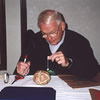
Harish Khandrika stands next to a poster of his award-winning science fair project, which used data from NASA's RXTE spacecraft to study the remains from a star explosion.
Click on image for full size
Courtesy of NASA
Student Astronomer Reaches for Exploded Stars
News story originally written on July 22, 2002
Student astronomer Harish Khandrika of La Jolla, California has done some amazing research! This high school student has been working with Dr. Richard Rothschild of the University of California, San Diego to learn more about exploded stars called supernovae.
For his project, Harish studied a supernova remnant called Cassiopeia A. He looked at gamma rays emitted by radioactive titanium from Cassiopeia A with the help of data collected by a NASA spacecraft called RXTE.
Harish’s conclusion is that the supernova produced a huge amount of radioactive titanium, about 40 times the mass of Earth. He presented this project and won many awards at the San Diego Science Fair and the Intel International Science and Technology Fair.
You may wonder how a kid on Earth got started making discoveries about supernovae. “I’m very passionate about studying the universe,” said Harish, who spent last summer searching for people who could help him follow his interest. “I knocked on the doors of scientists at the Center for Astrophysics and Space Sciences (CASS) at the University of California, San Diego, to ask if anyone would be kind enough to let me work in his or her laboratory,” describes Harish. Harish found Dr. Richard Rothschild who suggested he look at data from the RXTE and his research project was born!
Congratulations to Harish on his excellent research! We know he is not the only student astronomer out there. Are you a student astronomer too? Tell us about a research project you have done and we will tell you how to highlight it in our Student Projects page.

Shop Windows to the Universe Science Store!
Our
online store includes
issues of NESTA's quarterly journal, The Earth Scientist, full of classroom activities on different topics in Earth and space science, ranging from
seismology,
rocks and minerals,
oceanography, and
Earth system science to
astronomy!
You might also be interested in:

It was another exciting and frustrating year for the space science program. It seemed that every step forward led to one backwards. Either way, NASA led the way to a great century of discovery. Unfortunately,
...more
The Space Shuttle Discovery lifted off from Kennedy Space Center on October 29th at 2:19 p.m. EST. The weather was great as Discovery took 8 1/2 minutes to reach orbit. This was the United States' 123rd
...more
A moon was discovered orbiting the asteroid, Eugenia. This is only the second time in history that a satellite has been seen circling an asteroid. A special mirror allowed scientists to find the moon
...more
Will Russia ever put the service module for the International Space Station in space? NASA officials want an answer from the Russian government. The necessary service module is currently waiting to be
...more
A coronal mass ejection (CME) happened on the Sun early last month. The material that was thrown out from this explosion passed the ACE spacecraft. The SWICS instrument on ACE has produced a new and very
...more
J.S. Maini of the Canadian Forest Service called forests the "heart and lungs of the world." This is because forests filter air and water pollution, absorb carbon dioxide, release oxygen, and maintain
...more
In late April through mid-May 2002, all five naked-eye planets are visible at the same time in the night sky! This is includes Mercury which is generally very hard to see. You won't want to miss this!
...more