NASA's Lunar Prospector Completed
News story originally written on March 12, 1997
The construction of NASA's Lunar Prospector has been completed. This
spacecraft will travel to the Moon in September 1997 to make the first complete
compositional and gravity maps of the Moon.
The Lunar Prospector's mission will be a profound one. Over 75% of the Moon's
surface is not mapped out in detail. In addition, there are several mysteries
about the Moon's composition and internal processes. The Lunar Prospector will
provide information about all of these inconsistencies by mapping out the lunar
surface composition, and gravity/magnetic fields. In addition, the craft will
try to detect any kind of volatile activity on the Moon, and detect whether or
not the Moon's poles contain water ice.
The Lunar Prospector's mission is expected to last one year, and will have a
polar orbit about the Moon. The craft has a mass of 660 pounds, and is 4.5 feet
high by 4 feet in diameter. Solar cells have been added to the craft to provide
additional power.
The Lunar Prospector was built by Lockheed Martin Missiles and Space
Corporation. The cost of the craft and its mission are estimated to $63
million.
You might also be interested in:

Hale-Bopp continues to offer new surprises as two astronomers report of their study of the comet. Using the Hubble Space Telescope and the International Ultraviolet Explorer, the astronomers did a year-long
...more Comet Hale-Bopp is expected to give a spectacular show to the world as it reaches peak brightness in the skies this month. According to an update from the European Space Observatory, Hale-Bopp is set
...more
The construction of NASA's Lunar Prospector has been completed. This spacecraft will travel to the Moon in September 1997 to make the first complete compositional and gravity maps of the Moon. The Lunar
...more
We all know that milk "does a body good." Who knew that plastic milk containers could save lives in an emergency? In an attempt to find the perfect lightweight metal insulation for spacecraft, NASA created
...more
NASA and the Italian Space Agency (ASI) have released the report of the investigative board appointed to determine factors which resulted in the Feburary 25 tether break and loss of the Tethered Satellite
...more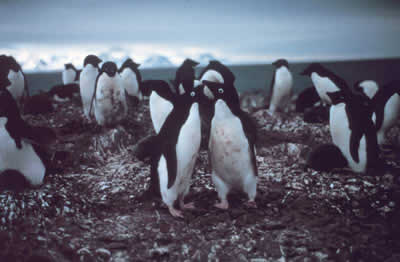
Scientists have recently discovered that thousands of Adelie Penguins thrive in patches of the chilly Southern Ocean near Antarctica's coastline. In these special areas of the ocean, called polynyas,
...more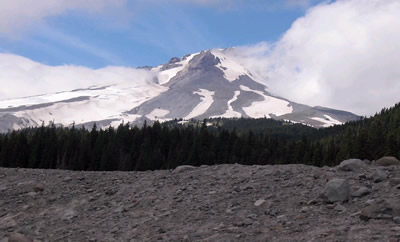
Scientists have learned that Mount Hood, Oregon's tallest mountain, has erupted in the past due to the mixing of two different types of magma. "The data will help give us a better road map to what a future
...more