Current Events

  • Kansas Legislator Proposes Bill to Outlaw Sustainability Education
    A bill has been introduced in the Kansas legislature this week that would prohibit the promotion of ...Read more

    x

    Kansas Legislator Proposes Bill to Outlaw Sustainability Education

    A bill has been introduced in the Kansas legislature this week that would prohibit the promotion of sustainability. Here is a link to the one-page bill: http://www.kslegislature.org/li/b2013_14/measures/documents/hb2366_00_0000.pdf. See report on Bloomberg News.
  • Earth's Center Is 1,000 Degrees Hotter Than Previously Thought, Synchrotron X-Ray Experiment Shows
    Scientists have determined the temperature near the Earth’s center to be 6000 degrees Celsius, 1000 ...Read more

    x

    Earth's Center Is 1,000 Degrees Hotter Than Previously Thought, Synchrotron X-Ray Experiment Shows

    Scientists have determined the temperature near the Earth’s center to be 6000 degrees Celsius, 1000 degrees hotter than in a previous experiment run 20 years ago. These measurements confirm geophysical models that the temperature difference between the solid core and the mantle above, must be at least 1500 degrees to explain why the Earth has a magnetic field. For more information about this study, see the press release from the European Synchrotron Radiation Facility.
  • Ocean Volcanic Rocks Contain Samples of Recycled Crust
    Scientists have long believed that lava erupted from certain oceanic volcanoes contains materials fr...Read more

    x

    Ocean Volcanic Rocks Contain Samples of Recycled Crust

    Scientists have long believed that lava erupted from certain oceanic volcanoes contains materials from the early Earth’s crust. But decisive evidence for this phenomenon has proven elusive. New research from a team including Carnegie’s Erik Hauri demonstrates that oceanic volcanic rocks contain samples of recycled crust dating back to the Archean era 2.5 billion years ago. Their work is published in Nature. Oceanic crust sinks into the Earth’s mantle at so-called subduction zones, where two plates come together. Much of what happens to the crust during this journey is unknown. Model-dependent studies for how long subducted material can exist in the mantle are uncertain and evidence of very old crust returning to Earth’s surface via upwellings of magma has not been found until now. For more information about these results, see the press release from the Carnegie Institution.
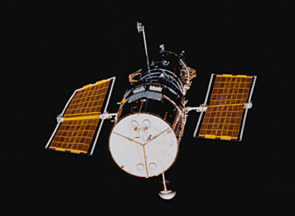
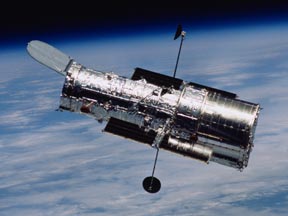
This image of the Hubble Space Telescope orbiting Earth was taken from the Space Shuttle Columbia in March 2002.
Click on image for full size
Image courtesy NASA.

Hubble Servicing Mission Canceled
News story originally written on April 21, 2004

On January 16, 2004, NASA Administrator Sean O'Keefe announced the cancellation of the final scheduled servicing mission to the Hubble Space Telescope (HST). The review board studying the Shuttle Columbia disaster recommended that all future Space Shuttle missions fly in orbits that allow them to reach the International Space Station (ISS) in case of an emergency. The orbit a shuttle would need to follow to service Hubble would not allow the shuttle to get to the ISS.

The final servicing mission to Hubble was scheduled for sometime in 2006. During that mission, shuttle astronauts were to replace a fine guidance sensor which points the telescope, install protective "blankets" on top of torn insulation, and replace numerous other aging components onboard the HST. They were also planning to install two new instruments that would have improved Hubble's capabilities: a wide field camera sensitive to both ultraviolet and infrared wavelengths that is two to three times more sensitive than Hubble's current near infrared camera, and a powerful new high-resolution spectrograph capable of studying the chemical composition of Hubble's targets.

Without the servicing mission, the aging Hubble will probably fail a few years sooner than previously expected. Predicting when the orbiting observatory will fail includes some guesswork, but NASA engineers expect that it will expire three or four years sooner than the previous estimate of 2010. Hubble's batteries, which its solar panels recharge several times each day, are gradually growing weaker. Gyroscopes that stabilize and help to point the telescope are prone to failure, and the eventual loss of these devices will prevent ground controllers from steering Hubble.

NASA's long-term plan for Hubble is to attach a rocket to the spacecraft and steer it to a controlled reentry into Earth's atmosphere. This controlled "crash landing" would plunge Hubble's remains into an ocean far from populated areas or shipping lanes. Without such a controlled crash, Hubble's orbit would eventually decay causing the spacecraft to tumble to Earth at an unpredictable location, possible causing damage or injuries.

NASA is developing a successor to Hubble called the James Webb Space Telescope, which is slated for launch around 2011. This new space telescope will have a mirror six times as large in area as Hubble's. There are some parts of the spectrum that Hubble can observe that the new telescope cannot, so the new telescope is not a perfect replacement for the HST.

Some people think NASA is making a mistake in canceling the final servicing mission to Hubble. They think the risk to Shuttle astronauts is small, and that Hubble is too valuable of a resource to abandon. They are urging NASA to reconsider its decision to cancel the mission to Hubble. Some Senators and members of Congress have started to debate the issue in the U.S. Congress. It seems unlikely, but still possible, that the servicing mission to Hubble could be reinstated in the future.

Last modified April 21, 2004 by Julia Genyuk.

Shop Windows to the Universe Science Store!

Our online store includes issues of NESTA's quarterly journal, The Earth Scientist, full of classroom activities on different topics in Earth and space science, ranging from seismology, rocks and minerals, oceanography, and Earth system science to astronomy!

Windows to the Universe Community

News

Opportunities

You might also be interested in:

Traveling Nitrogen Classroom Activity Kit

Check out our online store - minerals, fossils, books, activities, jewelry, and household items!...more

Hubble Space Telescope

The Hubble Space Telescope (HST) was one of the most important exploration tools of the past two decades, and will continue to serve as a great resource well into the new millennium. The HST is credited...more

A Rover on the Red Planet! Spirit Will Look at the Geology of Mars

NASA’s rover, named Spirit, has successfully landed and will soon be scouting the surface of Mars for interesting geology! Scientists are interested to know whether the depression where Spirit landed...more

Hubble Servicing Mission Canceled

On January 16, 2004, NASA Administrator Sean O'Keefe announced the cancellation of the final scheduled servicing mission to the Hubble Space Telescope (HST). The review board studying the Shuttle Columbia...more

Cassini approaches Saturn's Moon Phoebe

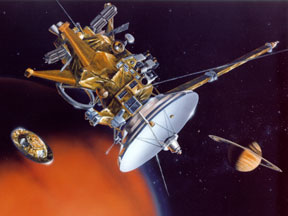
The Cassini spacecraft, en route to Saturn, will zoom past Saturn's odd moon Phoebe on June 11, 2004. Cassini will pass within 2,000 km (1,243 miles) of the moon's surface and should send back images with...more

Huygens probe on its way to Titan

NASA's Cassini spacecraft, which is in orbit around Saturn, released the Huygens probe and sent it on its way to Saturn's largest moon, Titan. The probe, pushed away from the Cassini "mothership"...more

Cassini Titan Flyby in October 2004

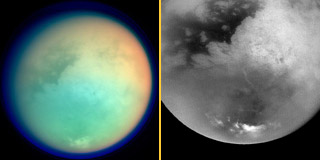
The robotic Cassini spacecraft flew by Saturn's moon Titan on October 26, 2004. Titan is Saturn's largest moon, and has the thickest atmosphere of any moon in our Solar System. Cassini captured what are...more

Cassini arrives at Saturn

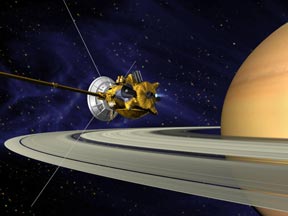
The Cassini spacecraft will arrive at Saturn on June 30, 2004. Cassini's engine will make a critical 96-minute burn starting at 7:36 p.m. Pacific Time (10:36 p.m. EDT) on June 30. The burn will slow Cassini...more

Shop Windows to the Universe

The Winter 2010 issue of The Earth Scientist includes a variety of educational resources, ranging from astronomy to glaciers. Check out the other publications and classroom materials in our online store.

Windows to the Universe, a project of the National Earth Science Teachers Association, is sponsored in part by the National Science Foundation and NASA, our Founding Partners (the American Geophysical Union and American Geosciences Institute) as well as through Institutional, Contributing, and Affiliate Partners, individual memberships and generous donors. Thank you for your support! NASA AGU AGI NSF