Current Events

  • Irish Chronicles Document Links Between Volcanoes and Weather
    A study of over 40,000 written entries in Irish Annals and ice core measurements shows a strong corr...Read more

    x

    Irish Chronicles Document Links Between Volcanoes and Weather

    A study of over 40,000 written entries in Irish Annals and ice core measurements shows a strong correlation between the occurrence of volcanic eruptions and extreme cold weather in Ireland over a 1200 year period. Data analyzed in this study cover the period from 431 to 1649, during which time up to 48 volcanic eruptions are identified in Greenland ice core records through deposition of volcanic sulfate in annual layers of ice. You can find the study (open access), published on 6 June 2013 in IOP Publishing's journal Environmental Research Letters, at http://iopscience.iop.org/1748-9326/8/2/024035/article. Find out more about how volcanoes can influence climate.
  • EF-5 Tornado in El Reno, Oklahoma Widest Ever Recorded in US
    The EF-5 tornado that hit El Reno, Oklahoma on May 31st was the widest ever recorded in the US, acco...Read more

    x

    EF-5 Tornado in El Reno, Oklahoma Widest Ever Recorded in US

    The EF-5 tornado that hit El Reno, Oklahoma on May 31st was the widest ever recorded in the US, according to the National Weather Service in Norman Oklahoma. The tornado, which remained on the ground for 40 minutes and reached 2.6 miles across (4.2 km), took the lives of 18 people including storm chasers Tim Samaras, Paul Samaras and Carl Young. For more information on the tornado, visit http://ow.ly/i/2hfDG.
  • Atmospheric CO2 Level Tops 400 ppm
    During the week of May 13th, the CO2 level at the Mauna Loa Observatory in Hawaii topped 400 ppm rep...Read more

    x

    Atmospheric CO2 Level Tops 400 ppm

    During the week of May 13th, the CO2 level at the Mauna Loa Observatory in Hawaii topped 400 ppm repeatedly. Daily levels of CO2 can vary due to weather, and there are seasonal trends as well. The level of atmospheric greenhouse gases continues to increase, now over 120 ppm since the Industrial Revolution began. For more on the Keeling Curve, see http://keelingcurve.ucsd.edu/. Find out more about greenhouse gases and warming.
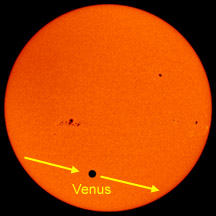
This picture shows what the Venus transit in 2004 may look like. The big black dot near the bottom is Venus. The yellow arrows show how Venus will move during the transit.
This illustration is original Windows to the Universe artwork created by Randy Russell. The image of the Sun is courtesy SOHO (ESA & NASA); information on the apparent size and path of Venus courtesy Fred Espenak, NASA's GSFC.

Venus Transit in June 2004
News story originally written on June 2, 2004

Astronomers are excited about a rare event that will happen in early June 2004. There will be a transit of the planet Venus on June 8, 2004. "Transit" is a word used by astronomers when a planet moves between Earth and the Sun. A transit is a bit like an eclipse of the Sun, when the Moon moves between Earth and the Sun.

This Venus transit will be the first one anyone alive today has seen. The last transit of Venus was in 1882! There will be another Venus transit in 2012.

This NASA web site has lots of great info about the transit. Remember, it is never safe to look directly at the Sun!

Last modified May 28, 2004 by Randy Russell.

Shop Windows to the Universe Science Store!

Our online store includes fun classroom activities for you and your students. Issues of NESTA's quarterly journal, The Earth Scientist are also full of classroom activities on different topics in Earth and space science!

Windows to the Universe Community

News

Opportunities

You might also be interested in:

Transits of Venus

Sometimes the planet Venus gets between Earth and the Sun. Astronomers call that a "transit" of Venus. A transit is a little bit like an eclipse of the Sun, when the Moon gets between Earth and the Sun....more

Transit

A "transit" is the name of a type of astronomical event. A transit is like a solar eclipse, when the moon blocks out the Sun. During a transit a planet, not the Moon, moves between Earth and the Sun. There...more

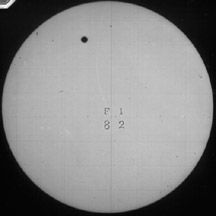
History of Venus Transits

Sometimes Venus passes between Earth and the Sun. This event is called a transit of Venus. Transits of Venus don't happen very often. There is a pattern in the time between transits of Venus. The pattern...more

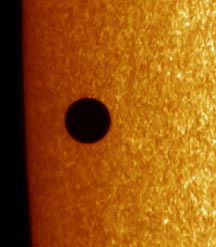
Mercury Transit on November 8, 2006

The planet Mercury will cross in front of the Sun on Wednesday, November 8, 2006. Astronomers call the event a transit. A transit is like a solar eclipse. However, a transit occurs when a planet, instead...more

Venus Transit in June 2004

Astronomers are excited about a rare event that will happen in early June 2004. There will be a transit of the planet Venus on June 8, 2004. "Transit" is a word used by astronomers when a planet moves...more

More than 100 planets orbit distant stars!

Astronomers have identified another exoplanet, that is, a planet outside our solar system. This makes a total of 102 exoplanets that have so far been found by astronomers! The astronomers that identified...more

Map of the Sky

Thanks to a couple of telescopes, everyone on the internet can browse through almost 2 million images. Stars throughout the sky were photographed by the Two-Micron All Sky Survey (2MASS) and are now available...more

The Equator is Growing!

Earth may look perfectly spherical from space, like a giant marble, but it actually isn't! Instead, our planet is wider around the equator because matter is forced out as Earth spins (just as you feel...more

Shop Windows to the Universe

The Universe at Your Fingertips 2.0 DVD from the Astronomical Society of the Pacific is in our online store, filled with Earth and space science resources.

Windows to the Universe, a project of the National Earth Science Teachers Association, is sponsored in part by the National Science Foundation and NASA, our Founding Partners (the American Geophysical Union and American Geosciences Institute) as well as through Institutional, Contributing, and Affiliate Partners, individual memberships and generous donors. Thank you for your support! NASA AGU AGI NSF