Current Events

  • Atmospheric CO2 Level Tops 400 ppm
    During the week of May 13th, the CO2 level at the Mauna Loa Observatory in Hawaii topped 400 ppm rep...Read more

    x

    Atmospheric CO2 Level Tops 400 ppm

    During the week of May 13th, the CO2 level at the Mauna Loa Observatory in Hawaii topped 400 ppm repeatedly. Daily levels of CO2 can vary due to weather, and there are seasonal trends as well. The level of atmospheric greenhouse gases continues to increase, now over 120 ppm since the Industrial Revolution began. For more on the Keeling Curve, see http://keelingcurve.ucsd.edu/. Find out more about greenhouse gases and warming.
  • Massive Tornado Outbreak on Tornado Alley
    The week of May 19 brings dozens of tornadoes to Tornado Alley in the states of Oklahoma, Kansas, Io...Read more

    x

    Massive Tornado Outbreak on Tornado Alley

    The week of May 19 brings dozens of tornadoes to Tornado Alley in the states of Oklahoma, Kansas, Iowa, Illinois and Missouri. On May 20th, a massive tornado struck Moore, Oklahoma, devastating communities - destroying over 100 homes and hitting two elementary schools and a hospital - with many casualties and deaths. Our thoughts are with our friends and colleagues suffering from these storms. For more on the May 20th storms, see the NOAA Storm Prediction Center Storm Report.
  • Kansas Legislator Proposes Bill to Outlaw Sustainability Education
    A bill has been introduced in the Kansas legislature this week that would prohibit the promotion of ...Read more

    x

    Kansas Legislator Proposes Bill to Outlaw Sustainability Education

    A bill has been introduced in the Kansas legislature this week that would prohibit the promotion of sustainability. Here is a link to the one-page bill: http://www.kslegislature.org/li/b2013_14/measures/documents/hb2366_00_0000.pdf. See report on Bloomberg News.

Click on image for full size
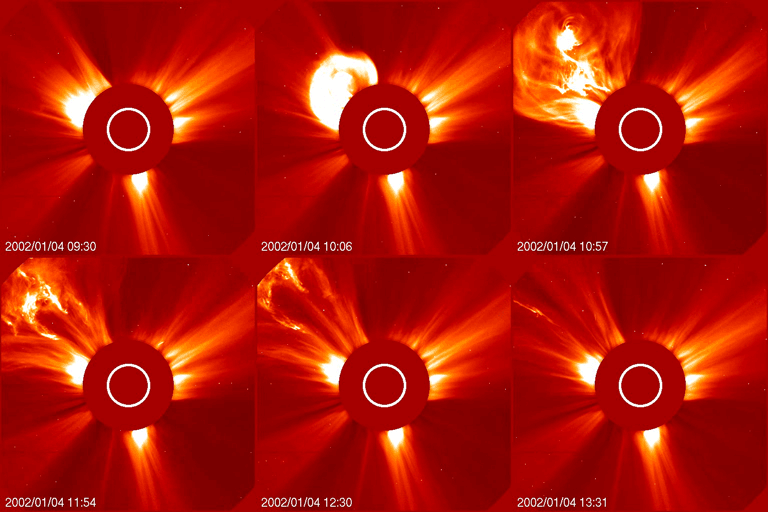
Image courtesy NASA/SOHO.

Space weather storms from the Sun
News story originally written on October 24, 2003

Two gigantic sunspot groups have recently appeared on the Sun and are generating tremendous space weather storms. The sunspot groups (known as group 484 and group 486) are about as large as the planet Jupiter. It is very unusual for two sunspot groups this large to appear on the Sun at the same time. Sunspots, which are the visible manifestations of regions where strong magnetic fields reach the surface of the Sun, are often indicators of high levels of solar activity. These two large groups have generated powerful solar flares and Coronal Mass Ejections (CMEs).

A CME generated by group 484 reached Earth on Friday, 24 October 2003, bombarding our planet with radiation and energetic protons and electrons. Such "space weather storms" produce spectacular displays of aurora and can damage satellites, disrupt electrical power distribution grids, and interfere with radio communications. These two large sunspot groups may continue to hurl such storms towards Earth for the next couple of weeks.

Last modified October 24, 2003 by Randy Russell.

Shop Windows to the Universe Science Store!

Our online store includes fun classroom activities for you and your students. Issues of NESTA's quarterly journal, The Earth Scientist are also full of classroom activities on different topics in Earth and space science!

Windows to the Universe Community

News

Opportunities

You might also be interested in:

Coronal Mass Ejections

"Without warning, the relatively calm solar atmosphere can be torn asunder by sudden outbursts of a scale unknown on Earth. Catastrophic events of incredible energy...stretch up to halfway across the visible...more

More and more Moons of Jupiter

Astronomers have discovered a dozen new moons of Jupiter so far in 2003. Scott Sheppard and David Jewitt of the University of Hawaii and Jan Kleyna of Cambridge University led the team of astronomers who...more

Mars Opposition in August 2003

On August 27, 2003, Earth and Mars will be closer together than they have been in thousands of years. The centers of the two planets will be 55,758,006 kilometers (34,646,418 miles) apart at 9:51 Universal...more

More Moons around Jupiter & Saturn

Astronomers have recently discovered several more moons in our Solar System. Scott Sheppard and David Jewitt of the University of Hawaii and Jan Kleyna of Cambridge University announced the discovery of...more

Mercury Transit on May 7, 2003

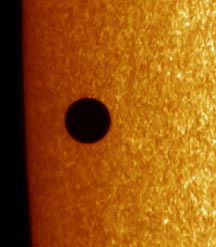
The planet Mercury appeared to cross in front of the disk of the Sun on May 7, 2003. Astronomers call the event a transit. A transit is similar to a solar eclipse. However, a transit occurs when a planet,...more

Space weather storms from the Sun

Two gigantic sunspot groups have recently appeared on the Sun and are generating tremendous space weather storms. The sunspot groups (known as group 484 and group 486) are about as large as the planet...more

More than 100 planets orbit distant stars!

Astronomers have identified another exoplanet, that is, a planet outside our solar system. This makes a total of 102 exoplanets that have so far been found by astronomers! The astronomers that identified...more

Map of the Sky

Thanks to a couple of telescopes, everyone on the internet can browse through almost 2 million images. Stars throughout the sky were photographed by the Two-Micron All Sky Survey (2MASS) and are now available...more

Shop Windows to the Universe

Check out the fun Earth science related bumper stickers in our online store! Express yourself!

Windows to the Universe, a project of the National Earth Science Teachers Association, is sponsored in part by the National Science Foundation and NASA, our Founding Partners (the American Geophysical Union and American Geosciences Institute) as well as through Institutional, Contributing, and Affiliate Partners, individual memberships and generous donors. Thank you for your support! NASA AGU AGI NSF